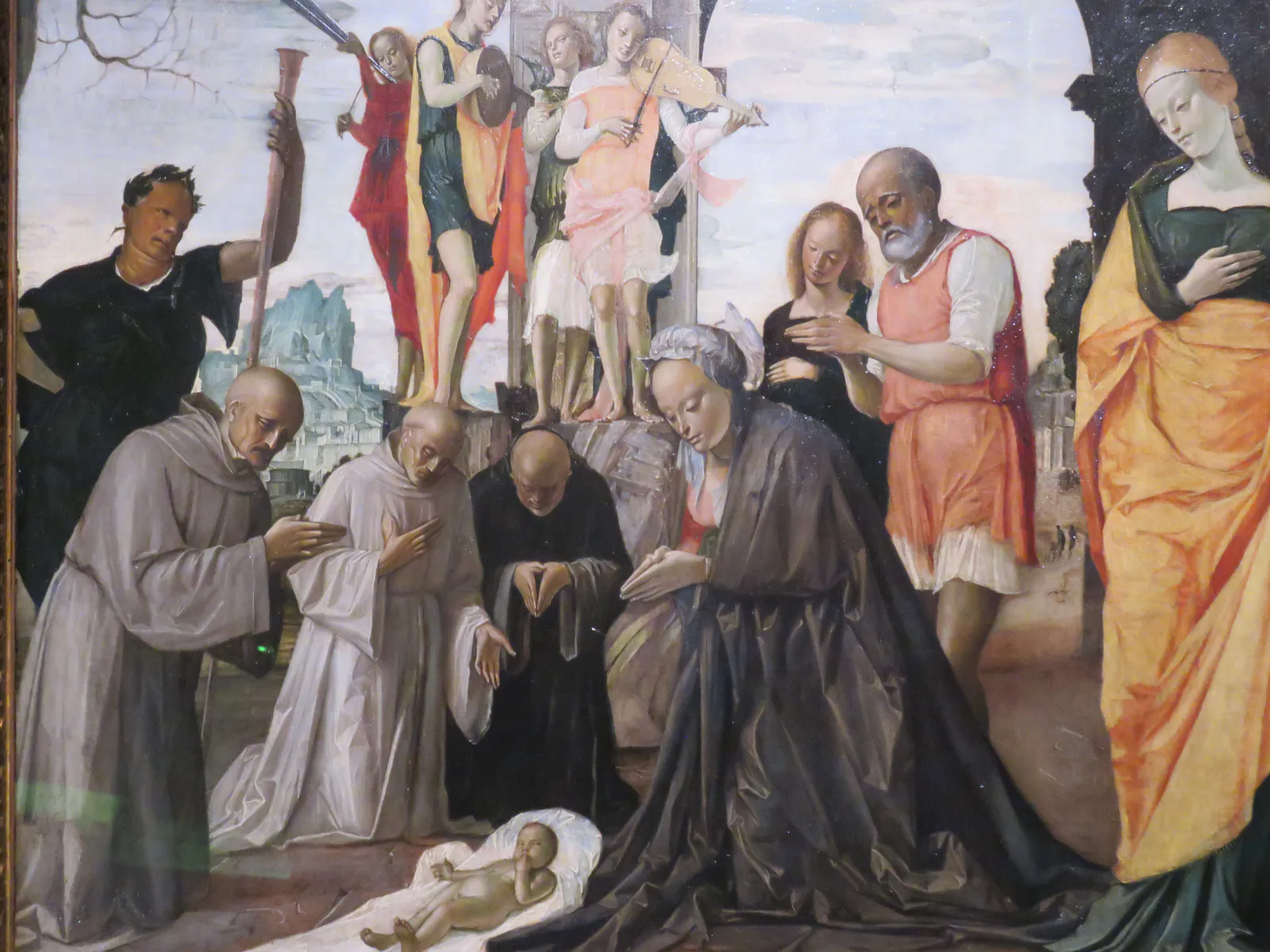
Adoration of the Christ Child
Bramantino
In this tempera panel (c. 1485), the Milanese innovator arranges the Nativity as a cool study of space. The Child rests on a stone slab, flanked by Mary and Saints Bernardino, Francis, and Benedict, while angel musicians provide a celestial motet. Rigid perspective, sculptural figures, and an architectonic backdrop reveal Bramantino’s quest for mathematical order within devotional feeling.
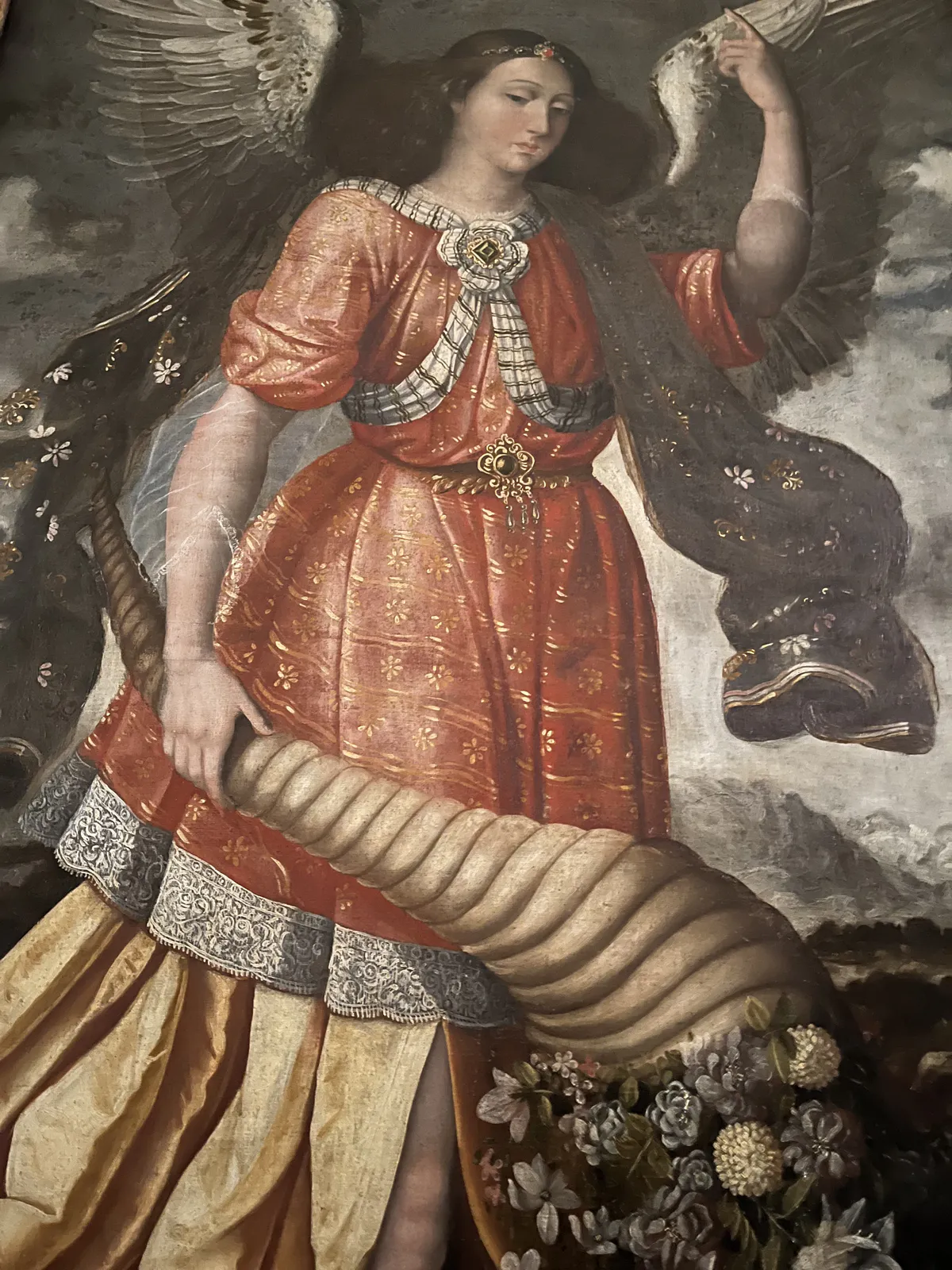
Isabel de Santiago
Archangel Gabriel
This early 18th-c. work by Isabel de Santiago—a rare female artist of the Quito School—portrays Gabriel as a celestial messenger of abundance. Draped in luminous textiles, the archangel holds a cornucopia, blending classical fertility symbols with baroque angelology in a uniquely Andean devotional image.
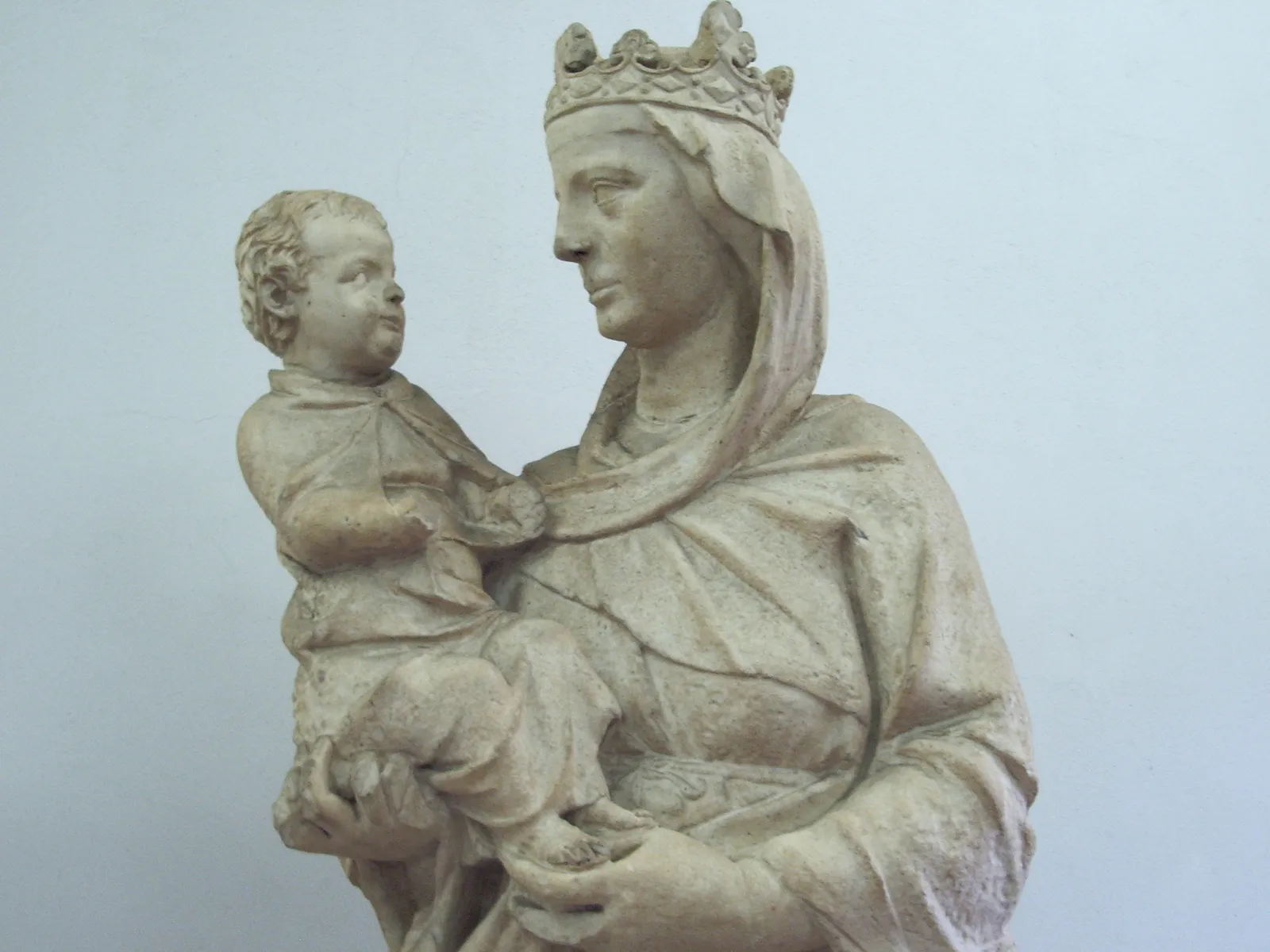
Madonna del colloquio
Giovanni Pisano
This half-length marble Virgin and Child (c. 1280–1284) originally stood at the south transept portal of Pisa Cathedral. Now, it captures a striking emotional exchange between mother and son. The Child gently grasps Mary’s veil, emphasizing Pisano’s innovative focus on tenderness and psychological realism in sacred art.
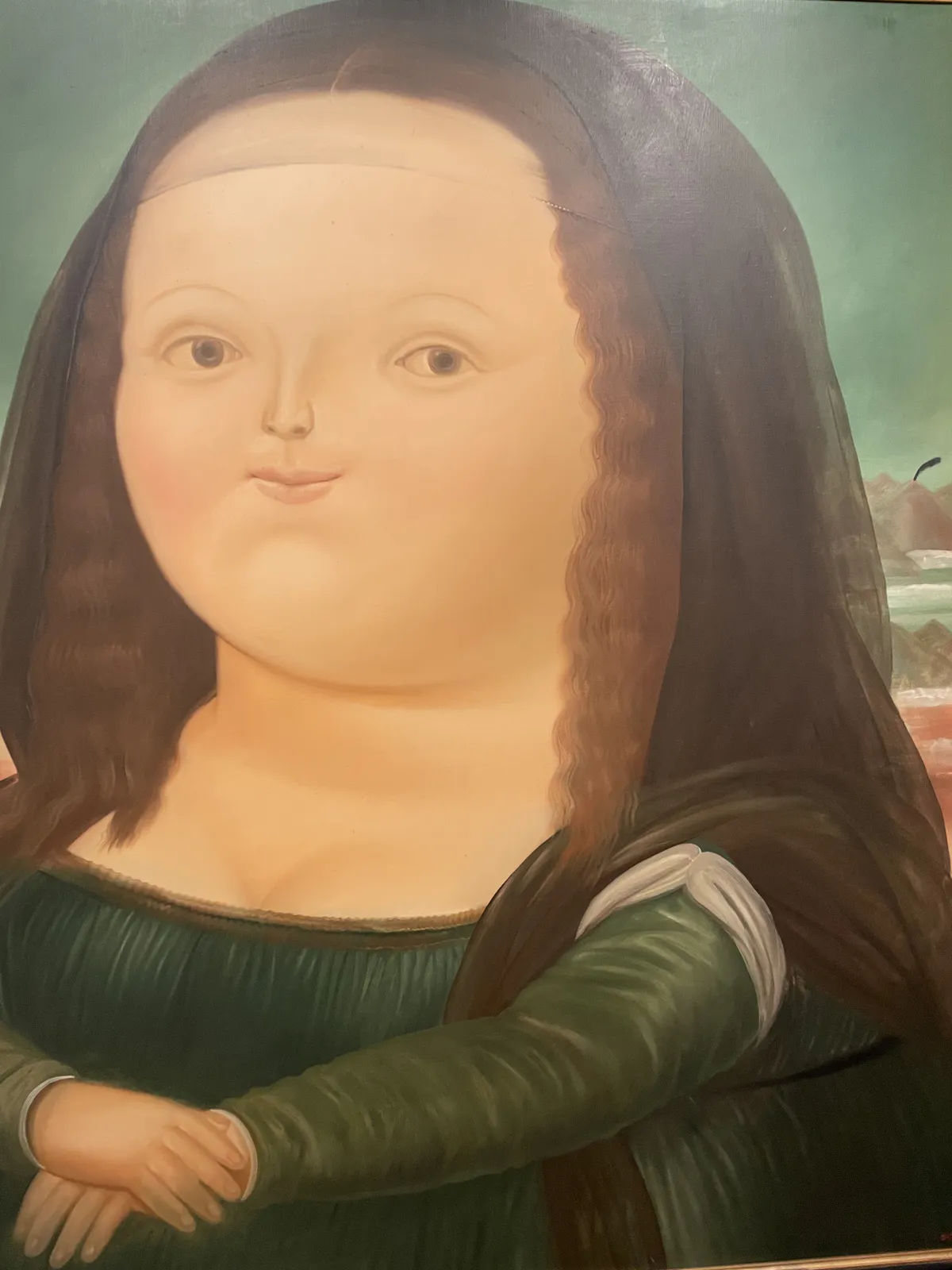
Mona Lisa, Age Twelve
Fernando Botero
In this whimsical reimagining (1959), Botero transforms da Vinci’s iconic subject into a voluminous child. Created in his signature Boterismo style, the painting blends parody with homage. Born from a cleaning lady’s remark, the work helped launch Botero’s career, celebrating exaggerated form as a tool for both humor and artistic identity.
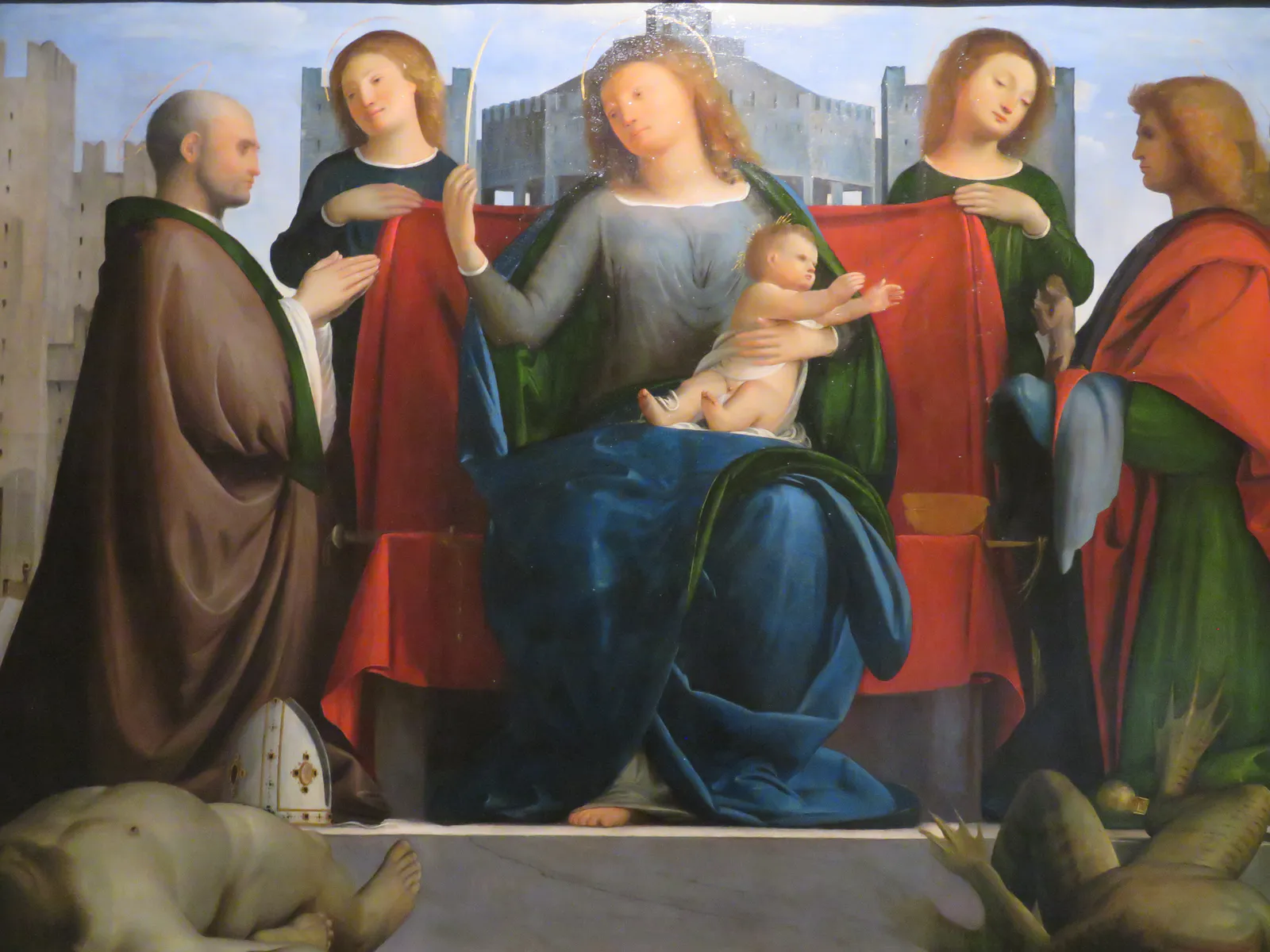
Madonna of the Towers
Bramantino
This tempera and oil painting (1515–20) presents the Madonna and Child enthroned between Saint Ambrose and Saint Michael. Set before fortified towers symbolizing Marian protection, the composition reflects Leonardo’s influence in its symmetry and restraint. Below, a toad representing the Devil lies defeated, underscoring the Virgin’s triumph over evil.
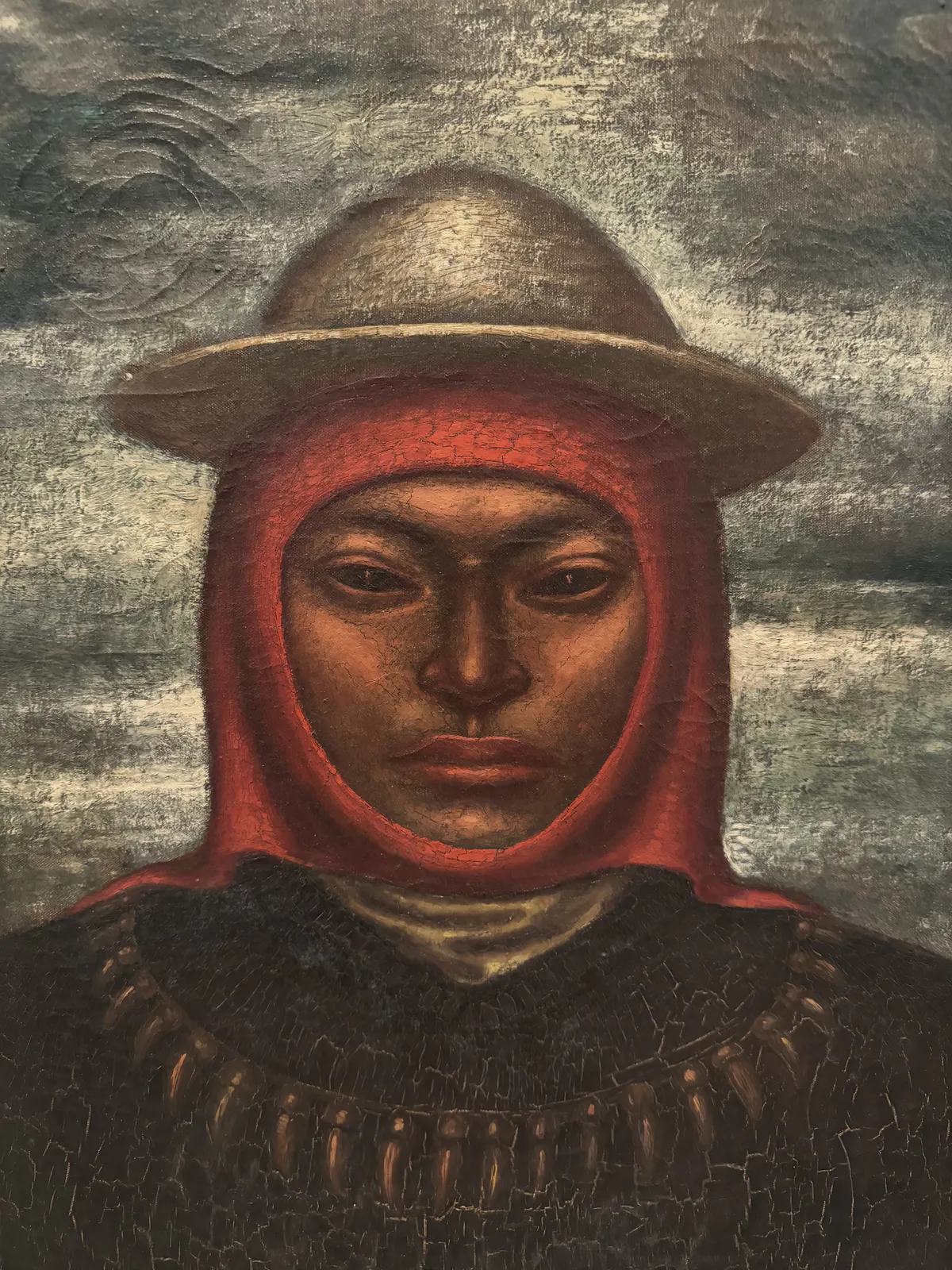
Portrait of Indigenous Person
Luis Alberto Acuña
This striking 1934 oil painting reflects the artist’s deep engagement with indigenous identity and pre-Columbian heritage. The stoic, symmetrical face, wrapped in a red hood beneath a wide-brimmed hat, evokes dignity and resilience. Acuña, a key figure in Colombian modernism, often highlighted native ancestry as a counter-narrative to Eurocentric ideals.
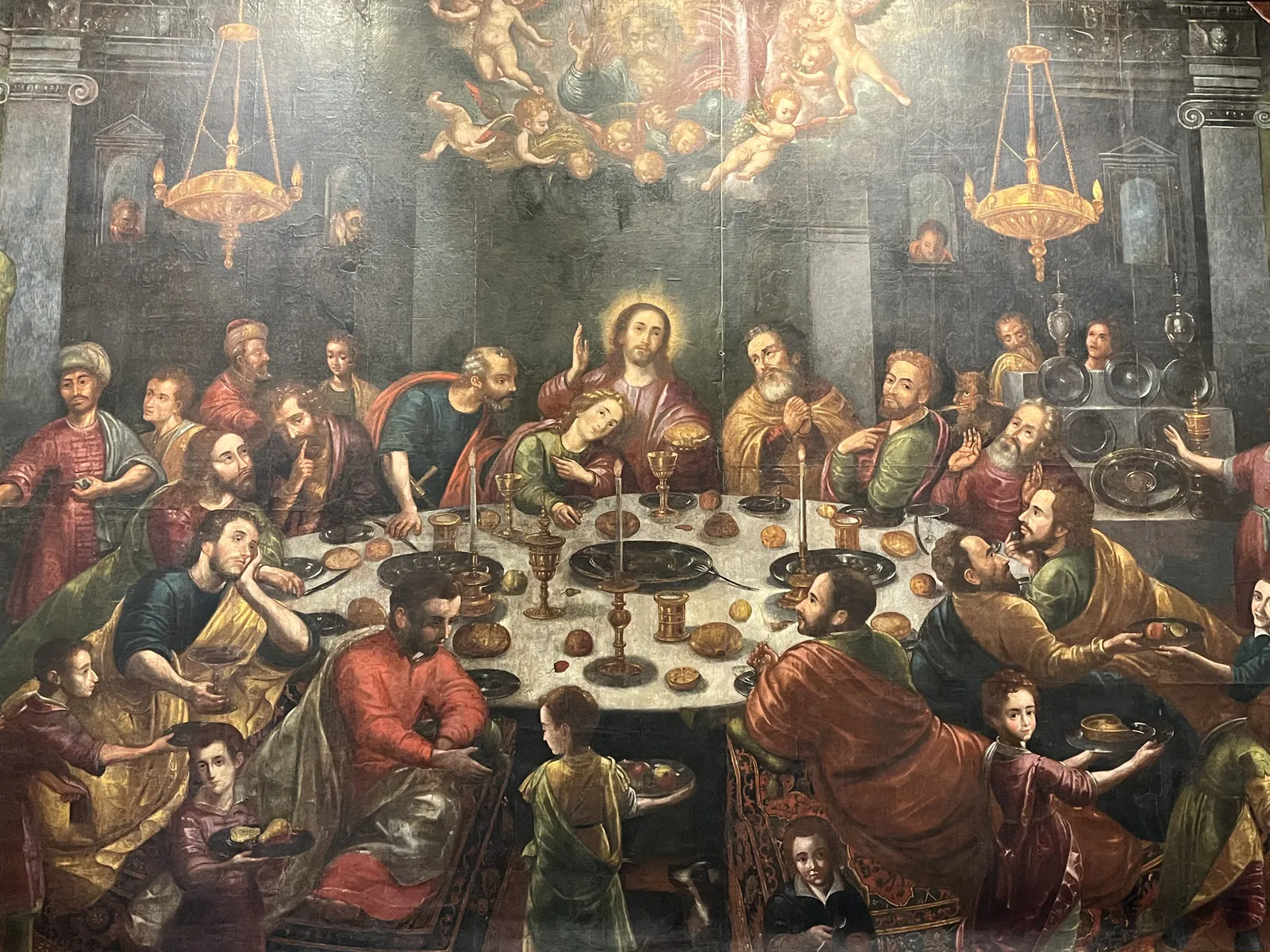
The Last Supper (with Cuy)
Diego de la Puente
De la Puente’s 1658 painting uniquely blends Spanish colonial art with Peruvian culture. It depicts Jesus and his disciples eating cuy (guinea pig), a local delicacy, instead of lamb. This substitution reflects how Catholic imagery was adapted to local customs, offering a clear example of the visual and cultural hybridization that shaped colonial Peru.
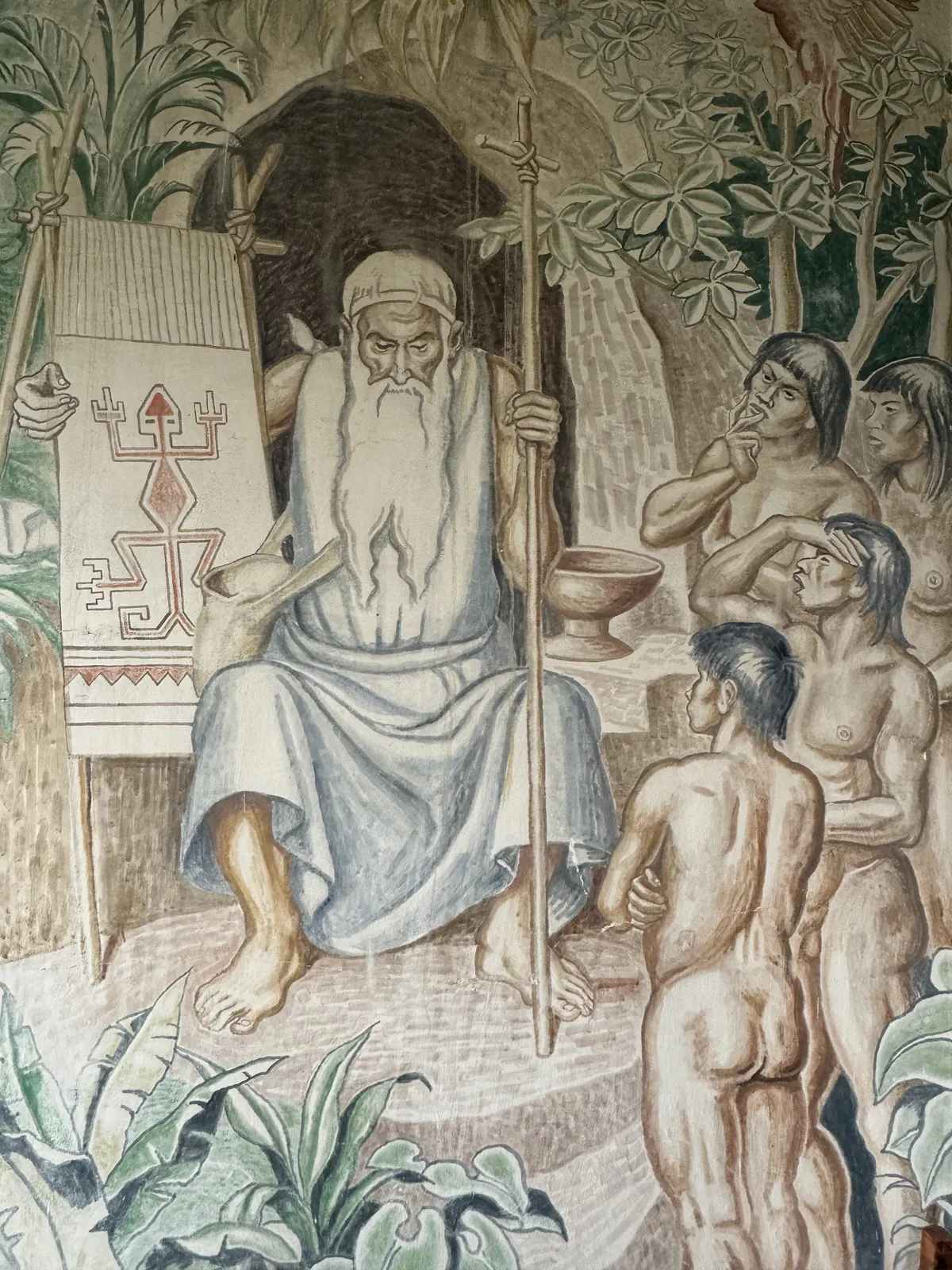
Bochica Teaching the Muisca
Luis Alberto Acuña
This 1960-70s mural depicts Bochica, the bearded sage and civilizing hero of Muisca mythology, imparting moral and spiritual lessons. Seated before young disciples, he holds symbols of power and knowledge, including a woven banner. A revered figure, Bochica was believed to have formed the Tequendama Falls and taught the Muisca how to live harmoniously.
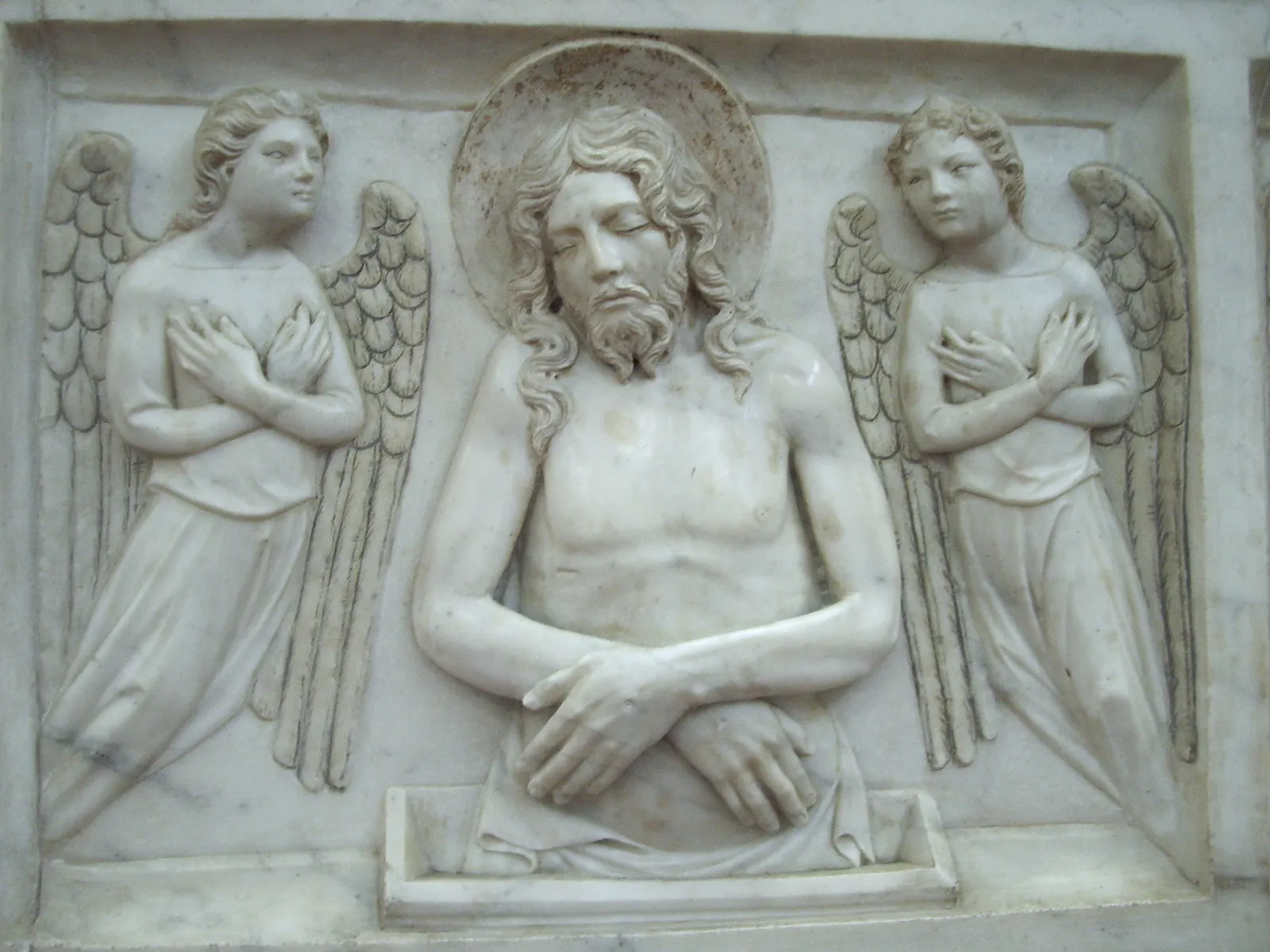
Tomb of Archbishop Scherlatti
Nino Pisano
This marble relief (c. 1300–1350) formed part of the tomb of Archbishop Scherlatti. Christ is depicted in the Imago Pietatis pose, rising from the tomb with eyes closed, flanked by two mourning angels. The scene blends devotional tenderness with refined Gothic elegance, exemplifying Nino Pisano’s lyrical style and the growing emotional realism in 14th-c. funerary art.
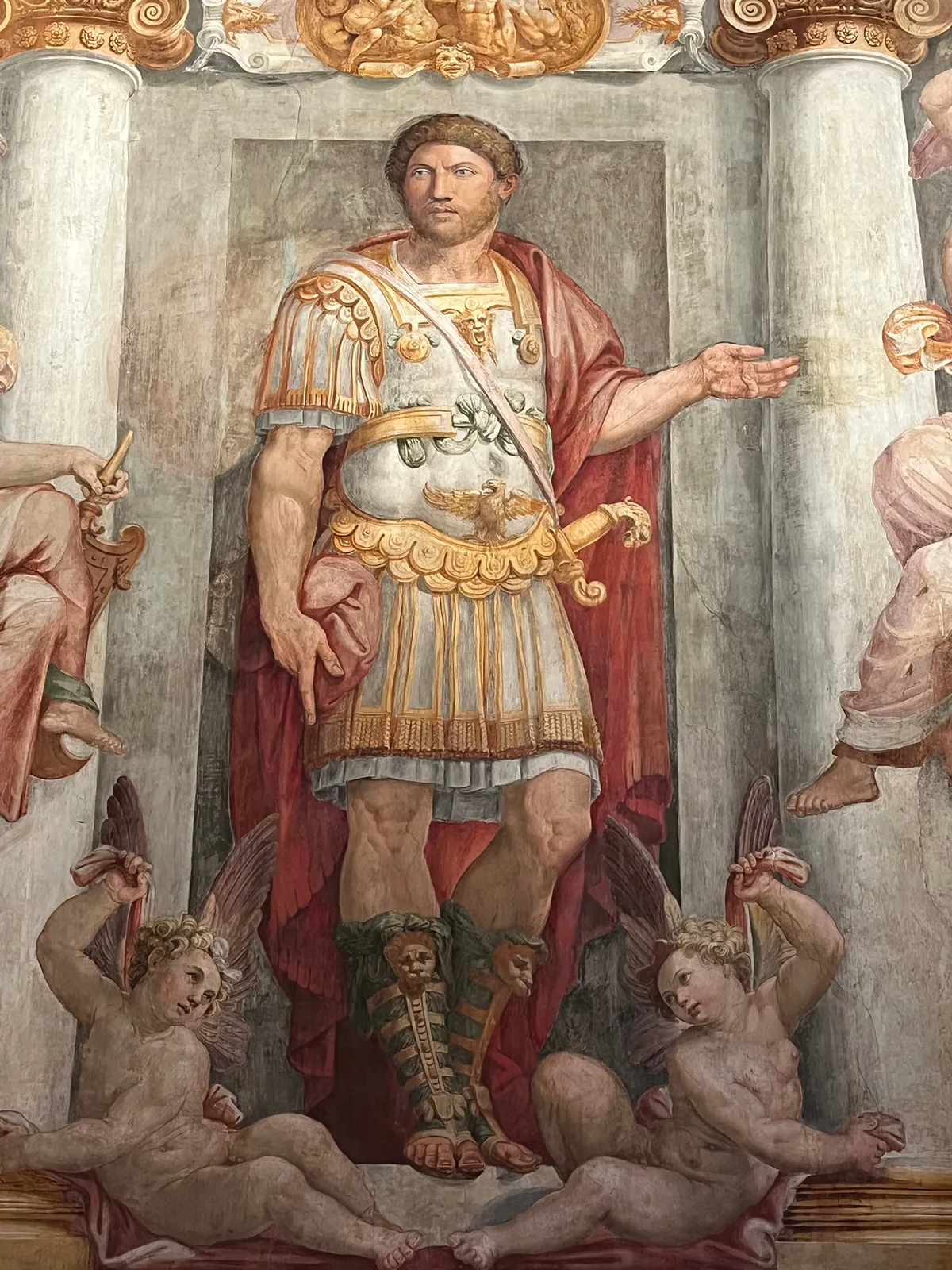
Emperor Hadrian
Girolamo Siciolante da Sermoneta (attrib.)
This 16th-c. fresco from the Sala Paolina depicts Emperor Hadrian in idealized Roman military attire. Portrayed with commanding calm, Hadrian stands framed by classical architecture and winged putti, symbolizing both earthly rule and divine favor. The work affirms his legacy as builder, humanist, and guardian of imperial order—within the very mausoleum he commissioned.
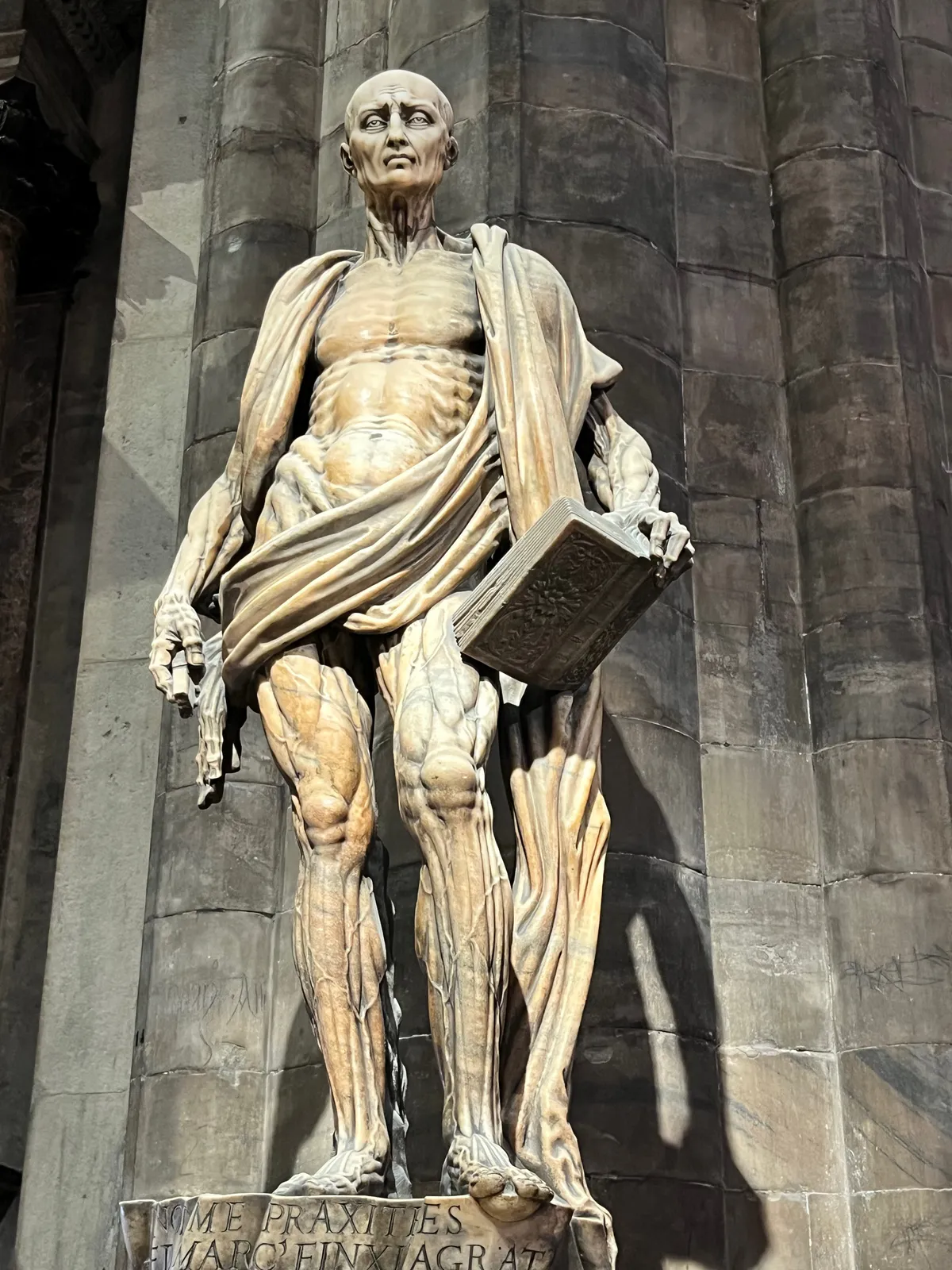
St Bartholomew Flayed
Marco d’Agrate
This haunting statue of Saint Bartholomew (1562) shows the martyr after being skinned alive, wearing his own flayed skin like a cloak. The anatomical precision reveals a Renaissance fascination with the human body, while the calm expression evokes spiritual endurance beyond physical torment.
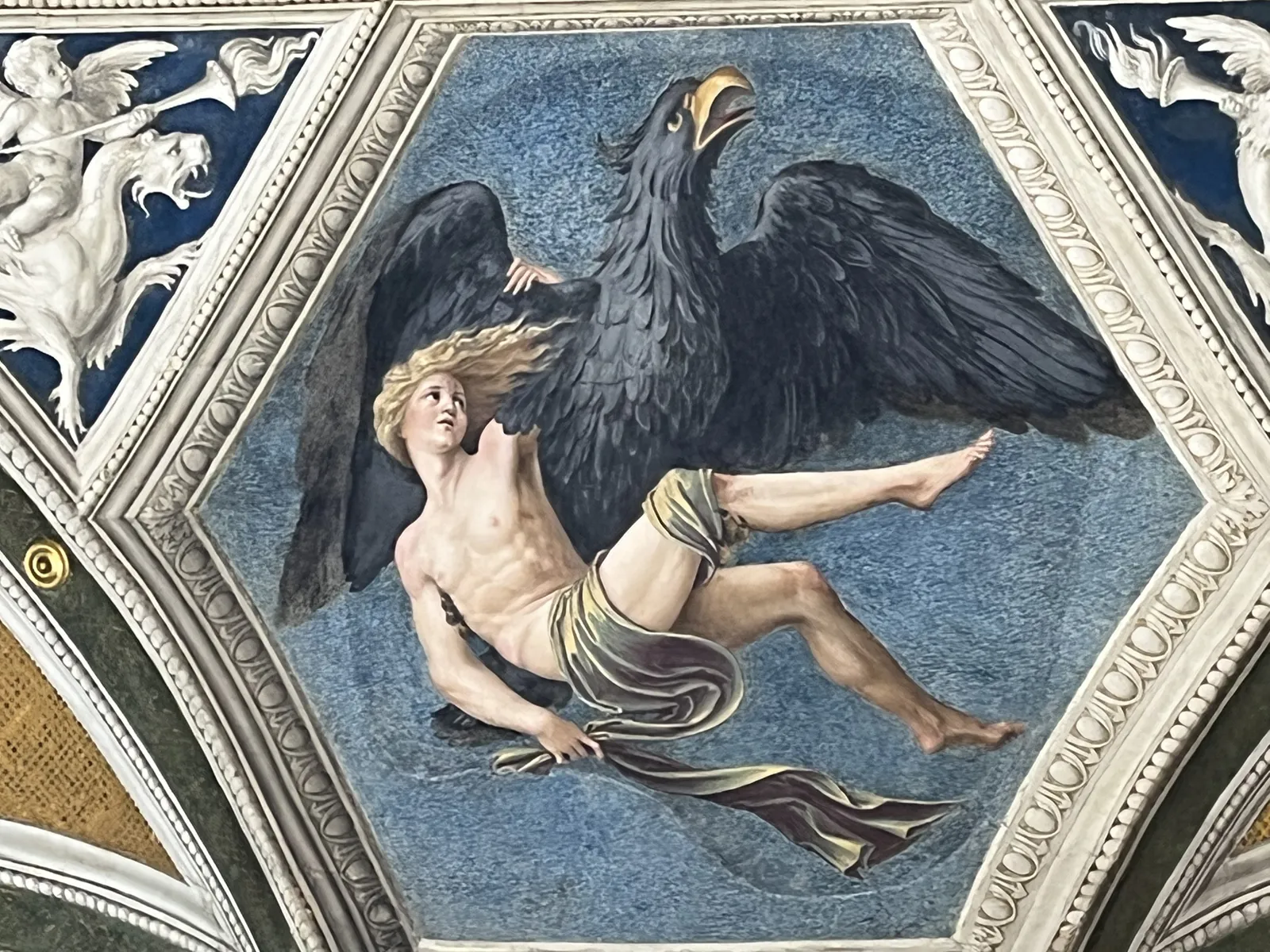
The Rape of Ganymede
Baldassarre Peruzzi
This Renaissance ceiling panel (1509–14) shows Zeus, in the form of an eagle, abducting the beautiful youth Ganymede to Olympus. The myth frames the act as a moment of divine erotic desire, with Ganymede raised to immortal companionship as Zeus’s beloved. The term rape follows the Latin raptus, meaning abduction, not its modern sense.
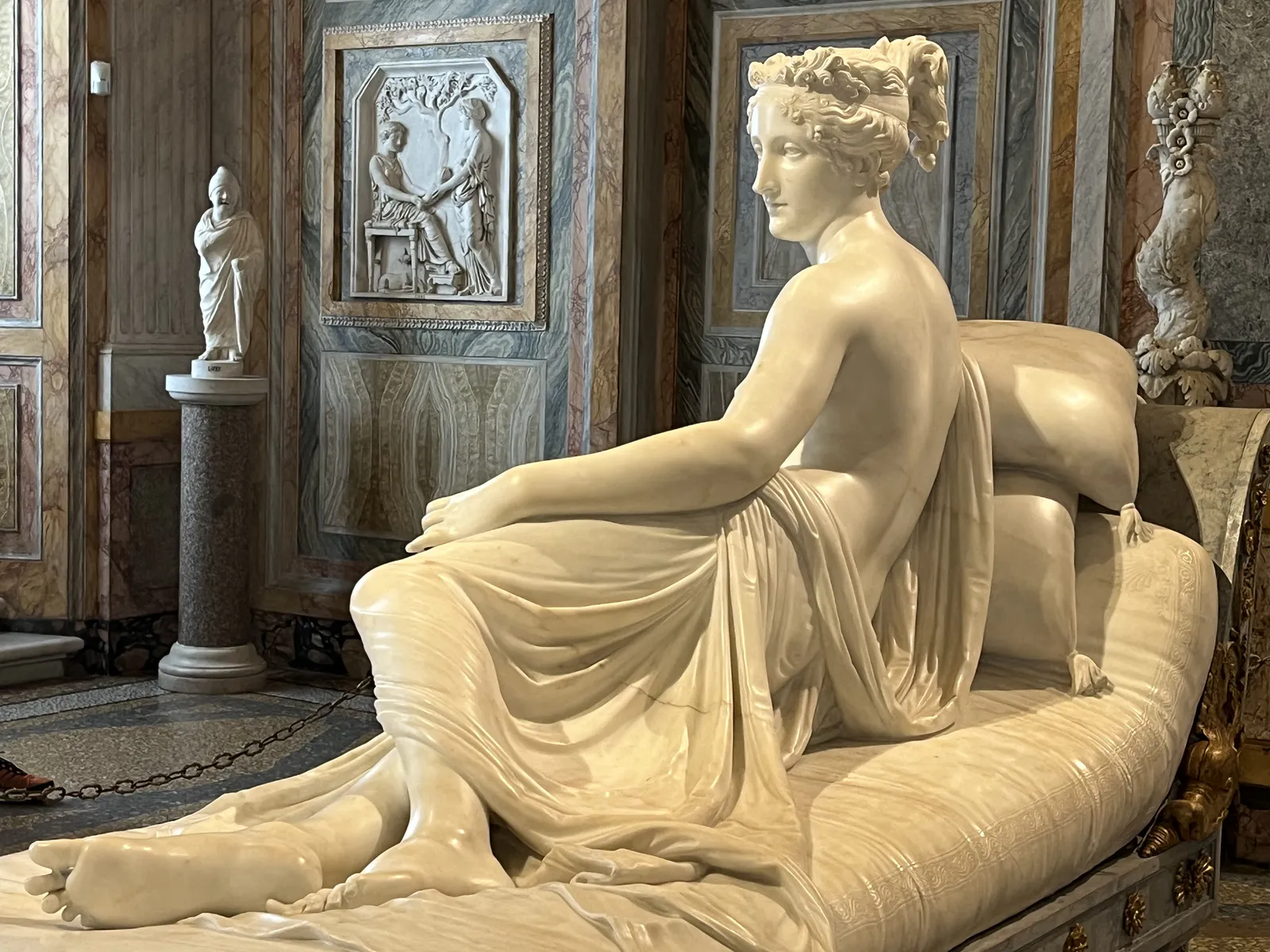
Pauline Bonaparte as Venus Victrix
Antonio Canova
Antonio Canova's marble masterpiece (1805–08) depicts Pauline Bonaparte as Venus Victrix, reclining semi-nude on a couch, holding an apple symbolizing Venus's triumph in the Judgement of Paris. Commissioned by her husband, Camillo Borghese, Pauline insisted on being portrayed as Venus rather than Diana. The sculpture, originally designed to rotate, reflects both personal ambition and classical beauty.
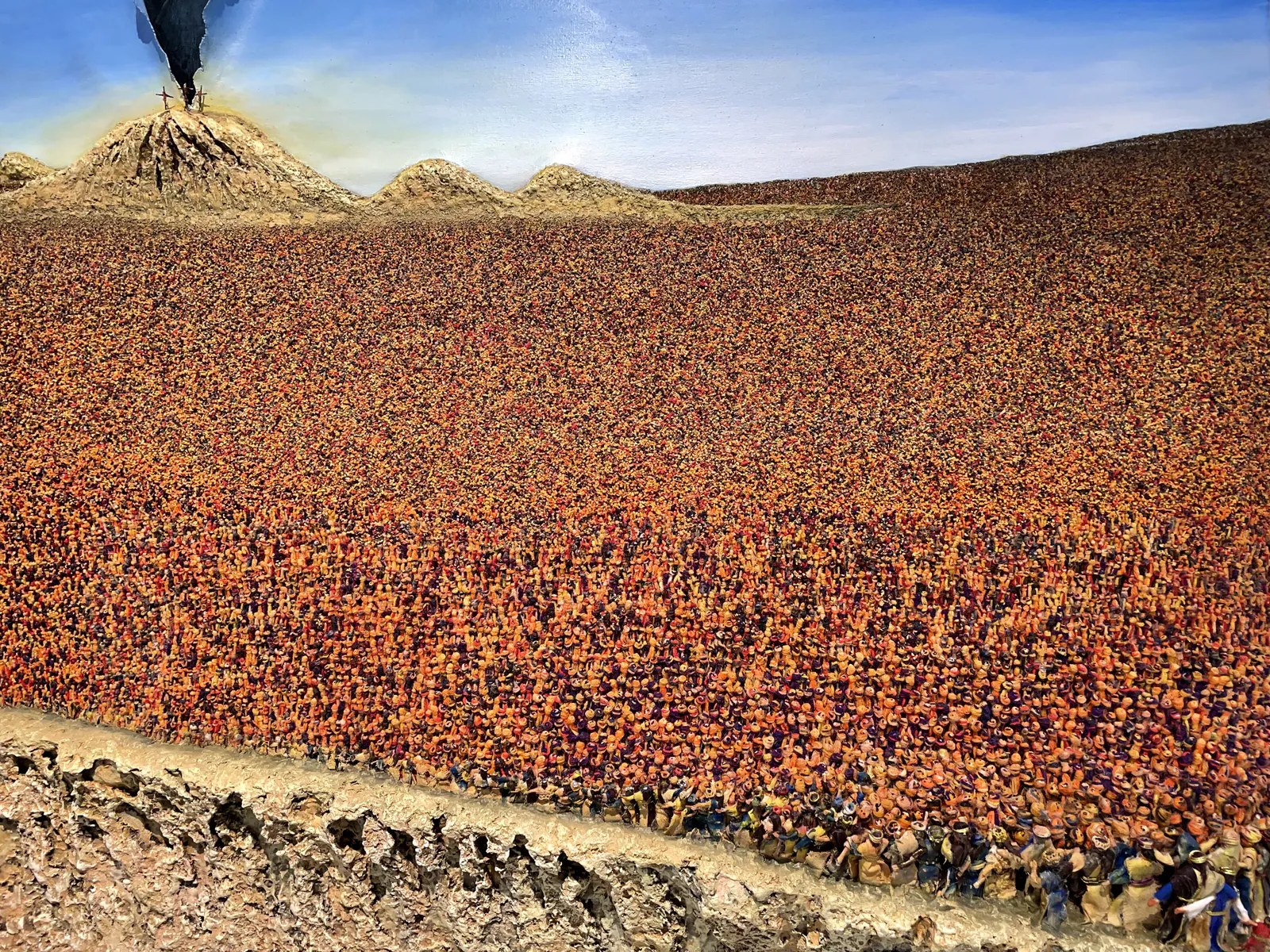
The Veil Torn (The Door to Heaven)
Mariano Bidó
In this mixed-media work (2018), a vast crowd moves toward a hill crowned by three crosses under a black veil of smoke. Referencing the crucifixion, the piece evokes mass devotion, suffering, and salvation. The dense humanity contrasts with the distant, divine climax—highlighting faith as both a collective journey and personal reckoning.
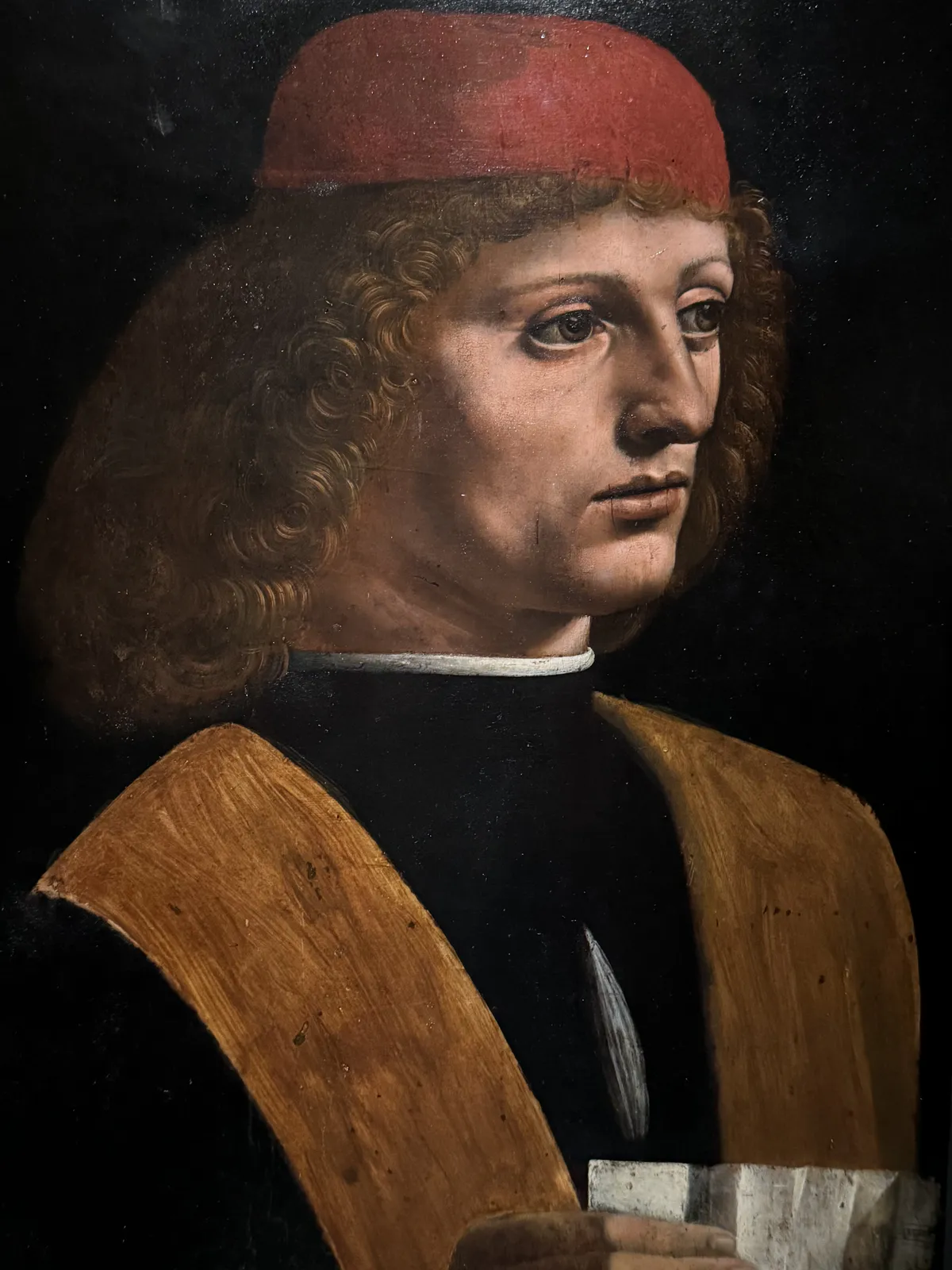
Portrait of a Musician
Leonardo da Vinci
This intimate oil on panel (c. 1485) is Leonardo da Vinci’s only known male portrait. Likely depicting a court musician in Milan, the sitter clutches a sheet of music, suggesting both profession and intellect. The unfinished lower section contrasts with the intense gaze, highlighting Leonardo’s interest in capturing psychological presence over ornamental finish.
“When the path is beautiful, do not ask where it leads.” — Zen proverb
Welcome to my travel photography!
“When the path is beautiful, do not ask where it leads.” — Zen proverb
Welcome to my travel photography!
For as long as I can remember, my path has been one of discovery—seeking beauty, timelessness, and connection in every corner of the world. It has also been a journey of deep learning and understanding. I’ve been an avid traveler (or perhaps a travel addict?) for most of my life. My love for travel began long before I ever left home: as a child, I drew a fantasy map of my grandparents’ apartment and “traveled” through it with my cousin Sonya, imagining adventures in every corner. Nearly 90 countries and countless moments of awe later, I’m excited to share this journey with you.
Thanks to the tireless and ingenious programming of Diagilev, we’re now able to present about fifteen percent of the images I’ve accumulated over the years. More will be released in small batches depending on your interest. While the first release leans toward museum photography, later ones will include more nature, architecture, culture, and general travel experiences. If you’d like to receive email notifications about new releases, feel free to reach out—no commercial use, ever.
Throughout my travels, I’ve been drawn to two intertwined kinds of discovery. One is intellectual: learning why the world is the way it is. History became my guide, shaping my perspective and filling my camera roll with museums and old buildings. To me, history is not the past—it is the key to understanding the present and how the world became what it is. The other is emotional: seeking moments of elevation—spirituality, beauty, harmony—often found in nature, monasteries, and ancient sacred spaces. Together, these impulses shape my photography. It invites you to learn, admire, and soar—to rise above the mundane and see the world through a lens of curiosity and wonder.
Much of my later travel became possible thanks to my job with Delta Air Lines, but the wanderlust began years earlier. By the time I joined the industry, I had already visited over 35 countries and lived in several—largely thanks to a backpacking journey around the world with Luis León, whose face appears in many early photos. I grew up in Ufa in the USSR, and since leaving it I have lived, studied, and worked in Latvia, the United States, France, South Korea, Canada, Spain, Italy, Brazil, Japan, and Colombia.
A life of near-constant movement may seem a little crazy, but it has deepened my understanding of the world and produced the photography you are about to see. Over the years, my style has evolved—more intentional, more refined—yet its core remains the same: a search for understanding, timeless beauty, and a connection to those who walked this earth long before us.
I hope these photos stir something in your soul, just as they did in mine. I’d love to hear from you—whether reactions, suggestions, corrections, or a request to be added to the email list for new releases (no commercial use, I promise). You can learn more about my travels here, and my academic life here.
Enjoy our shared journey!