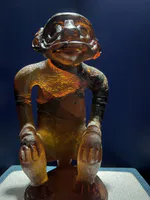
Amber Figurine of a Taíno Chief
From Ancient Amber to the Birth of Electricity
Electricity
Amber, when rubbed with wool, becomes electrically charged and attracts light objects—a phenomenon first observed by the ancient Greeks more than two thousand years ago. This was humanity’s earliest experience producing electricity. The Greeks called amber elektron, a word that later inspired “electricity” and, more recently, “electronic,” terms whose origins trace back to this simple natural experiment.
Amber, when rubbed with wool, becomes electrically charged and attracts light objects—a phenomenon first observed by the ancient Greeks more than two thousand years ago. This was humanity’s earliest experience producing electricity. The Greeks called amber elektron, a word that later inspired “electricity” and, more recently, “electronic,” terms whose origins trace back to this simple natural experiment.
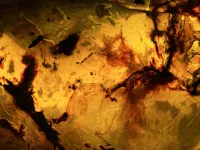
Amber with Botanical Inclusions
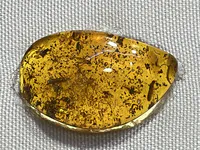
Amber with Organic Debris
Social Life of Ants: Inside Insect Civilizations
Social Life of Ants
Ant colonies function as unified organisms: complex societies based on cooperation, specialization, and collective survival. Ants gather food, hunt, and even practice agriculture, making their colonies the closest equivalent to “civilizations” in the insect world. Their success stems from three traits: adults care for the young, multiple generations live together, and colonies divide into reproductive queens and sterile workers.
These eusocial bonds—shared with termites, some bees, and some wasps—define all ants, which belong to the Formicidae family of the order Hymenoptera. About 9,500 species are known, mostly in tropical regions, though many more remain undiscovered. Their dominance arises from highly evolved colonial life, marked by individual sacrifice. Scientists note that each colony balances collective survival with internal competition, and multi-queen colonies can survive for extremely long periods, reaching enormous size.
Ant colonies function as unified organisms: complex societies based on cooperation, specialization, and collective survival. Ants gather food, hunt, and even practice agriculture, making their colonies the closest equivalent to “civilizations” in the insect world. Their success stems from three traits: adults care for the young, multiple generations live together, and colonies divide into reproductive queens and sterile workers.
These eusocial bonds—shared with termites, some bees, and some wasps—define all ants, which belong to the Formicidae family of the order Hymenoptera. About 9,500 species are known, mostly in tropical regions, though many more remain undiscovered. Their dominance arises from highly evolved colonial life, marked by individual sacrifice. Scientists note that each colony balances collective survival with internal competition, and multi-queen colonies can survive for extremely long periods, reaching enormous size.
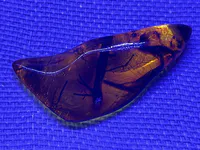
Amber with Plant Material under UV Light
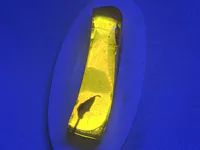
Amber with Leaf Inclusion under UV Light
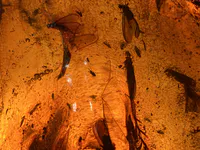
Insects Trapped in Amber
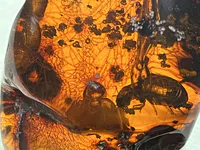
Weevil in Amber
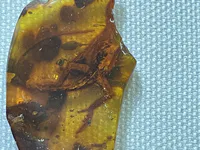
Fossilized Frog in Amber
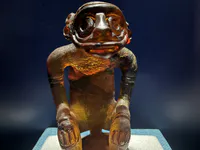
Taíno Cacique
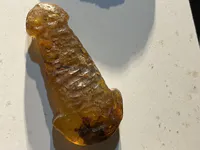
Amber Phallus Amulet
Amber and the Ancient Discovery of Electricity
Amber and the Origins of “Electricity”
When amber is rubbed with a woollen cloth, it acts as a conductor of electricity and attracts small, lightweight objects such as bits of paper. This simple experiment, already known to the ancient Greeks more than two thousand years ago, was humanity’s first encounter with electricity of its own making.
The Greeks called amber elektron. Over time, this term was transferred to the phenomenon we now call “electricity,” and later adapted into the word “electronic”—which, in a sense, could be understood as “pertaining to amber.”
When amber is rubbed with a woollen cloth, it acts as a conductor of electricity and attracts small, lightweight objects such as bits of paper. This simple experiment, already known to the ancient Greeks more than two thousand years ago, was humanity’s first encounter with electricity of its own making.
The Greeks called amber elektron. Over time, this term was transferred to the phenomenon we now call “electricity,” and later adapted into the word “electronic”—which, in a sense, could be understood as “pertaining to amber.”
Classes of Ants and Their Remarkable Ways of Life
Classes of Ants
There are many types of ants, each adapted to a distinct way of life. Carpenter ants bore tunnels in decaying wood, warriors hunt other insects, and “nurses” tend herds of plant lice. Harvesters store large quantities of seeds, while leaf-cutters chew leaves into a paste to cultivate edible fungi. Other species act as thieves, living inside the nests of different ants, or as honey-gatherers, storing sweet liquids inside the elastic bodies of young workers.
Some ants raid other colonies, capturing larvae and raising them as “slaves.” Others serve as guards, using their large heads to block nest entrances. Each caste reflects a unique ecological role and a highly specialized form of cooperative life.
There are many types of ants, each adapted to a distinct way of life. Carpenter ants bore tunnels in decaying wood, warriors hunt other insects, and “nurses” tend herds of plant lice. Harvesters store large quantities of seeds, while leaf-cutters chew leaves into a paste to cultivate edible fungi. Other species act as thieves, living inside the nests of different ants, or as honey-gatherers, storing sweet liquids inside the elastic bodies of young workers.
Some ants raid other colonies, capturing larvae and raising them as “slaves.” Others serve as guards, using their large heads to block nest entrances. Each caste reflects a unique ecological role and a highly specialized form of cooperative life.
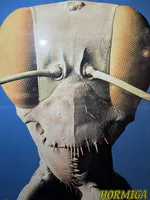
Ant Under Electron Microscope
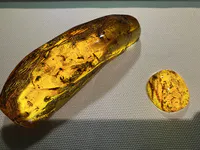
Amber with Insect Inclusions
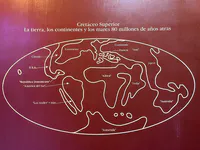
Continental Shift in the Late Cretaceous
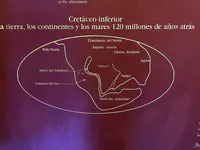
Continental Drift in the Early Cretaceo
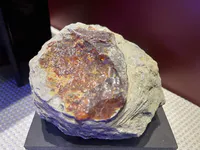
Miocene Amber in Sedimentary Matrix
The Social Life of Ants: Inside Eusocial Insect Societies
Social Life of Ants
For ants, the basic unit of life is the colony. Like an organism, this collective body must be studied as a whole to understand the biology of colonial species. Dense ant communities offer the closest thing to a “civilisation” in the insect world, and in many respects their societies resemble our own. As with human groups, ant communities have specialised in three main strategies for obtaining food: gathering, hunting, and cultivation.
Ants are among the most highly evolved social insects, and social insects themselves form the largest and most complex insect groups. Their success rests on three traits: adults care for the young; two or more generations of adults coexist in the same nest; and colony members are divided into a reproductive “royal” caste and a sterile worker caste.
Entomologists define such tightly organised societies as eusocial (“truly social”). Four main insect groups qualify: ants, termites, certain bees, and some wasps. All ants are eusocial and belong to the Formicidae family in the order Hymenoptera. Around 9,500 species are currently known, though at least twice that number likely remain undescribed. Most live in tropical regions.
Specialists believe that ants’ rise as the dominant insect group is due to their highly developed colonial life, built on individual sacrifice for the common good. They have also found that each colony is governed by a Darwinian balance between collective survival and internal struggles for control. Polygynous colonies—with several fertile queens—can persist for very long periods, reaching enormous size and population.
For ants, the basic unit of life is the colony. Like an organism, this collective body must be studied as a whole to understand the biology of colonial species. Dense ant communities offer the closest thing to a “civilisation” in the insect world, and in many respects their societies resemble our own. As with human groups, ant communities have specialised in three main strategies for obtaining food: gathering, hunting, and cultivation.
Ants are among the most highly evolved social insects, and social insects themselves form the largest and most complex insect groups. Their success rests on three traits: adults care for the young; two or more generations of adults coexist in the same nest; and colony members are divided into a reproductive “royal” caste and a sterile worker caste.
Entomologists define such tightly organised societies as eusocial (“truly social”). Four main insect groups qualify: ants, termites, certain bees, and some wasps. All ants are eusocial and belong to the Formicidae family in the order Hymenoptera. Around 9,500 species are currently known, though at least twice that number likely remain undescribed. Most live in tropical regions.
Specialists believe that ants’ rise as the dominant insect group is due to their highly developed colonial life, built on individual sacrifice for the common good. They have also found that each colony is governed by a Darwinian balance between collective survival and internal struggles for control. Polygynous colonies—with several fertile queens—can persist for very long periods, reaching enormous size and population.
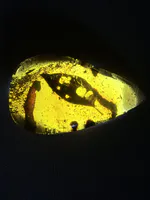
Fossilized Lizard in Amber
Ant Castes and the Many Specialized Roles in a Colony
Ant Castes and Specialised Roles
There are numerous kinds of ants, each with its own way of life and specialised role within the colony. Carpenter ants excavate long tunnels in decaying wood. Warrior ants hunt other insects, storing and transporting the remains when the colony moves. “Dairy” ants herd plant lice, leading them to feed and protecting them in exchange for sweet secretions. Harvester ants stockpile large quantities of seeds. Leaf-cutting ants chew leaves into a paste used to cultivate the fungi that serve as their primary food.
Other forms include thieves or beggars that live underground in the nests of other species; honey ants that store sweet juices in the distended bodies of young workers; slave-raiding ants that capture the eggs and larvae of other species and raise them as workers; and doorkeeper or guard ants that use their oversized heads like a living plug, sealing and disguising the nest entrance.
There are numerous kinds of ants, each with its own way of life and specialised role within the colony. Carpenter ants excavate long tunnels in decaying wood. Warrior ants hunt other insects, storing and transporting the remains when the colony moves. “Dairy” ants herd plant lice, leading them to feed and protecting them in exchange for sweet secretions. Harvester ants stockpile large quantities of seeds. Leaf-cutting ants chew leaves into a paste used to cultivate the fungi that serve as their primary food.
Other forms include thieves or beggars that live underground in the nests of other species; honey ants that store sweet juices in the distended bodies of young workers; slave-raiding ants that capture the eggs and larvae of other species and raise them as workers; and doorkeeper or guard ants that use their oversized heads like a living plug, sealing and disguising the nest entrance.
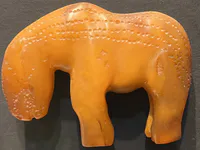
Amber Horse Carving
Inside Ant Nests: Architecture, Castes, and Longevity
Ant Nests
The ants’ dwelling is called a nest. It offers shelter, security, protection from enemies, a stable microclimate, a safe space for reproduction, and storage for food. Some nests are simple, with just a few galleries, while others form complex systems of chambers with flat floors and interconnecting tunnels. Nests may lie beneath stones, next to walls, inside wooden beams, under trees, or as earthen mounds across open fields and plains. They can stretch over many metres and reach depths of up to five metres, ending in chambers about a metre long and thirty centimetres high.
Inside, the microclimate is carefully regulated to ensure ideal conditions for life and the rearing of offspring. Forest ant mounds, for example, may have ventilation openings that can be opened or closed to maintain stable temperature and humidity. Ant societies are generally divided into three castes. Queens found new colonies and then serve mainly as egg-layers. Winged males undertake a single nuptial flight, fertilise the queen for life, and soon die. Sterile female workers carry out all the colony’s tasks—nursing, cleaning, building, defending, and foraging.
Queens are larger than the other castes and usually winged, losing their wings after mating. To establish a new colony, a young queen digs a small chamber in the earth where she lays her first eggs. Winged males are much smaller, short-lived, and die shortly after mating. Workers are wingless, sterile, and perform the heavy labour.
Smaller colonies may have only these three types, but larger colonies can contain several worker sub-castes of different sizes, shapes, and behaviours. Ant longevity is remarkable: some workers live up to seven years, and queens may reach fifteen. The record for a captive queen is a Lasius niger (European black ant) that lived 29 years in an artificial colony in Switzerland. Over their lifetime, queens may produce a few hundred workers—or, in the case of leaf-cutting ant queens in Central and South America, up to 150 million.
The ants’ dwelling is called a nest. It offers shelter, security, protection from enemies, a stable microclimate, a safe space for reproduction, and storage for food. Some nests are simple, with just a few galleries, while others form complex systems of chambers with flat floors and interconnecting tunnels. Nests may lie beneath stones, next to walls, inside wooden beams, under trees, or as earthen mounds across open fields and plains. They can stretch over many metres and reach depths of up to five metres, ending in chambers about a metre long and thirty centimetres high.
Inside, the microclimate is carefully regulated to ensure ideal conditions for life and the rearing of offspring. Forest ant mounds, for example, may have ventilation openings that can be opened or closed to maintain stable temperature and humidity. Ant societies are generally divided into three castes. Queens found new colonies and then serve mainly as egg-layers. Winged males undertake a single nuptial flight, fertilise the queen for life, and soon die. Sterile female workers carry out all the colony’s tasks—nursing, cleaning, building, defending, and foraging.
Queens are larger than the other castes and usually winged, losing their wings after mating. To establish a new colony, a young queen digs a small chamber in the earth where she lays her first eggs. Winged males are much smaller, short-lived, and die shortly after mating. Workers are wingless, sterile, and perform the heavy labour.
Smaller colonies may have only these three types, but larger colonies can contain several worker sub-castes of different sizes, shapes, and behaviours. Ant longevity is remarkable: some workers live up to seven years, and queens may reach fifteen. The record for a captive queen is a Lasius niger (European black ant) that lived 29 years in an artificial colony in Switzerland. Over their lifetime, queens may produce a few hundred workers—or, in the case of leaf-cutting ant queens in Central and South America, up to 150 million.
Inside Ant Nests: Architecture, Castes, and Lifespans
Nests
Ant nests function as secure refuges that provide protection, a controlled micro-climate, and space for reproduction and food storage. Some are simple structures with a few galleries, while others form extensive systems of interconnected chambers. They can appear under rocks, in wood, at the base of trees, or as mounds in open fields, sometimes covering several meters and reaching depths of up to five meters. Inside, temperature and ventilation are regulated to ensure ideal conditions for raising offspring.
Ant societies comprise three main castes. Queens found new colonies and lay eggs; winged males fertilize the queen during a single nuptial flight and die shortly after; and sterile female workers handle all labor—nursing, cleaning, foraging, and defense. Queens are the largest and lose their wings after mating. Workers, always wingless, may vary widely in size and behavior in large colonies. Lifespans are notable: workers may live up to seven years, while queens can reach fifteen or more, with some documented cases far exceeding this. Depending on the species, a queen may produce hundreds to millions of workers over her lifetime.
Ant nests function as secure refuges that provide protection, a controlled micro-climate, and space for reproduction and food storage. Some are simple structures with a few galleries, while others form extensive systems of interconnected chambers. They can appear under rocks, in wood, at the base of trees, or as mounds in open fields, sometimes covering several meters and reaching depths of up to five meters. Inside, temperature and ventilation are regulated to ensure ideal conditions for raising offspring.
Ant societies comprise three main castes. Queens found new colonies and lay eggs; winged males fertilize the queen during a single nuptial flight and die shortly after; and sterile female workers handle all labor—nursing, cleaning, foraging, and defense. Queens are the largest and lose their wings after mating. Workers, always wingless, may vary widely in size and behavior in large colonies. Lifespans are notable: workers may live up to seven years, while queens can reach fifteen or more, with some documented cases far exceeding this. Depending on the species, a queen may produce hundreds to millions of workers over her lifetime.
Mundo de Ámbar
Mundo de Ámbar is a museum where science, natural history and imagination gather around the warm glow of amber. Visitors learn how this ancient resin, known to the Greeks as “elektron”, revealed early human encounters with static electricity and later lent its name to the electronic age. Exhibits explore amber’s physical properties and invite you to see it not just as a gemstone, but as a material that has shaped language, technology and myth.
The museum also opens a window onto the hidden civilizations preserved in and inspired by amber, from intricate ant societies to the wider world of social insects. Detailed displays explain colonies, castes, nests and the strategies that have made ants so successful, drawing subtle parallels with human communities. The result is an intimate, slightly otherworldly space where tiny creatures, deep time and modern science are woven into a single, memorable visit.
The museum also opens a window onto the hidden civilizations preserved in and inspired by amber, from intricate ant societies to the wider world of social insects. Detailed displays explain colonies, castes, nests and the strategies that have made ants so successful, drawing subtle parallels with human communities. The result is an intimate, slightly otherworldly space where tiny creatures, deep time and modern science are woven into a single, memorable visit.
Popular categories
Advertising space