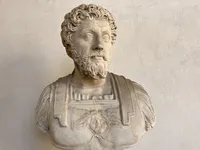
Emperor Marcus Aurelius
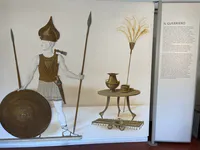
The Warrior
Landforms and Rivers that Shaped Ancient Latium
Landforms and Rivers of Latium
Latium’s geomorphology is varied. In the north, the volcanic massif of the Alban Hills dominates, while the south is formed by limestone chains of the pre-Apennines (Lepini, Ausoni, Aurunci). Along the coast, plains rise gently toward the interior: the Roman Campagna in the north and the Pontine and Fondi plains in the south.
Major rivers—Tiber, Aniene, Sacco, Liri and Garigliano—served as natural routes of communication and boundaries with Etruria, Sabina, Abruzzo and Campania. Smaller watercourses created a dense internal network. These features shaped the historical prominence of certain areas, especially the Alban Hills in the earliest phases, before Rome’s urban expansion shifted the region’s political and economic center of gravity to the city itself.
⸻
Latium’s geomorphology is varied. In the north, the volcanic massif of the Alban Hills dominates, while the south is formed by limestone chains of the pre-Apennines (Lepini, Ausoni, Aurunci). Along the coast, plains rise gently toward the interior: the Roman Campagna in the north and the Pontine and Fondi plains in the south.
Major rivers—Tiber, Aniene, Sacco, Liri and Garigliano—served as natural routes of communication and boundaries with Etruria, Sabina, Abruzzo and Campania. Smaller watercourses created a dense internal network. These features shaped the historical prominence of certain areas, especially the Alban Hills in the earliest phases, before Rome’s urban expansion shifted the region’s political and economic center of gravity to the city itself.
⸻
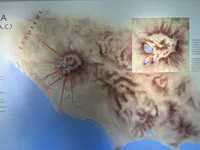
Map of Early Latial Centers
Population and Funerary Customs in Early Latium
Population And Funerary Customs In Early Latium
Paleodemographic analysis from cemeteries such as Osteria dell’Osa suggests that those who reached 20 years of age could expect, on average, about 25 more years of life. Among adults, women significantly outnumbered men, with a sex ratio of roughly 0.73 males per female. In the second Latial period (c. 10th–9th c. BC), adult men often received distinct funerary treatment: early on they were commonly cremated and later sometimes excluded from burial in the main sacred area. Changes in ritual and grave goods reveal evolving ideas about status, gender, and the community’s relationship to its dead.
Paleodemographic analysis from cemeteries such as Osteria dell’Osa suggests that those who reached 20 years of age could expect, on average, about 25 more years of life. Among adults, women significantly outnumbered men, with a sex ratio of roughly 0.73 males per female. In the second Latial period (c. 10th–9th c. BC), adult men often received distinct funerary treatment: early on they were commonly cremated and later sometimes excluded from burial in the main sacred area. Changes in ritual and grave goods reveal evolving ideas about status, gender, and the community’s relationship to its dead.
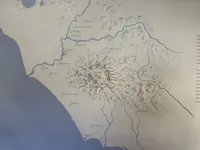
Map of Ancient Latium Settlements
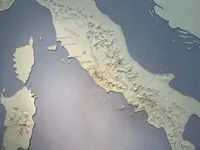
Ancient Latium and Neighbors
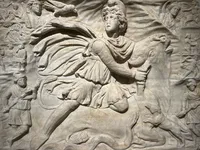
Mithras Slaying the Bull
Climate, Environment, and Ancient Economy in Latium
Climate, Environment and Economy in Latium
Latium has a Mediterranean climate with hot summers and humid winters. Long summer dry spells favored seasonal livestock movements (transhumance). Natural vegetation changes with altitude: Mediterranean scrub up to about 500 m, mixed woodland to c. 1000 m and beech forests to around 1700 m.
Soils also vary: volcanic zones are highly fertile, former marshlands were only recently reclaimed, and southern limestone areas are generally poorer. In antiquity, the economy relied on cereals (emmer, barley, einkorn, millet, wheat, spelt), legumes (beans, peas), animal husbandry (goats, pigs, cattle) and wild game. Horses are attested from the Copper Age, while domestic cats appear in the 9th c. BC.
⸻
Latium has a Mediterranean climate with hot summers and humid winters. Long summer dry spells favored seasonal livestock movements (transhumance). Natural vegetation changes with altitude: Mediterranean scrub up to about 500 m, mixed woodland to c. 1000 m and beech forests to around 1700 m.
Soils also vary: volcanic zones are highly fertile, former marshlands were only recently reclaimed, and southern limestone areas are generally poorer. In antiquity, the economy relied on cereals (emmer, barley, einkorn, millet, wheat, spelt), legumes (beans, peas), animal husbandry (goats, pigs, cattle) and wild game. Horses are attested from the Copper Age, while domestic cats appear in the 9th c. BC.
⸻
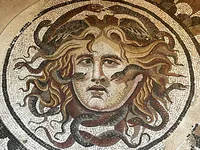
Medusa
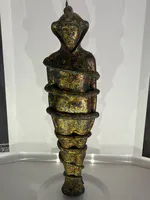
Deity with Serpent Coils
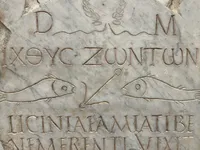
Funerary Stele of Licinia Amias (detail)
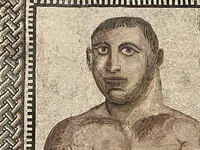
Boxer
Life, Death, and Changing Funerary Customs in Latium
Population and Funerary Customs in Latium
Paleodemographic analysis suggests that, after reaching 20 years of age, individuals lived on average for another 25 years. Among adults there was a marked predominance of women, with a male-to-female ratio of about 0.73.
Study of the Osteria dell’Osa necropolis, combining demographic data with funerary rituals and grave goods, shows that in Latial II (c. 10th–9th cc. BC) adult men often received distinct treatment. Initially they were commonly cremated; in later phases some were excluded from burial in the sacred area altogether, indicating changing social and ritual roles within the community.
⸻
Paleodemographic analysis suggests that, after reaching 20 years of age, individuals lived on average for another 25 years. Among adults there was a marked predominance of women, with a male-to-female ratio of about 0.73.
Study of the Osteria dell’Osa necropolis, combining demographic data with funerary rituals and grave goods, shows that in Latial II (c. 10th–9th cc. BC) adult men often received distinct treatment. Initially they were commonly cremated; in later phases some were excluded from burial in the sacred area altogether, indicating changing social and ritual roles within the community.
⸻
The Cult of Mithras and the Mystery of the Bull-Slaying
The Cult of Mithras
Mithras is an Iranian deity whose name means “contract” or “friendship.” In his original context he was revered as a solar guarantor of social stability and royal power. In the Roman world Mithraism appeared in the second half of the 1st c. AD as a markedly different mystery cult, reserved to male initiates, often soldiers. According to the myth, Mithras is born from a rock, armed with knife and torch and wearing a Phrygian cap. After a victorious encounter with the Sun, he receives a radiant crown.
The central scene of the cult is the tauroctony, the killing of the bull. Mithras seizes the animal by the nostrils and plunges a knife into its flank while a raven, a dog, a serpent and a scorpion attend; ears of grain sprout from the bull’s tail, symbolizing renewed life. Beside him stand Cautes and Cautopates, holding torches up and down to mark dawn and sunset, echoed by the Sun and Moon above. Worship took place in mithraea—usually underground, apsed chambers with side benches—where initiates shared ritual meals of bread and wine before an altar bearing the tauroctony. The cult prescribed seven grades of initiation: Corax (Raven), Cryphius or Nymphius (Occult or Groom), Miles (Soldier), Leo (Lion), Perses (Persian), Heliodromus (Sun Messenger) and, highest of all, Pater (Father).
Mithras is an Iranian deity whose name means “contract” or “friendship.” In his original context he was revered as a solar guarantor of social stability and royal power. In the Roman world Mithraism appeared in the second half of the 1st c. AD as a markedly different mystery cult, reserved to male initiates, often soldiers. According to the myth, Mithras is born from a rock, armed with knife and torch and wearing a Phrygian cap. After a victorious encounter with the Sun, he receives a radiant crown.
The central scene of the cult is the tauroctony, the killing of the bull. Mithras seizes the animal by the nostrils and plunges a knife into its flank while a raven, a dog, a serpent and a scorpion attend; ears of grain sprout from the bull’s tail, symbolizing renewed life. Beside him stand Cautes and Cautopates, holding torches up and down to mark dawn and sunset, echoed by the Sun and Moon above. Worship took place in mithraea—usually underground, apsed chambers with side benches—where initiates shared ritual meals of bread and wine before an altar bearing the tauroctony. The cult prescribed seven grades of initiation: Corax (Raven), Cryphius or Nymphius (Occult or Groom), Miles (Soldier), Leo (Lion), Perses (Persian), Heliodromus (Sun Messenger) and, highest of all, Pater (Father).
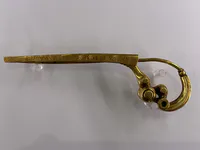
Praeneste Fibula
Latium’s Varied Landscapes and Shaping River Networks
Latium: Landscapes And River Networks
Latium’s landscape is highly varied: to the north, volcanic relief dominates around the Alban Hills; to the south, limestone chains of the pre-Apennines (Lepini, Ausoni, Aurunci) frame the land. Coastal plains—Campagna Romana, Pontine plain, and Fondi plain—rise gently inland. Major rivers such as the Tiber, Aniene, Sacco, Liri, and Garigliano provided natural routes and borders with Etruria, Sabina, Abruzzo, and Campania, while smaller streams formed a dense internal network. These geomorphological contrasts shaped shifting centers of power, with the Alban Hills prominent in early periods before Rome’s expansion eclipsed them.
Latium’s landscape is highly varied: to the north, volcanic relief dominates around the Alban Hills; to the south, limestone chains of the pre-Apennines (Lepini, Ausoni, Aurunci) frame the land. Coastal plains—Campagna Romana, Pontine plain, and Fondi plain—rise gently inland. Major rivers such as the Tiber, Aniene, Sacco, Liri, and Garigliano provided natural routes and borders with Etruria, Sabina, Abruzzo, and Campania, while smaller streams formed a dense internal network. These geomorphological contrasts shaped shifting centers of power, with the Alban Hills prominent in early periods before Rome’s expansion eclipsed them.
The Cult of Mithras: Mystery, Soldiers, and the Sun
The Cult Of Mithras
Mithras was an Iranian god whose name means “contract” or “friendship,” revered as a solar guarantor of social order and royal power. In the Roman world, his cult appeared in the later 1st century CE as a mystery religion reserved mainly for male initiates, often soldiers. According to the myth, Mithras is born from a rock with knife, torch, and Phrygian cap, defeats the Sun to gain a radiant crown, and performs the central act of tauroctonia: slaying a bull attended by a raven, dog, serpent, scorpion, and symbols of fertility like wheat sprouting from the bull’s tail.
The cult was practiced in underground mithraea—rectangular, apse-ended rooms with side benches where initiates shared a ritual meal of bread and wine facing an image of the tauroctony. Mithraism organized its followers through seven grades of initiation, from Corax (Raven) up to Pater (Father), guiding members through a symbolic journey tied to cosmic cycles of beginning and end, dawn and sunset, Sun and Moon.
Mithras was an Iranian god whose name means “contract” or “friendship,” revered as a solar guarantor of social order and royal power. In the Roman world, his cult appeared in the later 1st century CE as a mystery religion reserved mainly for male initiates, often soldiers. According to the myth, Mithras is born from a rock with knife, torch, and Phrygian cap, defeats the Sun to gain a radiant crown, and performs the central act of tauroctonia: slaying a bull attended by a raven, dog, serpent, scorpion, and symbols of fertility like wheat sprouting from the bull’s tail.
The cult was practiced in underground mithraea—rectangular, apse-ended rooms with side benches where initiates shared a ritual meal of bread and wine facing an image of the tauroctony. Mithraism organized its followers through seven grades of initiation, from Corax (Raven) up to Pater (Father), guiding members through a symbolic journey tied to cosmic cycles of beginning and end, dawn and sunset, Sun and Moon.
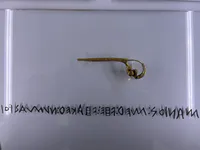
Praeneste Fibula
Latium’s Ancient Boundaries and Early Urbanization
Latium: Boundaries And Early Urbanization
Ancient Latium was a much smaller region than modern Lazio, bounded by the Tiber, Sacco, Liri, and Garigliano rivers and the Tyrrhenian Sea. Tradition distinguishes Latium Vetus, between the Tiber and Monte Circeo, inhabited by the Latins, from Latium Adjectum, annexed later from neighboring peoples such as the Ausoni and Aurunci. Rome urbanized early in the Iron Age, while centers like Lavinium, Ardea, Anzio, Satricum, Gabii, Tivoli, and Praeneste grew later—dates now revised earlier thanks to dendrochronology and radiocarbon analysis.
Ancient Latium was a much smaller region than modern Lazio, bounded by the Tiber, Sacco, Liri, and Garigliano rivers and the Tyrrhenian Sea. Tradition distinguishes Latium Vetus, between the Tiber and Monte Circeo, inhabited by the Latins, from Latium Adjectum, annexed later from neighboring peoples such as the Ausoni and Aurunci. Rome urbanized early in the Iron Age, while centers like Lavinium, Ardea, Anzio, Satricum, Gabii, Tivoli, and Praeneste grew later—dates now revised earlier thanks to dendrochronology and radiocarbon analysis.
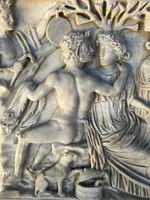
Dionysus and Ariadne
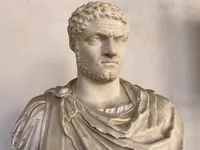
Caracalla (as an Adult)
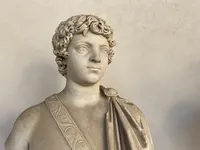
Caracalla as a Child
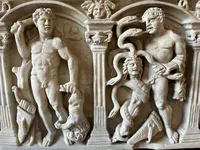
Hercules Slaying Lion and Hydra
Latium’s Climate, Soils, and Ancient Economy
Latium: Climate, Soils And Ancient Economy
Latium has a Mediterranean climate, with hot, dry summers and humid winters that favored seasonal transhumance of herds. Vegetation ranges from coastal scrub below 500 m to mixed woods and beech forests at higher altitudes. Volcanic soils are notably fertile, whereas marshlands (only recently drained) and many southern limestone areas are poorer. Ancient subsistence combined cereals (emmer, barley, einkorn, millet, wheat, spelt), legumes, and livestock—goats, pigs, cattle—supplemented by hunting and riverine resources. Horses are attested from the Copper Age, and domestic cats appear archaeologically from the 9th century BC.
Latium has a Mediterranean climate, with hot, dry summers and humid winters that favored seasonal transhumance of herds. Vegetation ranges from coastal scrub below 500 m to mixed woods and beech forests at higher altitudes. Volcanic soils are notably fertile, whereas marshlands (only recently drained) and many southern limestone areas are poorer. Ancient subsistence combined cereals (emmer, barley, einkorn, millet, wheat, spelt), legumes, and livestock—goats, pigs, cattle—supplemented by hunting and riverine resources. Horses are attested from the Copper Age, and domestic cats appear archaeologically from the 9th century BC.
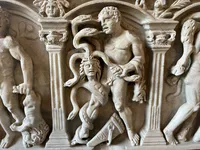
Hercules Battling the Lernaean Hydra
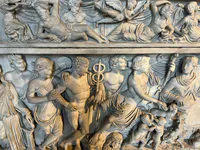
Marriage of Dionysus and Ariadne
Latium’s Ancient Boundaries and Early Urban Growth
Latium: Boundaries and Early Urban Growth
The ancient region of Latium, much smaller than modern Lazio, was bounded by the Tiber to the north, the Sacco and Liri valleys to the east, the Cogliano river to the south, and the Tyrrhenian Sea to the west. Traditional accounts distinguish Latium Vetus (Old Latium), between the Tiber and Monte Circeo and inhabited by the Latins, from Latium Adiectum, the area between Monte Circeo and Arigliano later annexed by Rome from neighboring peoples such as the Ausoni, Aurunci and Ernici.
Urban development began early in Rome during the Iron Age, while centers such as Lavinium, Ardea, Anzio, Satricum, Gabii, Tivoli and Palestrina grew later. Dendrochronology and radiocarbon dating now suggest earlier chronologies for some of these phases.
⸻
The ancient region of Latium, much smaller than modern Lazio, was bounded by the Tiber to the north, the Sacco and Liri valleys to the east, the Cogliano river to the south, and the Tyrrhenian Sea to the west. Traditional accounts distinguish Latium Vetus (Old Latium), between the Tiber and Monte Circeo and inhabited by the Latins, from Latium Adiectum, the area between Monte Circeo and Arigliano later annexed by Rome from neighboring peoples such as the Ausoni, Aurunci and Ernici.
Urban development began early in Rome during the Iron Age, while centers such as Lavinium, Ardea, Anzio, Satricum, Gabii, Tivoli and Palestrina grew later. Dendrochronology and radiocarbon dating now suggest earlier chronologies for some of these phases.
⸻
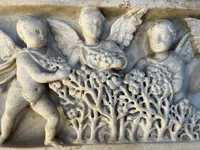
Putti Gathering Blossoms
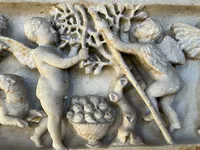
Putti Harvesting Fruit
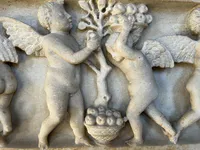
Winged Putti Harvesting Fruit
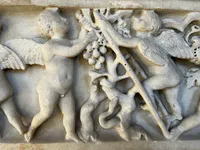
Winged Putti Harvesting Grapes
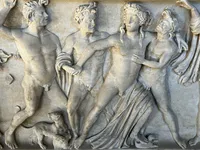
Dionysian Procession
Diocletian’s Baths
Diocletian’s Baths, once part of a vast ancient bath complex in Rome, now house an evocative museum where archaeology, religion and daily life in the Roman world come into focus. Within these monumental spaces, visitors encounter stories that range from the secretive cult of Mithras and its underground mithraea to the broader history of Latium, the region that nurtured Rome’s rise. Carefully curated displays explain how landscapes, rivers and climate shaped settlement, belief and power across this territory.
The galleries guide you from volcanic hills and coastal plains to early cities and necropoleis, revealing how people lived, farmed and worshipped over many centuries. Objects and reconstructions illuminate ritual banquets of bread and wine, changing funerary customs and demographic patterns. The atmosphere is both scholarly and accessible, inviting visitors to imagine ancient ceremonies, follow the evolution of Rome’s hinterland, and reflect on how this once-bustling bath complex now preserves the memory of an entire region’s past.
The galleries guide you from volcanic hills and coastal plains to early cities and necropoleis, revealing how people lived, farmed and worshipped over many centuries. Objects and reconstructions illuminate ritual banquets of bread and wine, changing funerary customs and demographic patterns. The atmosphere is both scholarly and accessible, inviting visitors to imagine ancient ceremonies, follow the evolution of Rome’s hinterland, and reflect on how this once-bustling bath complex now preserves the memory of an entire region’s past.
Popular categories
Advertising space