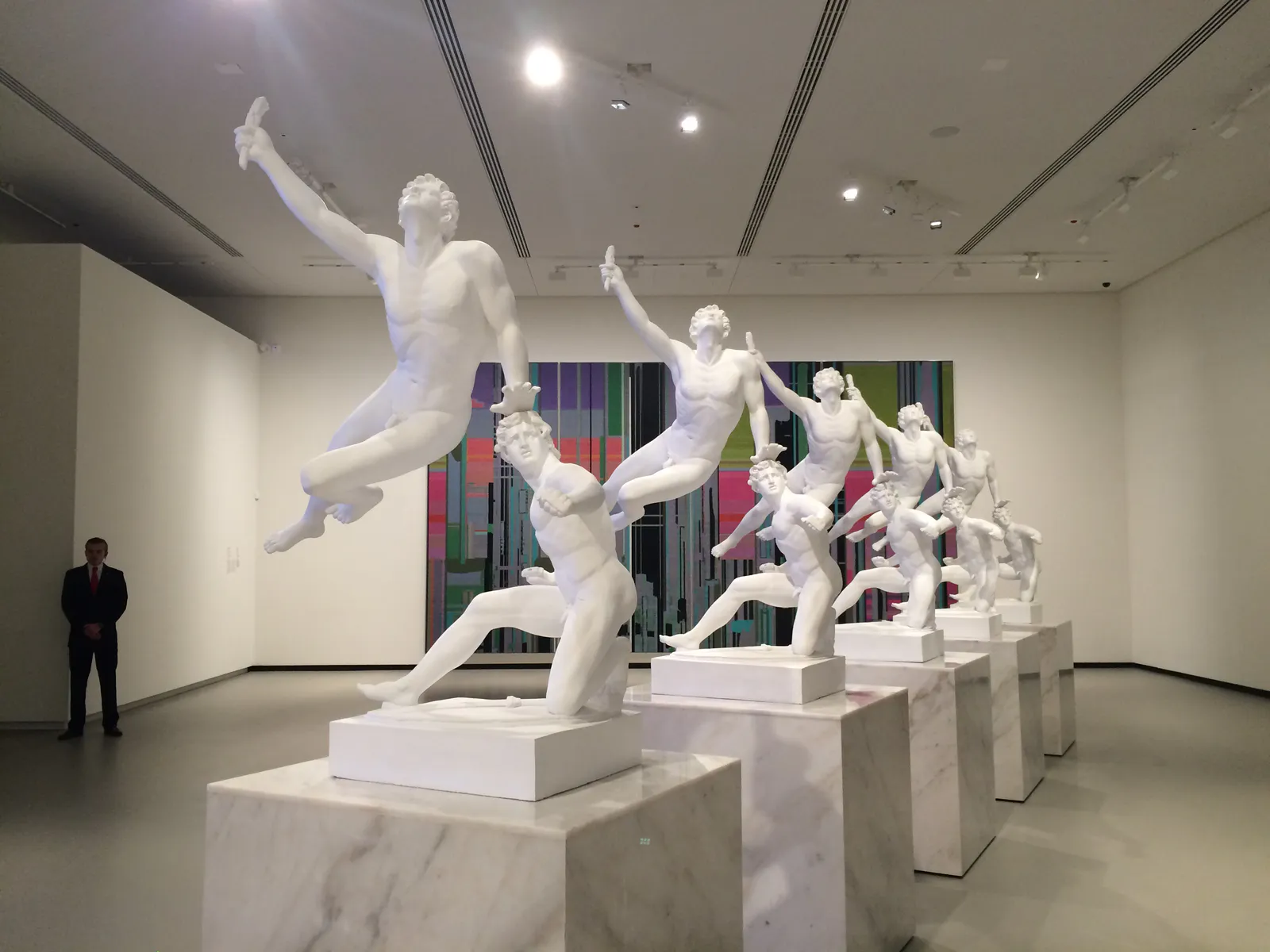
Eternity - The Soldier of Marathon Announcing Victory
Xu Zhen
This 2011 sculpture installation Eternity – Eternity - The Soldier of Marathon Announcing Victory, a Wounded Galatian fuses classical Greek forms with contemporary fragmentation. Crafted from concrete, fiberglass, marble powder, and metal, the sequence begins with a whole figure and gradually breaks apart, evoking cultural transformation and the erosion of historical continuity.
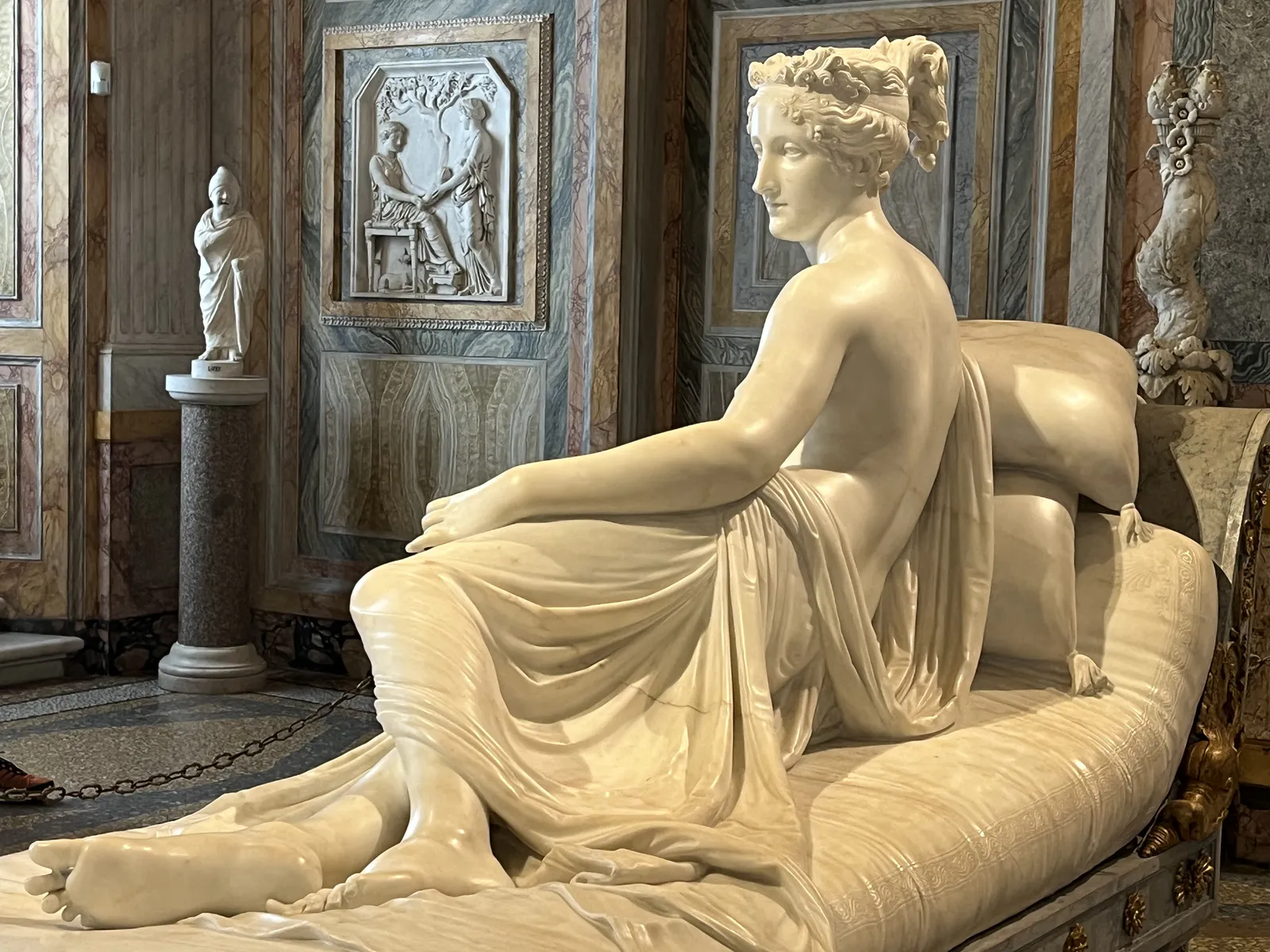
Pauline Bonaparte as Venus Victrix
Antonio Canova
Antonio Canova's marble masterpiece (1805–08) depicts Pauline Bonaparte as Venus Victrix, reclining semi-nude on a couch, holding an apple symbolizing Venus's triumph in the Judgement of Paris. Commissioned by her husband, Camillo Borghese, Pauline insisted on being portrayed as Venus rather than Diana. The sculpture, originally designed to rotate, reflects both personal ambition and classical beauty.
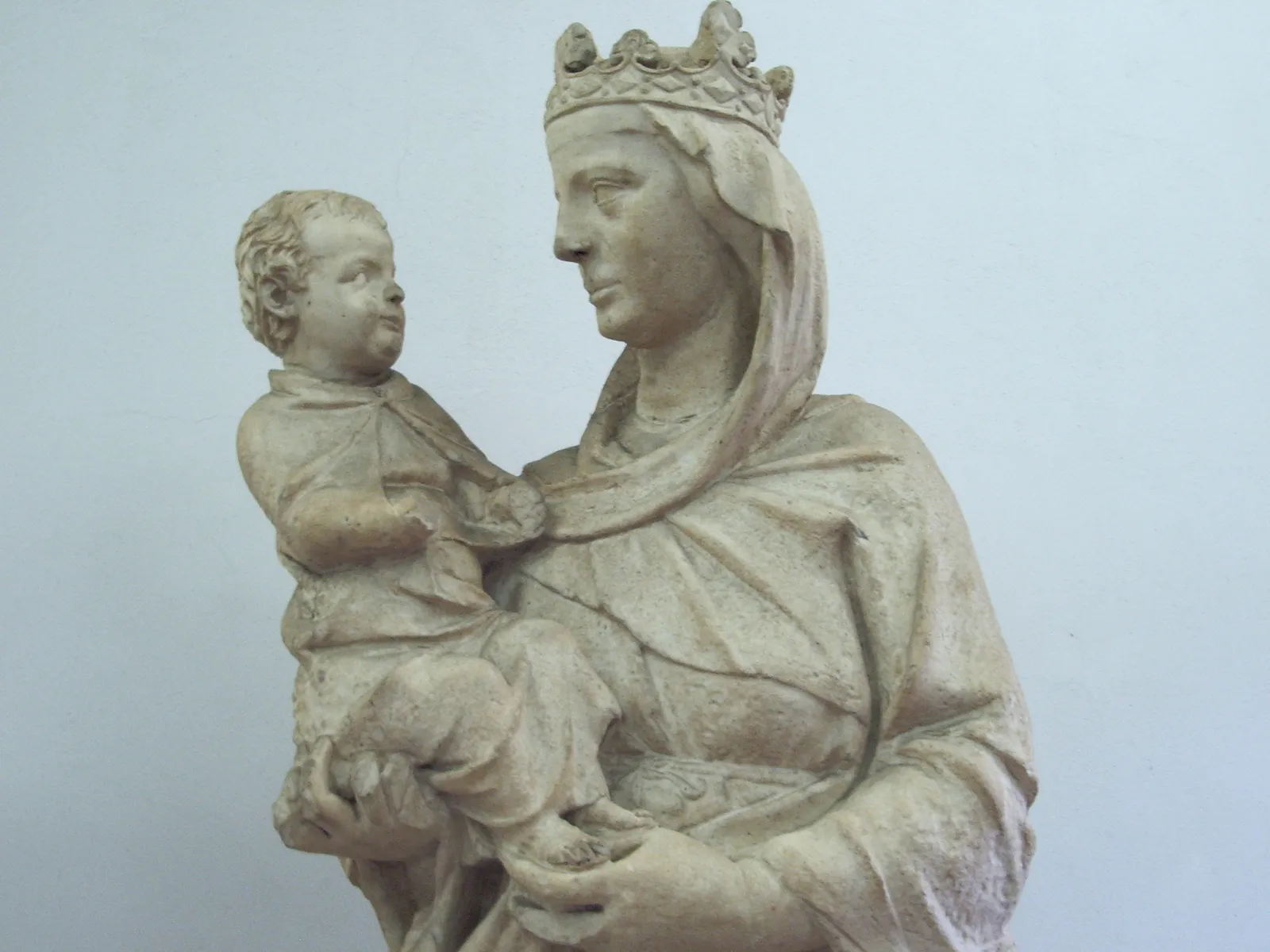
Madonna del colloquio
Giovanni Pisano
This half-length marble Virgin and Child (c. 1280–1284) originally stood at the south transept portal of Pisa Cathedral. Now, it captures a striking emotional exchange between mother and son. The Child gently grasps Mary’s veil, emphasizing Pisano’s innovative focus on tenderness and psychological realism in sacred art.
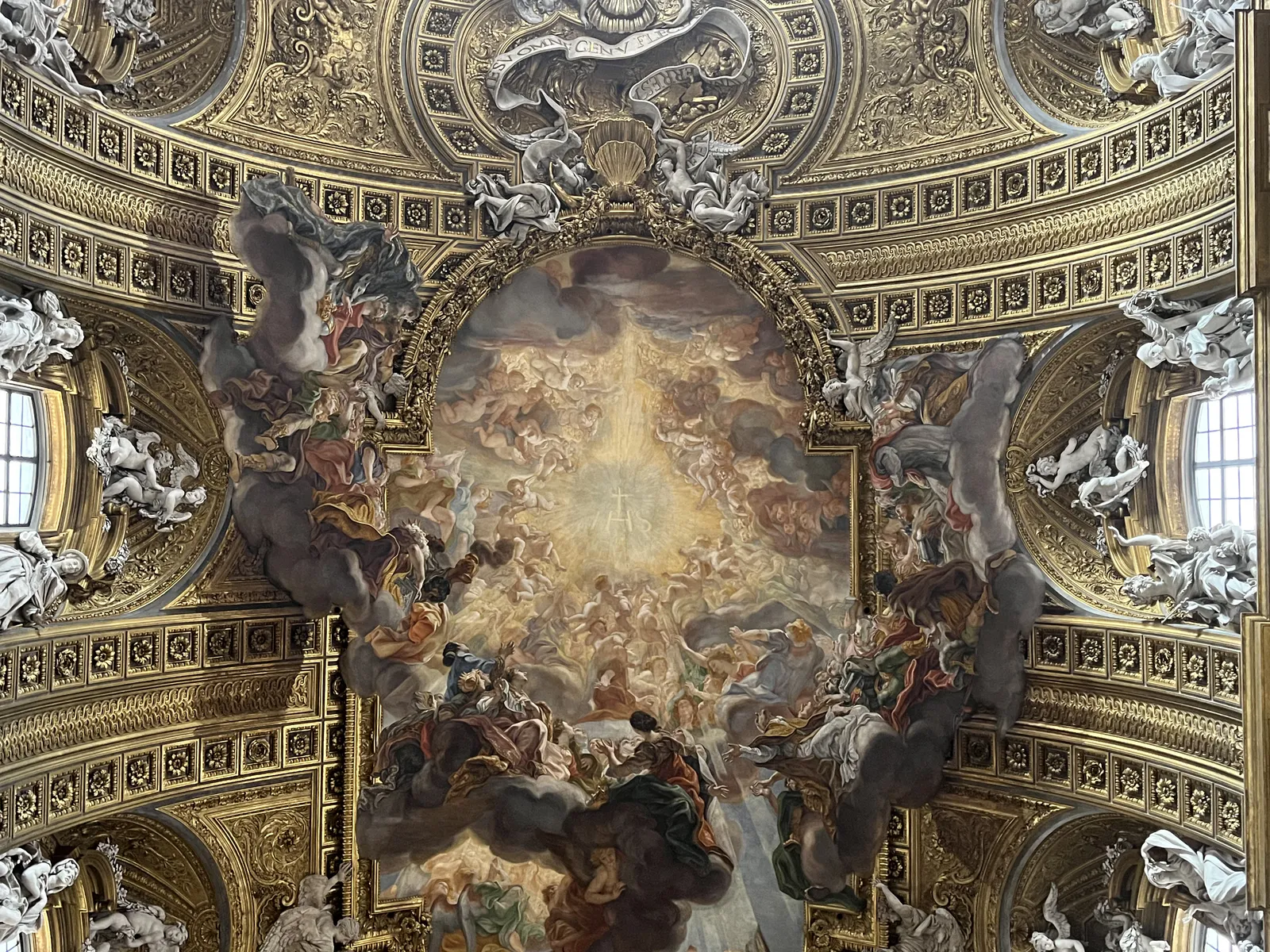
Triumph of the Name of Jesus
Giovanni Battista Gaulli
This dramatic fresco (1676–79) fills the nave ceiling with a celestial eruption of light and figures. At its center, divine radiance emanates from the monogram IHS, the symbol of Jesus. Saved souls rise toward the light, while sinners tumble into shadow. Blending paint and stucco, the work fuses heaven and church in Baroque theatricality.
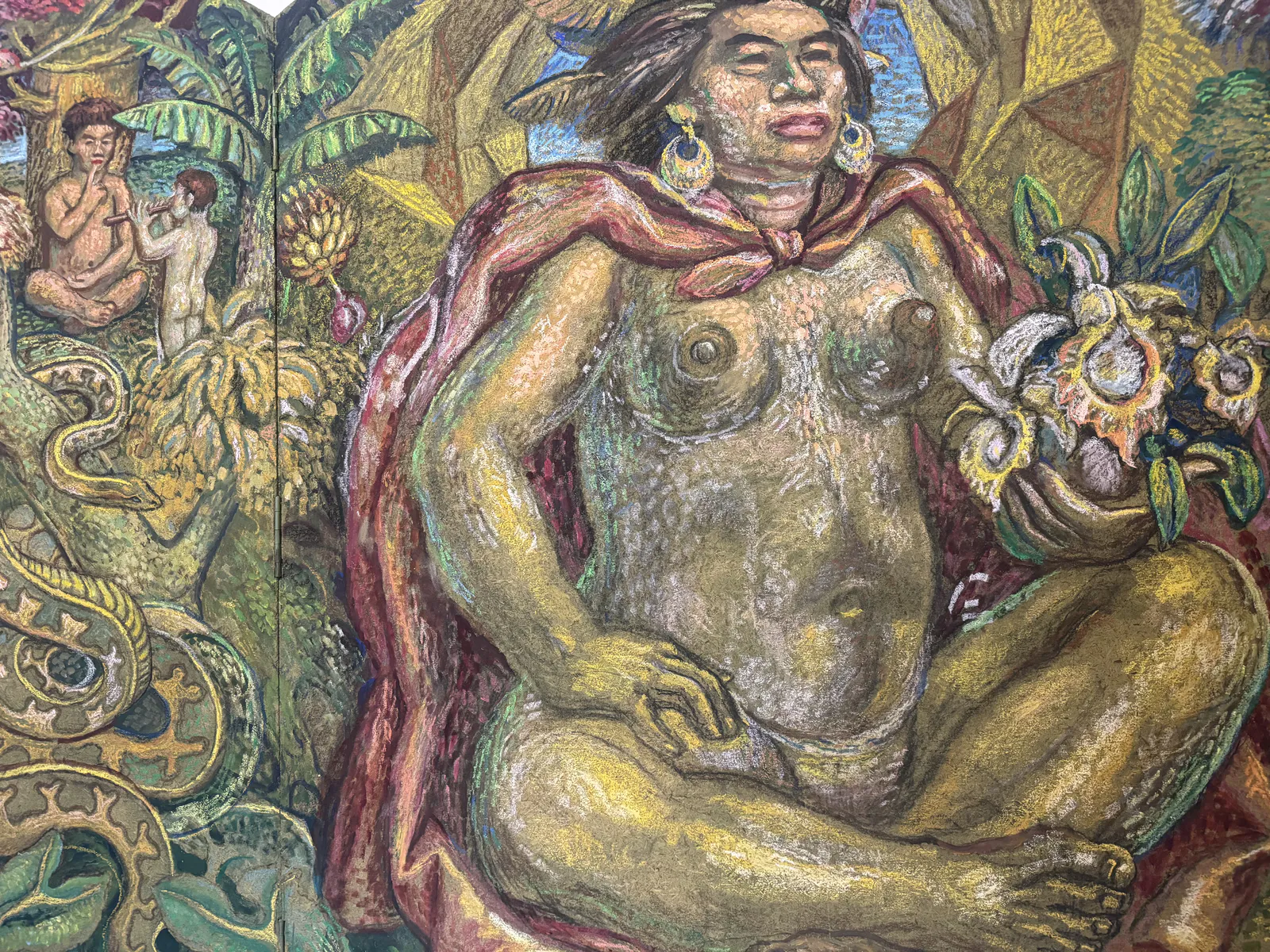
Mapiripana
Luis Alberto Acuña
Inspired by a myth from La Vorágine (a novel by José Eustasio Rivera), this 1950s painting depicts Mapiripana, a river spirit who guards silence and nature’s purity. When a missionary attempts to capture her, she punishes him by birthing monstrous twins—a vampire and an owl. In his final feverish agony, he sees a blue butterfly, symbol of his soul’s escape and eternal remorse.
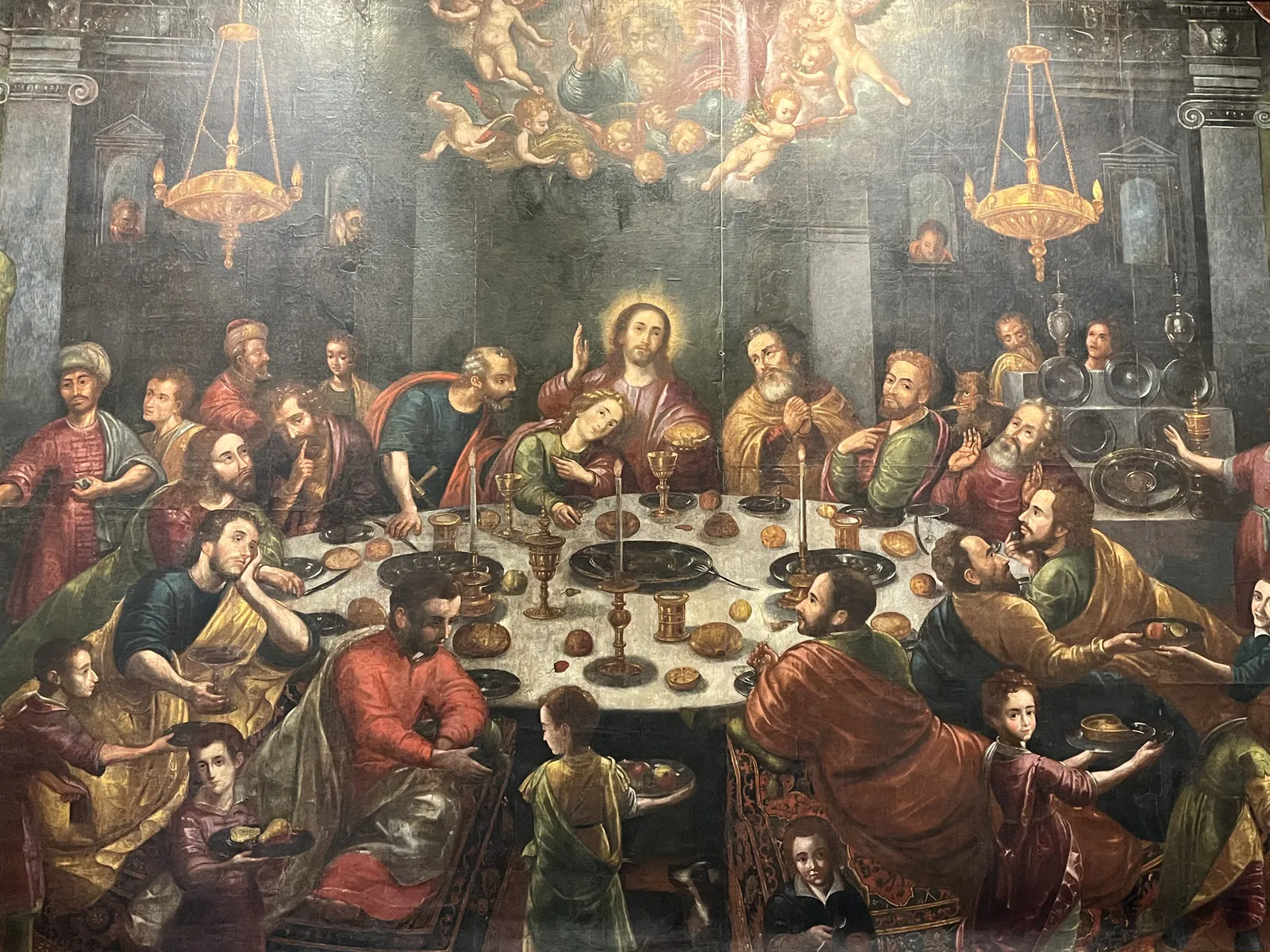
The Last Supper (with Cuy)
Diego de la Puente
De la Puente’s 1658 painting uniquely blends Spanish colonial art with Peruvian culture. It depicts Jesus and his disciples eating cuy (guinea pig), a local delicacy, instead of lamb. This substitution reflects how Catholic imagery was adapted to local customs, offering a clear example of the visual and cultural hybridization that shaped colonial Peru.
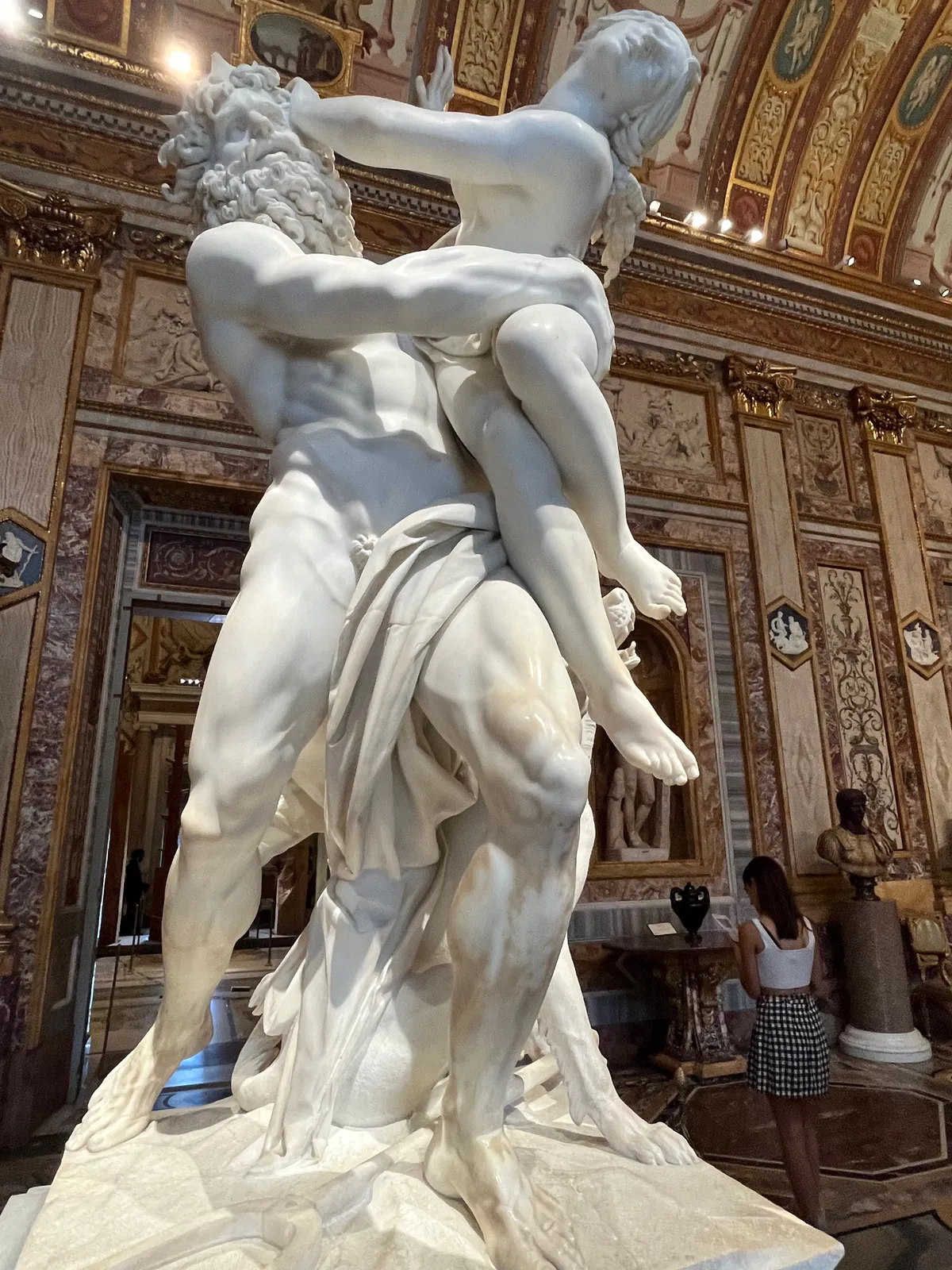
The Rape of Proserpina
Gian Lorenzo Bernini
From this angle, Bernini’s technical genius is apparent. Pluto’s gripping hands sink into Proserpina’s flesh with astonishing realism, turning marble into living form. The work (1621–22) stages emotional and physical tension at its peak, embodying the Baroque goal of stirring awe, drama, and pathos in a single breathtaking moment.
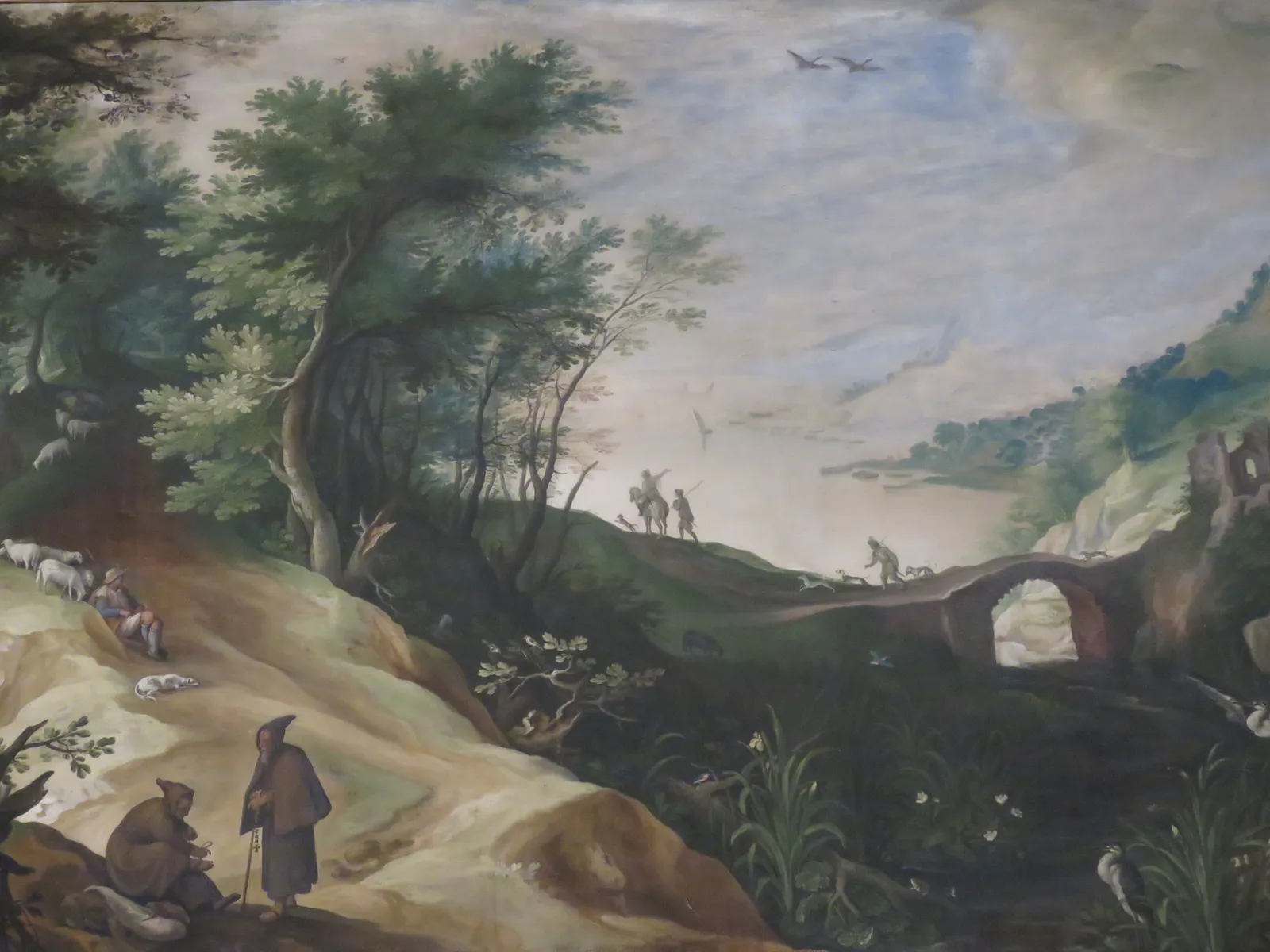
Landscape with Hermits
Paul Bril
This landscape (c. 1600) shows monks gathered in a wooded clearing beneath a broad, luminous sky. Their small figures sit or stand along a path that opens toward distant hills. Such scenes appeared in early Baroque painting, especially in northern regions where sacred retreat was a common theme. The composition indicates how artists linked hermitic life with the ordered quiet of nature.
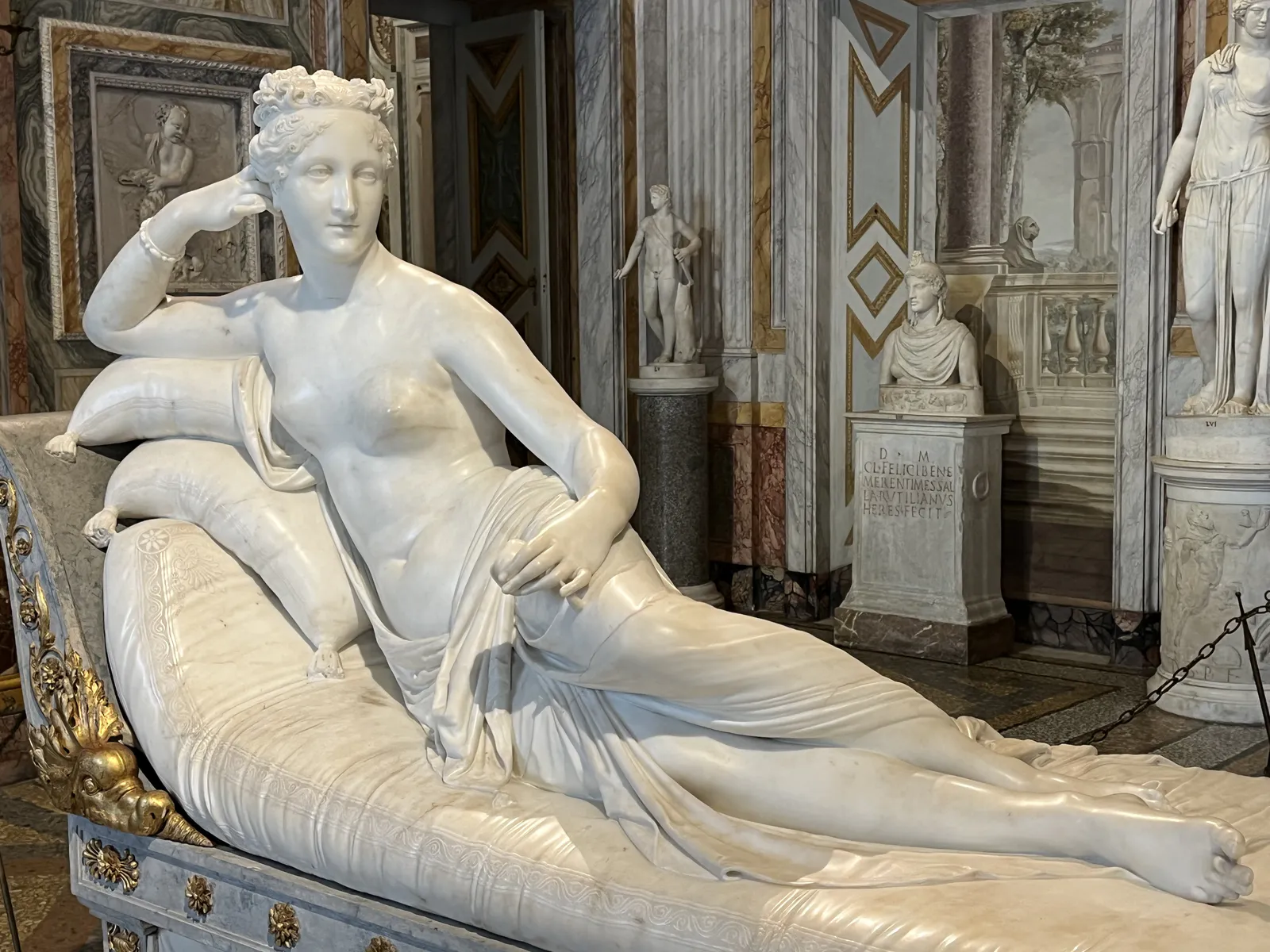
Pauline Bonaparte as Venus Victrix
Antonio Canova
This statue (1805–08) presents Pauline Bonaparte, sister of Napoleon, as Venus, reclining semi-nude and holding the golden apple of victory. Commissioned by her husband Camillo Borghese, the statue blends neoclassical elegance with sensual myth. Its rotating base once allowed viewers to admire it from every angle.
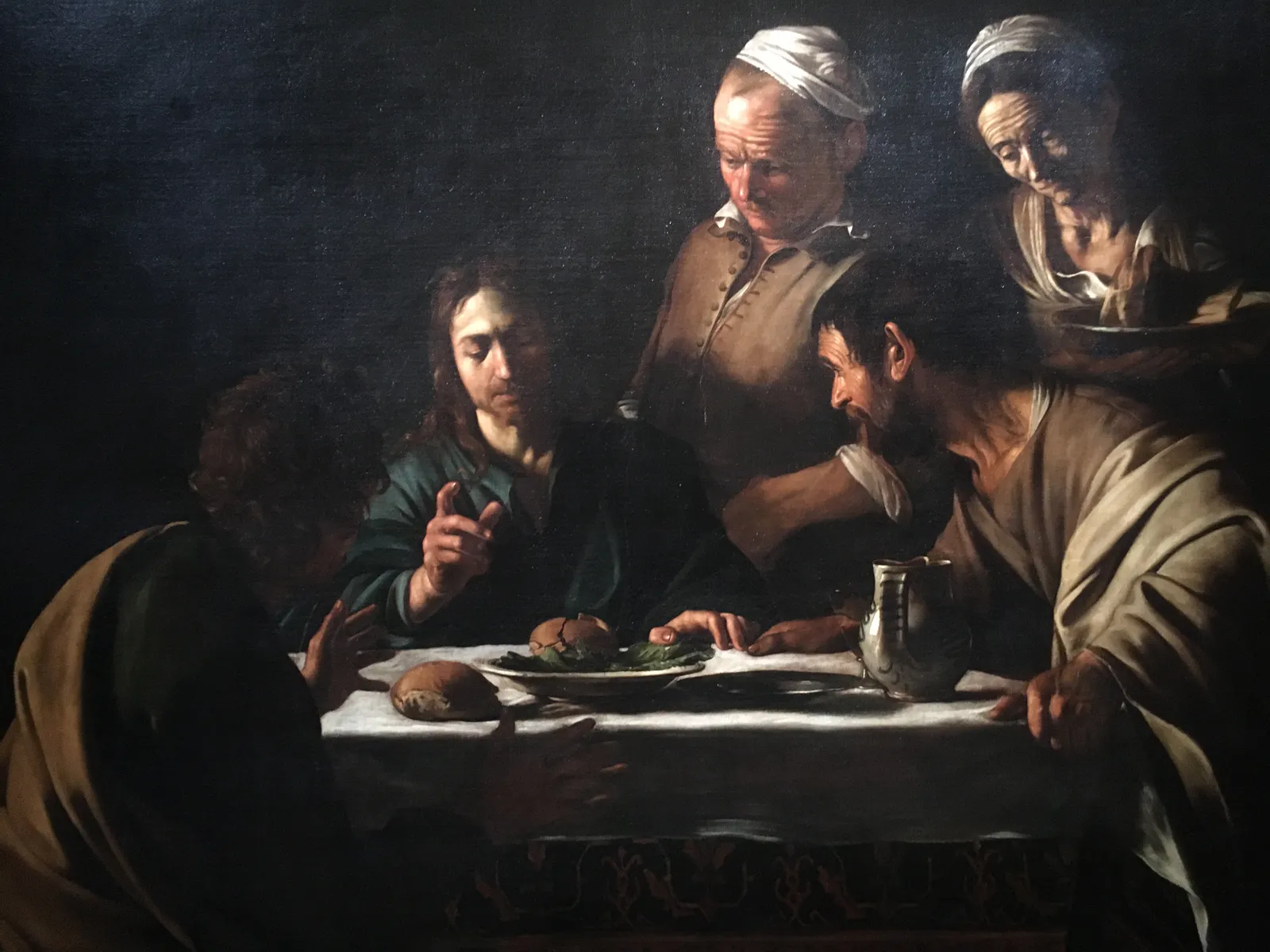
The Supper at Emmaus
Caravaggio
This painting (c.1606) was created after Caravaggio fled Rome for Naples. It depicts Christ revealing himself in Emmaus at the blessing of bread. Unlike Caravaggio’s earlier 1601 version, gestures are subdued and the table almost bare. In this darker vision, the recognition of the divine comes not in spectacle but in shadow and silence.
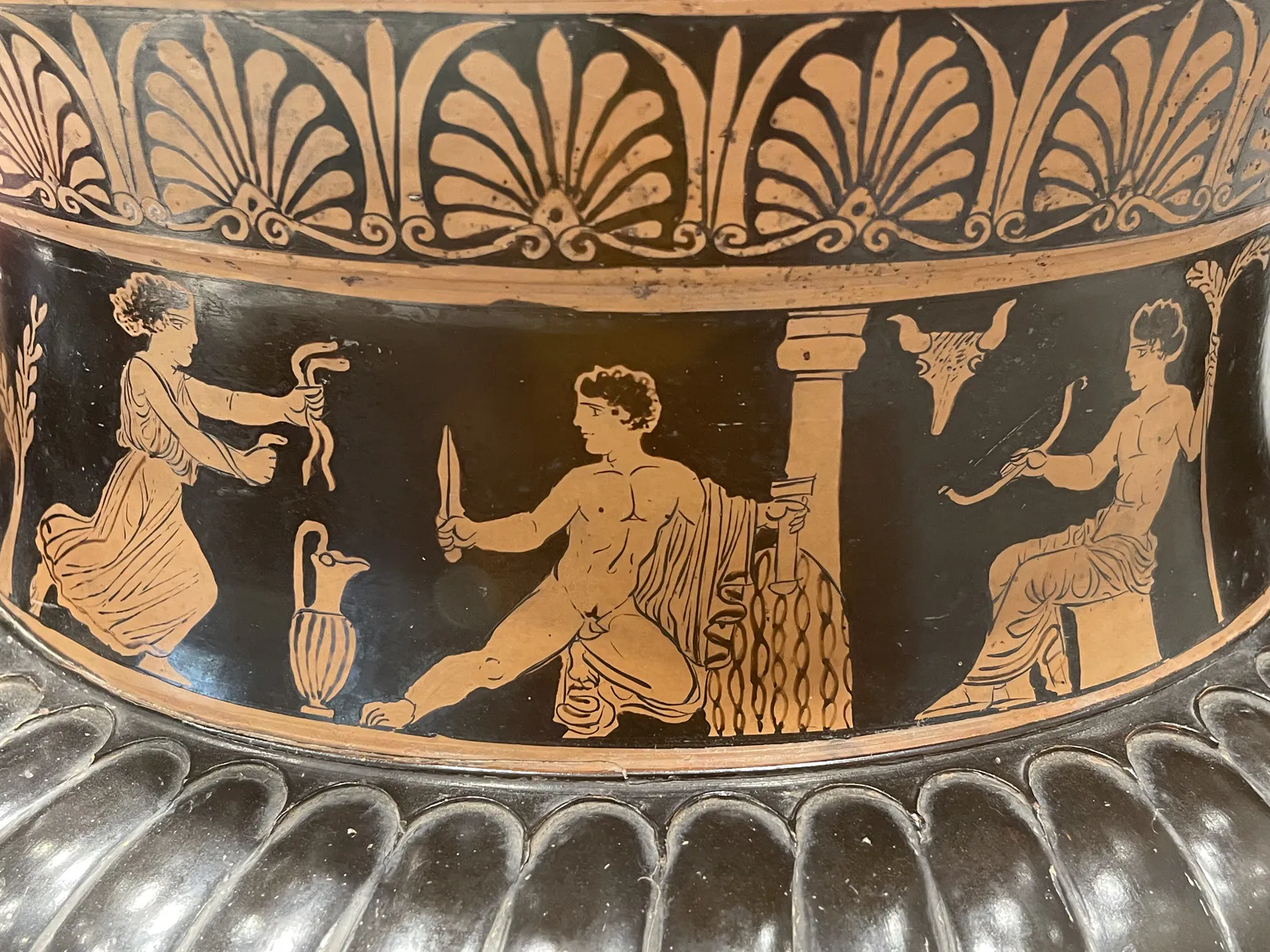
Orestes Pursued by the Furies
Painter of the Birth of Dionysus
This Apulian red-figure krater, used for mixing wine and water, (410–390 BC) depicts Orestes defending himself with a sword against the Erinyes, avenging his mother's death. Apollo, seated with a bow, offers protection, symbolizing divine sanction amid human guilt. This scene illustrates the complex interplay of justice and retribution in Greek mythology.
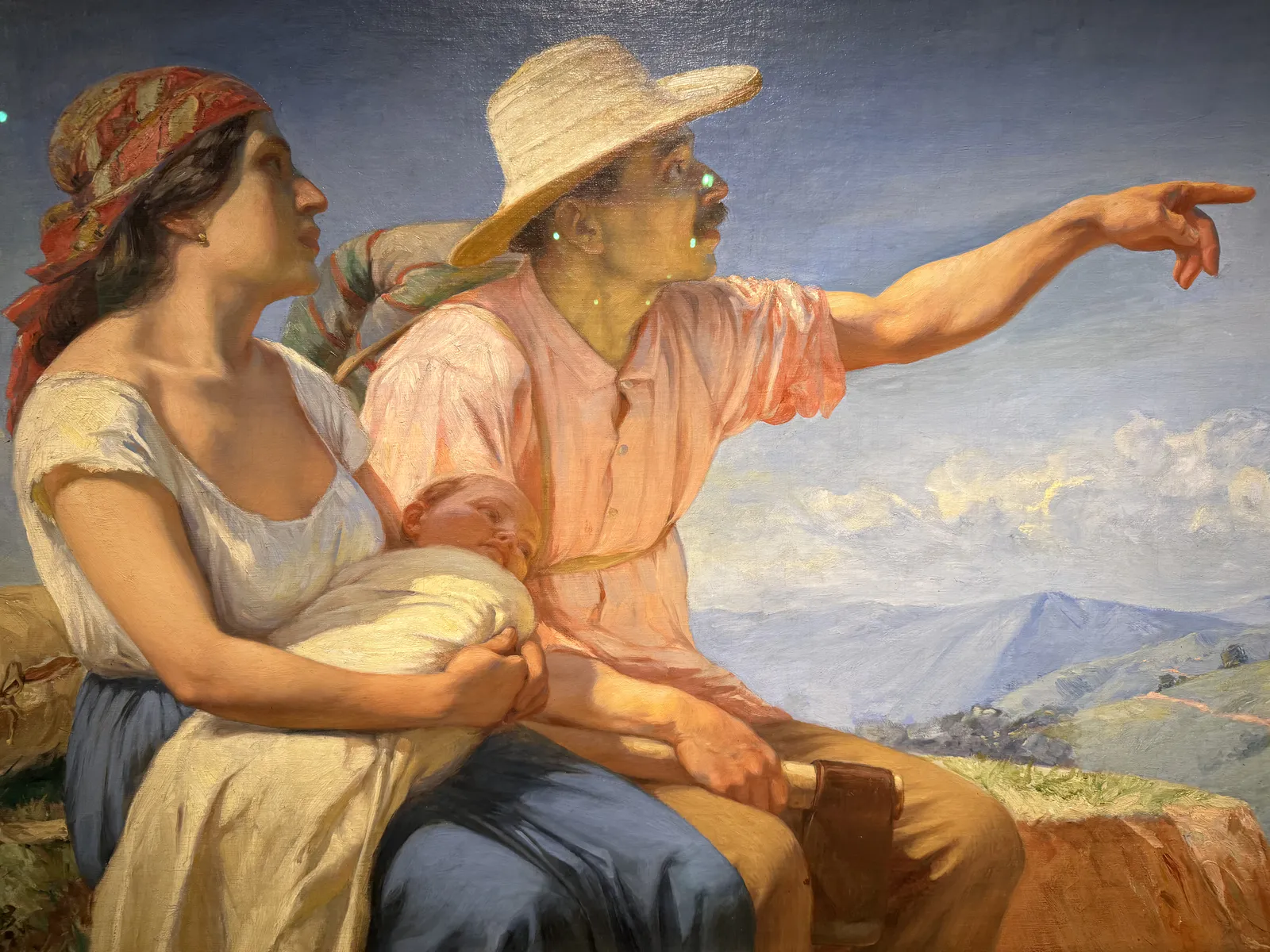
Horizons
Francisco Antonio Cano
Horizontes (1913) presents an idealized vision of Colombia’s settler frontier. The man's outstretched arm signifies hope and destiny, while the woman and child convey continuity and rootedness. This work by a leading Colombian academic painter uses the peasant family to symbolize national identity and the forging of a future in the Andean landscape.
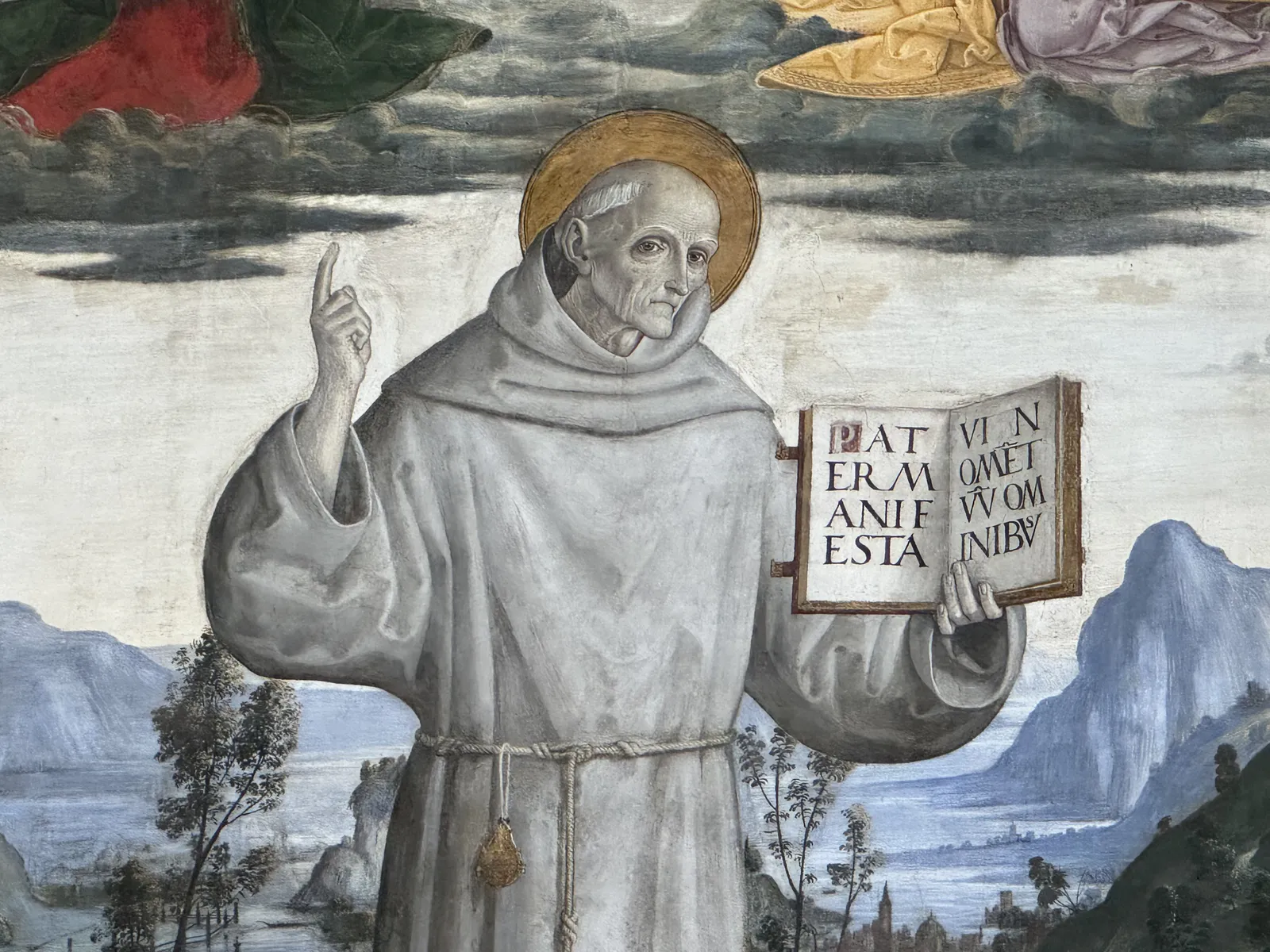
St. Bernardino (detail)
Pinturicchio
In this detail (1484–1486), Pinturicchio portrays St. Bernardino holding an open book inscribed PATER MANIFESTA NOMEN TUUM OMNIBUS (Father, manifest Your name to all). His raised finger points toward heaven, symbolizing his mission to glorify the Holy Name of Jesus and promote peace amid social discord.
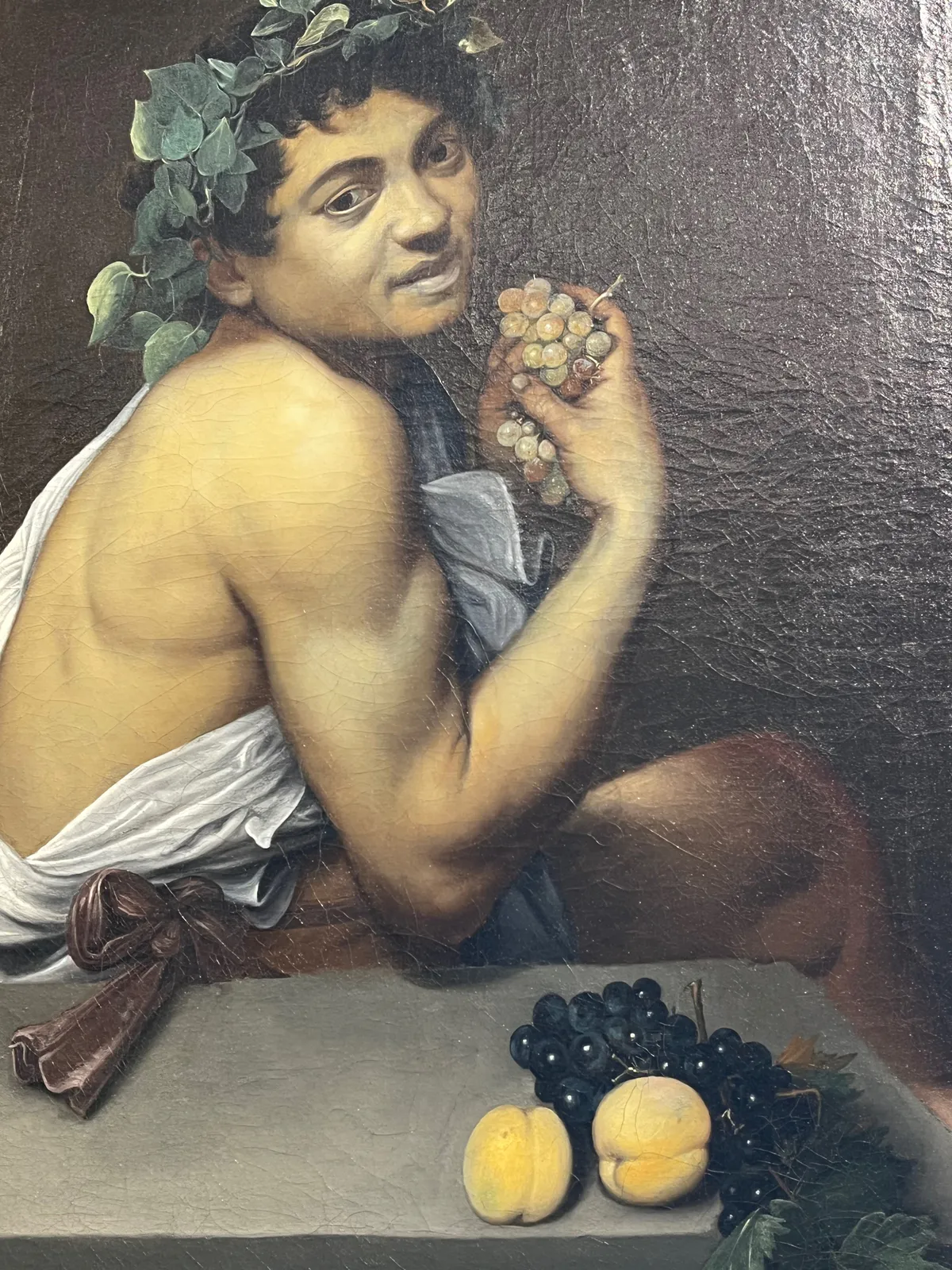
Young Sick Bacchus
Caravaggio
This self-portrait (c. 1593) shows Caravaggio as Bacchus with jaundiced skin and tense features, painted while recovering from illness. The ivy crown replaces the usual vine leaves, subverting divine idealism. Both sensual and unsettling, the image mocks classical beauty and reveals the artist’s own physical vulnerability.
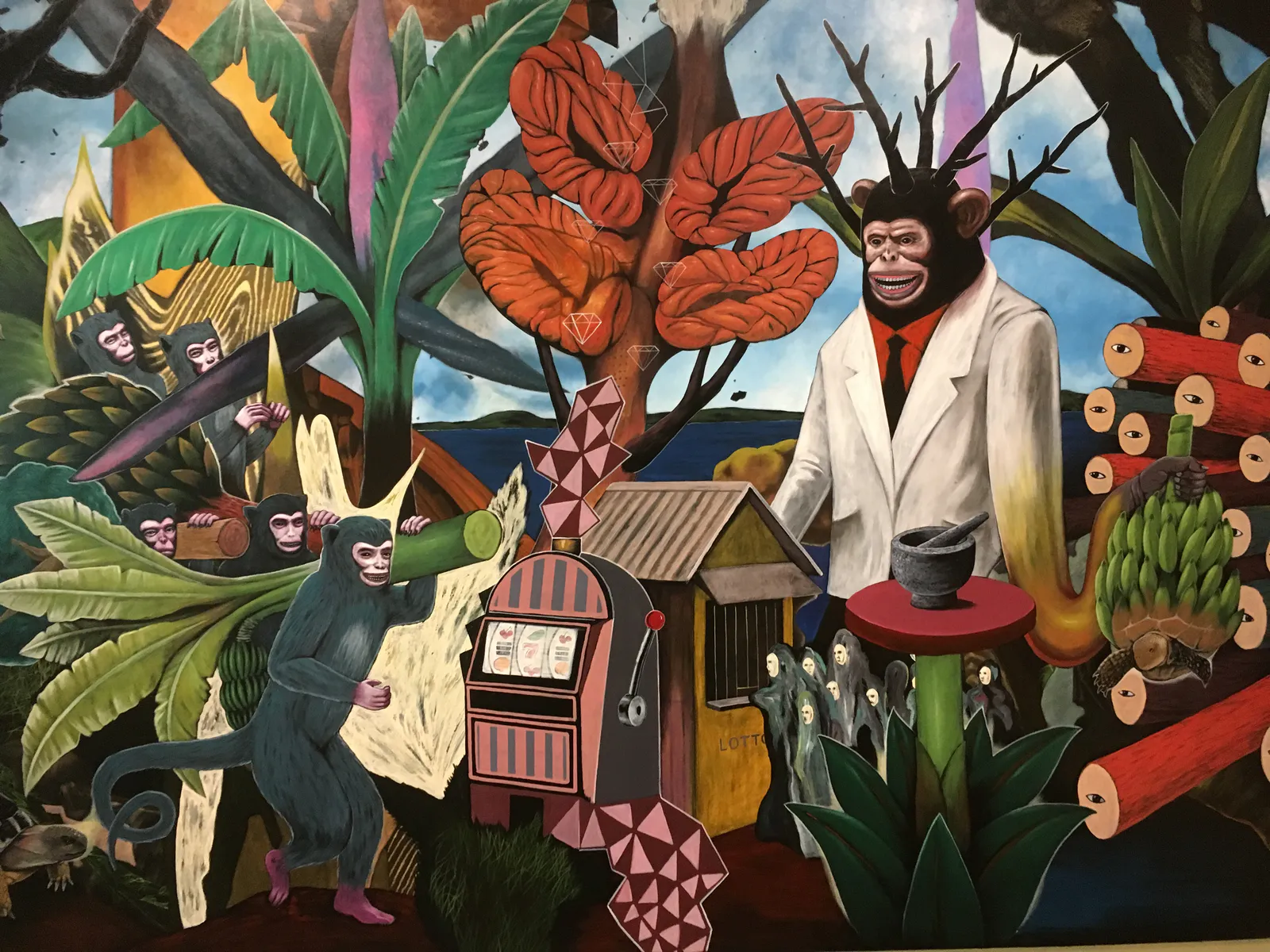
Instant Gratification
Rodel Tapaya
This work (2018) reinterprets the Filipino fable of The Monkey and the Turtle, placing its lesson within a crowded jungle of gambling stalls and restless figures. Monkeys embody the tale’s impatience and hunger for quick gain, while a small turtle-the steady effort outlasts reckless desire. Log piles, patterned trunks, and theatrical foliage frame a world driven by instant gratification and easy profit. Tapaya adapts indigenous storytelling to expose modern cycles of greed.
“When the path is beautiful, do not ask where it leads.” — Zen proverb
Welcome to my travel photography!
“When the path is beautiful, do not ask where it leads.” — Zen proverb
Welcome to my travel photography!
For as long as I can remember, my path has been one of discovery—seeking beauty, timelessness, and connection in every corner of the world. It has also been a journey of deep learning and understanding. I’ve been an avid traveler (or perhaps a travel addict?) for most of my life. My love for travel began long before I ever left home: as a child, I drew a fantasy map of my grandparents’ apartment and “traveled” through it with my cousin Sonya, imagining adventures in every corner. Nearly 90 countries and countless moments of awe later, I’m excited to share this journey with you.
Thanks to the tireless and ingenious programming of Diagilev, we’re now able to present about fifteen percent of the images I’ve accumulated over the years. More will be released in small batches depending on your interest. While the first release leans toward museum photography, later ones will include more nature, architecture, culture, and general travel experiences. If you’d like to receive email notifications about new releases, feel free to reach out—no commercial use, ever.
Throughout my travels, I’ve been drawn to two intertwined kinds of discovery. One is intellectual: learning why the world is the way it is. History became my guide, shaping my perspective and filling my camera roll with museums and old buildings. To me, history is not the past—it is the key to understanding the present and how the world became what it is. The other is emotional: seeking moments of elevation—spirituality, beauty, harmony—often found in nature, monasteries, and ancient sacred spaces. Together, these impulses shape my photography. It invites you to learn, admire, and soar—to rise above the mundane and see the world through a lens of curiosity and wonder.
Much of my later travel became possible thanks to my job with Delta Air Lines, but the wanderlust began years earlier. By the time I joined the industry, I had already visited over 35 countries and lived in several—largely thanks to a backpacking journey around the world with Luis León, whose face appears in many early photos. I grew up in Ufa in the USSR, and since leaving it I have lived, studied, and worked in Latvia, the United States, France, South Korea, Canada, Spain, Italy, Brazil, Japan, and Colombia.
A life of near-constant movement may seem a little crazy, but it has deepened my understanding of the world and produced the photography you are about to see. Over the years, my style has evolved—more intentional, more refined—yet its core remains the same: a search for understanding, timeless beauty, and a connection to those who walked this earth long before us.
I hope these photos stir something in your soul, just as they did in mine. I’d love to hear from you—whether reactions, suggestions, corrections, or a request to be added to the email list for new releases (no commercial use, I promise). You can learn more about my travels here, and my academic life here.
Enjoy our shared journey!