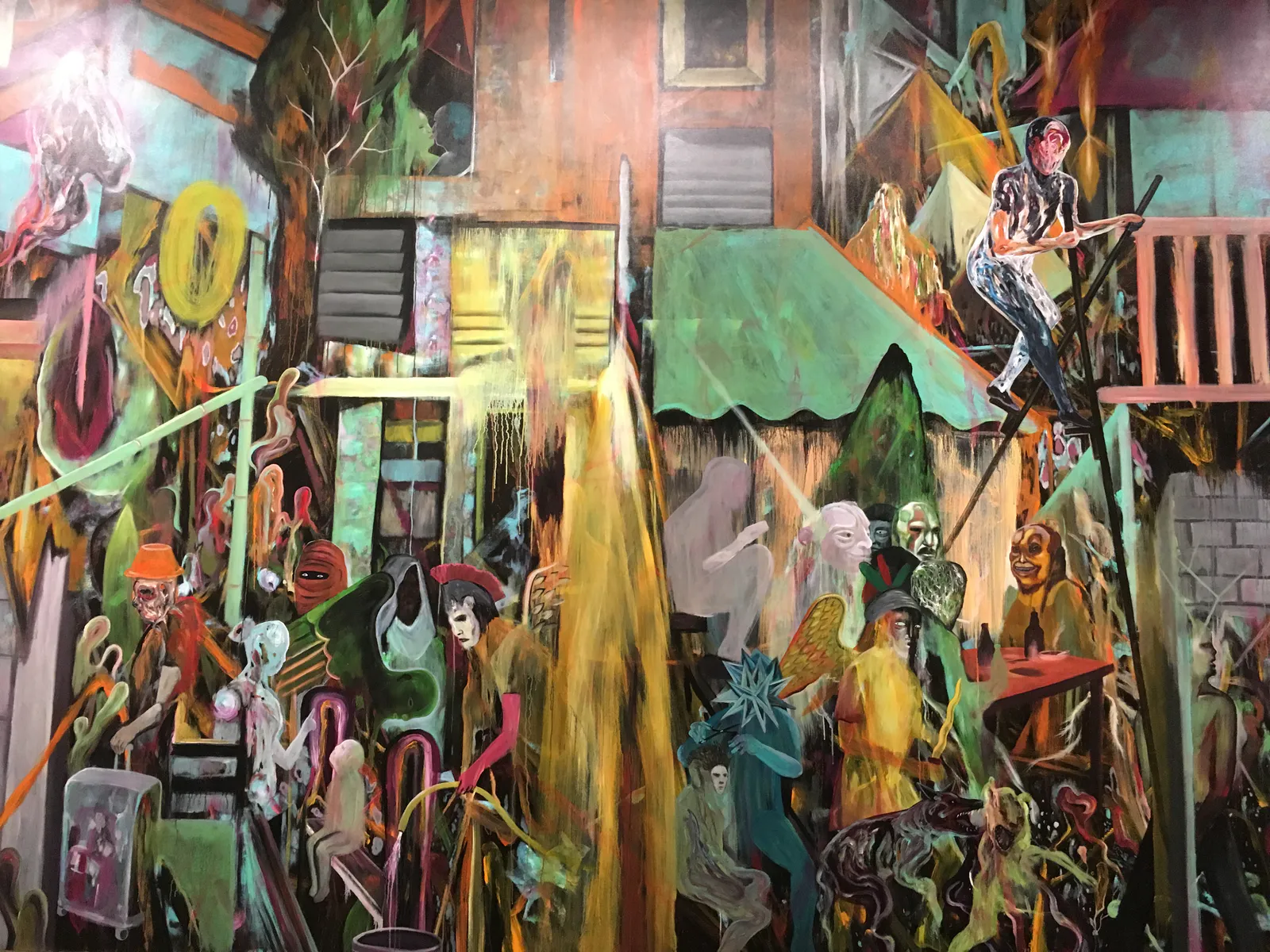
The Comedy, Parody, and Tragedy
Rodel Tapaya
This 2018 painting layers crowded shanties, billboards, and tangled walkways with mythic creatures from Philippine folklore. Human figures mingle with spirits and masked characters, blurring everyday life with the supernatural. Bright colors and abrupt shifts in scale evoke noise, congestion, and spectacle. Tapaya unfolds contemporary urban experience as a chaotic folk tale, where comedy, parody, and tragedy coexist in a single scene.
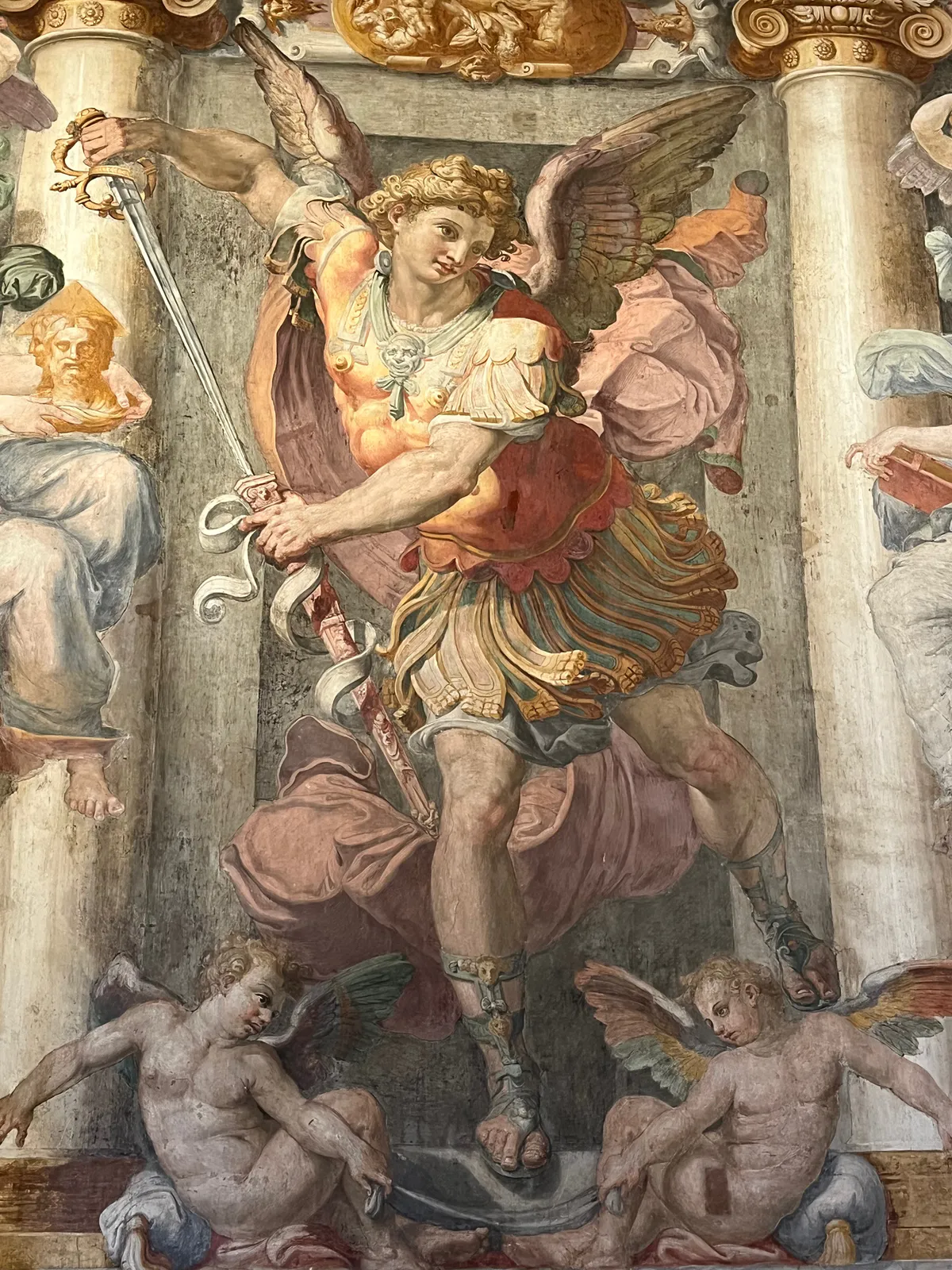
Saint Michael the Archangel
Pellegrino Tibaldi
This fresco (1545–46) in the Sala Paolina at Castel Sant'Angelo depicts the Archangel Michael sheathing his sword, symbolizing the end of the plague in 590. His muscular form and gilded armor convey divine justice and Roman salvation, highlighting the spiritual and civic authority of angelic intervention.
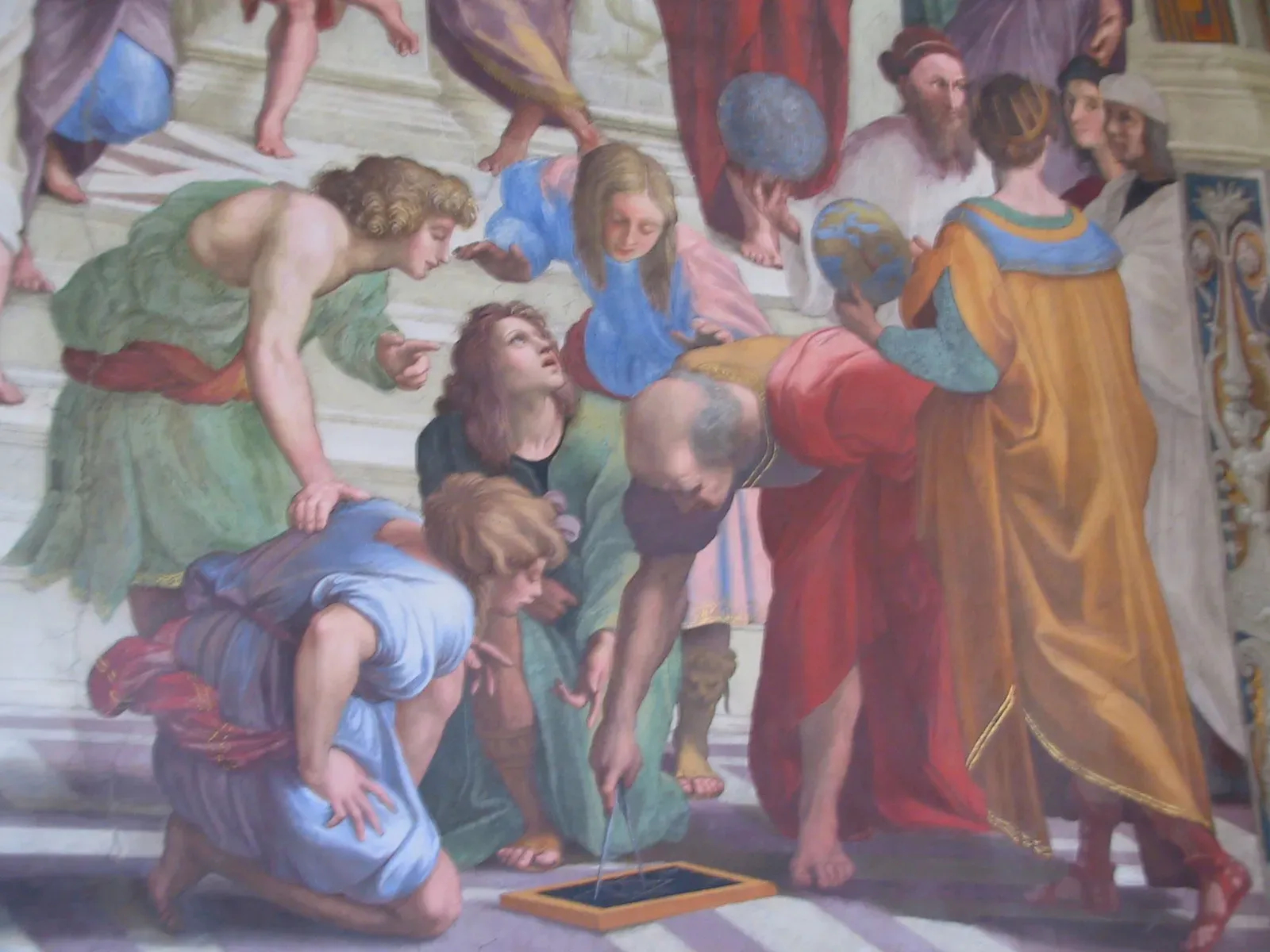
Euclid Teaching Geometry
Rapahel
In this vibrant lower-right scene from The School of Athens (1509–1511), Raphael presents Euclid demonstrating geometric principles with a compass. Painted in Rome during the High Renaissance, this detail celebrates empirical learning as foundational to human knowledge. The intense focus of his young onlookers reflects the Renaissance ideal of rediscovering ancient scientific wisdom through observation and reason.
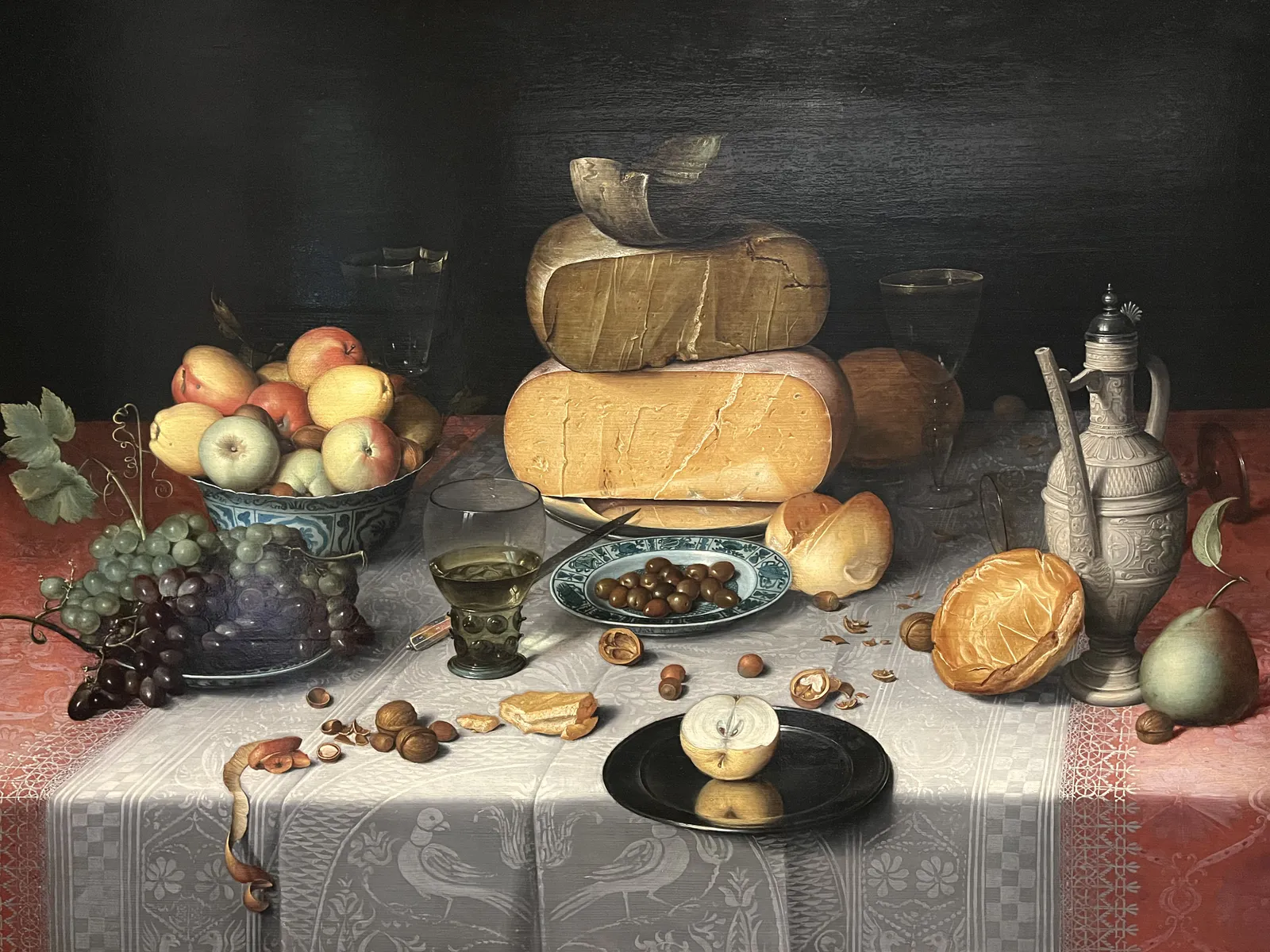
Still Life with Cheese
Floris Claesz van Dijck
On a damask-draped table (c.1615) lie fruit, bread, and three cheeses, carefully grouped by type. Floris van Dijck’s mastery of illusion is evident in the pewter plate jutting over the edge, as if within reach. A pioneer of Haarlem still-life painting, he helped establish the Dutch Golden Age tradition of rendering everyday abundance with startling realism.
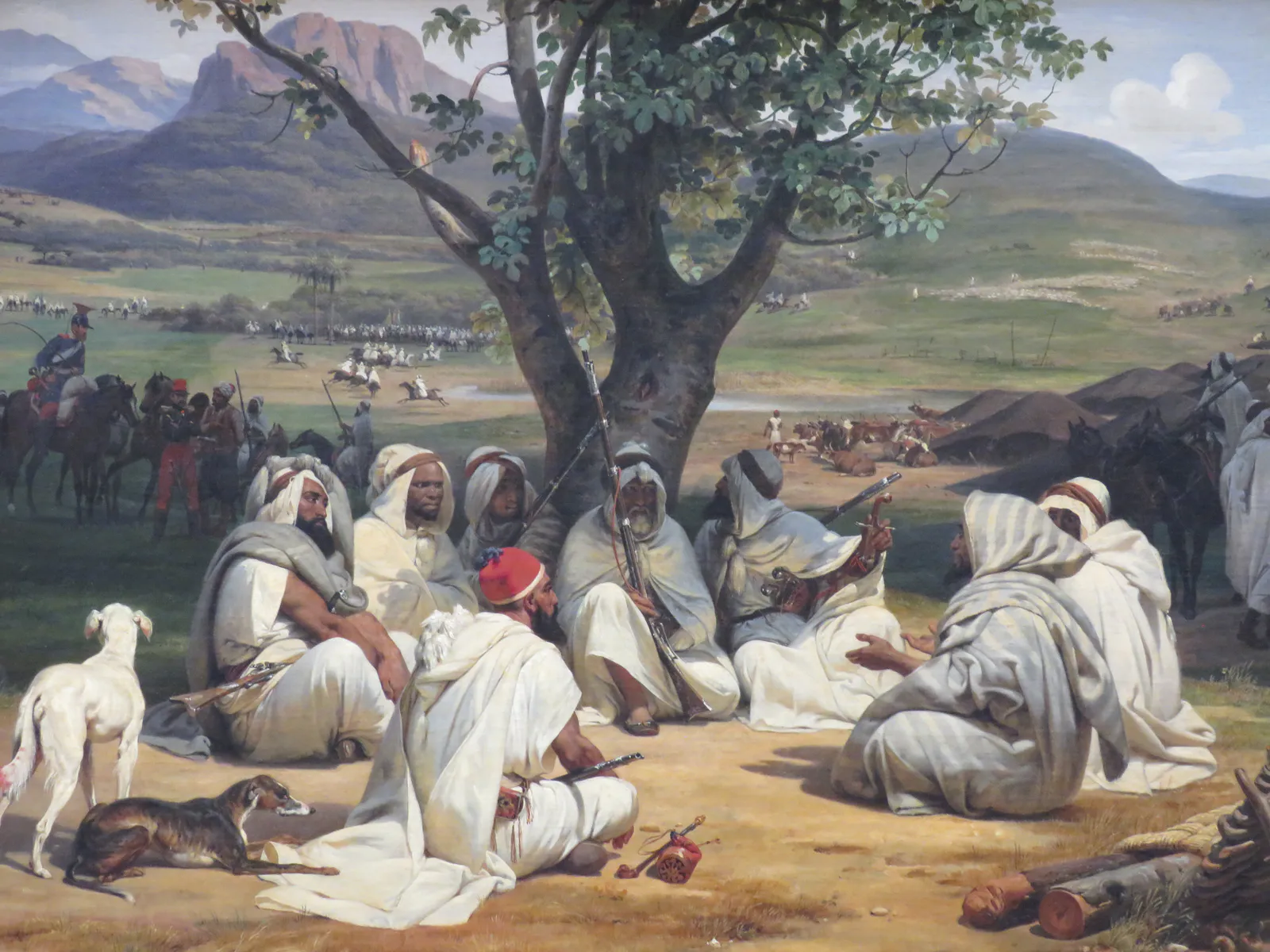
Arab Chieftains in Council
Horace Vernet
This 1834 work depicts Arab chieftains in council, likely discussing tribal matters or alliances. Vernet, a French artist known for battle scenes and Orientalist themes, illustrates the 19th-c. European interest in the Orient. The painting reflects the complex interplay of art, culture, and imperialism of the era.
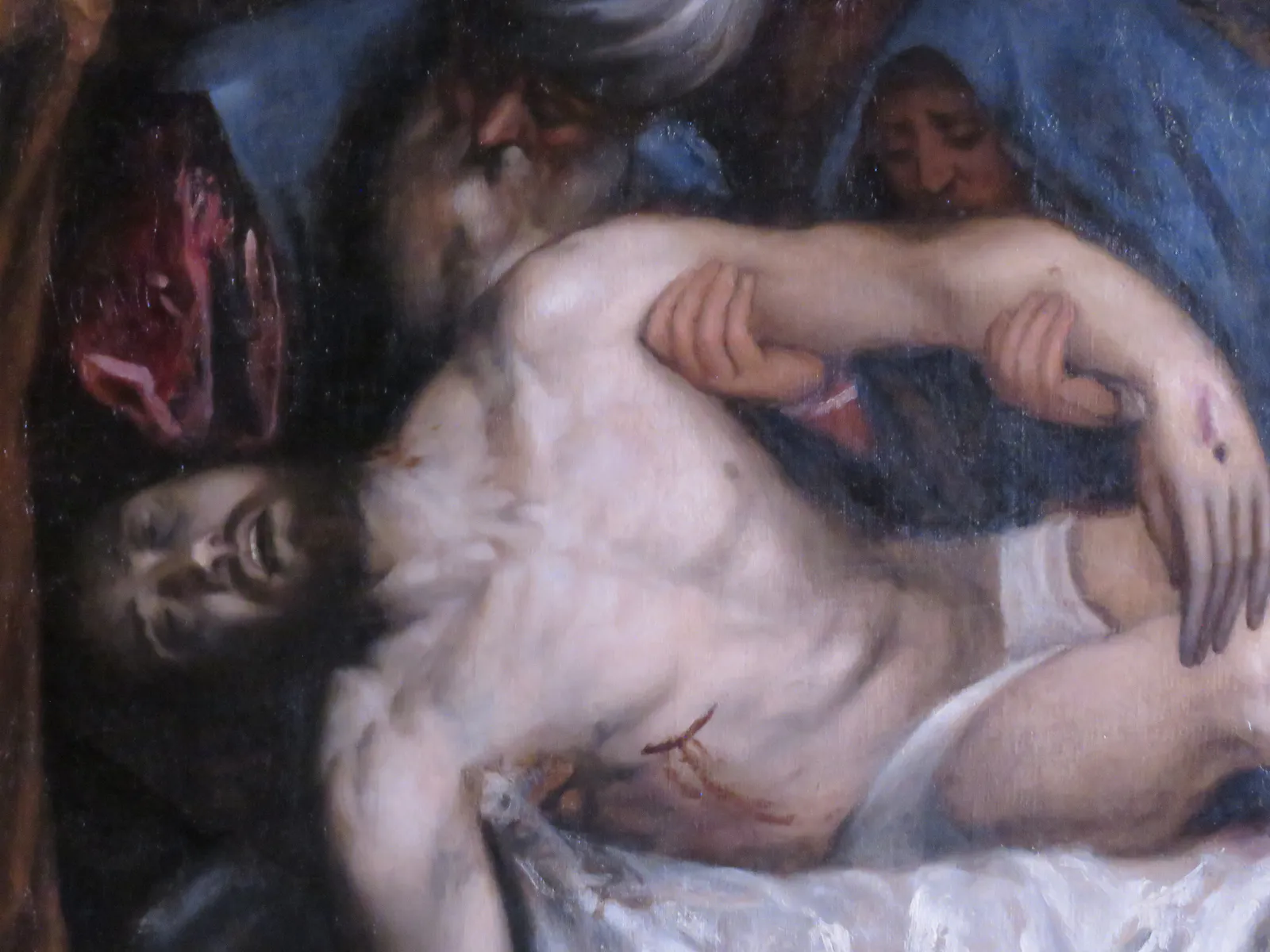
The Entombment of Christ (detail)
Titian and Palma the Younger
This fragment (1618) reveals Christ’s lifeless body marked by crucifixion wounds, cradled with reverence by mourning figures. The interplay of flesh, fabric, and sorrow exemplifies Titian’s emotive realism, while Palma the Younger completes the drama with expressive gestures—honoring human grief and divine sacrifice in one timeless moment.
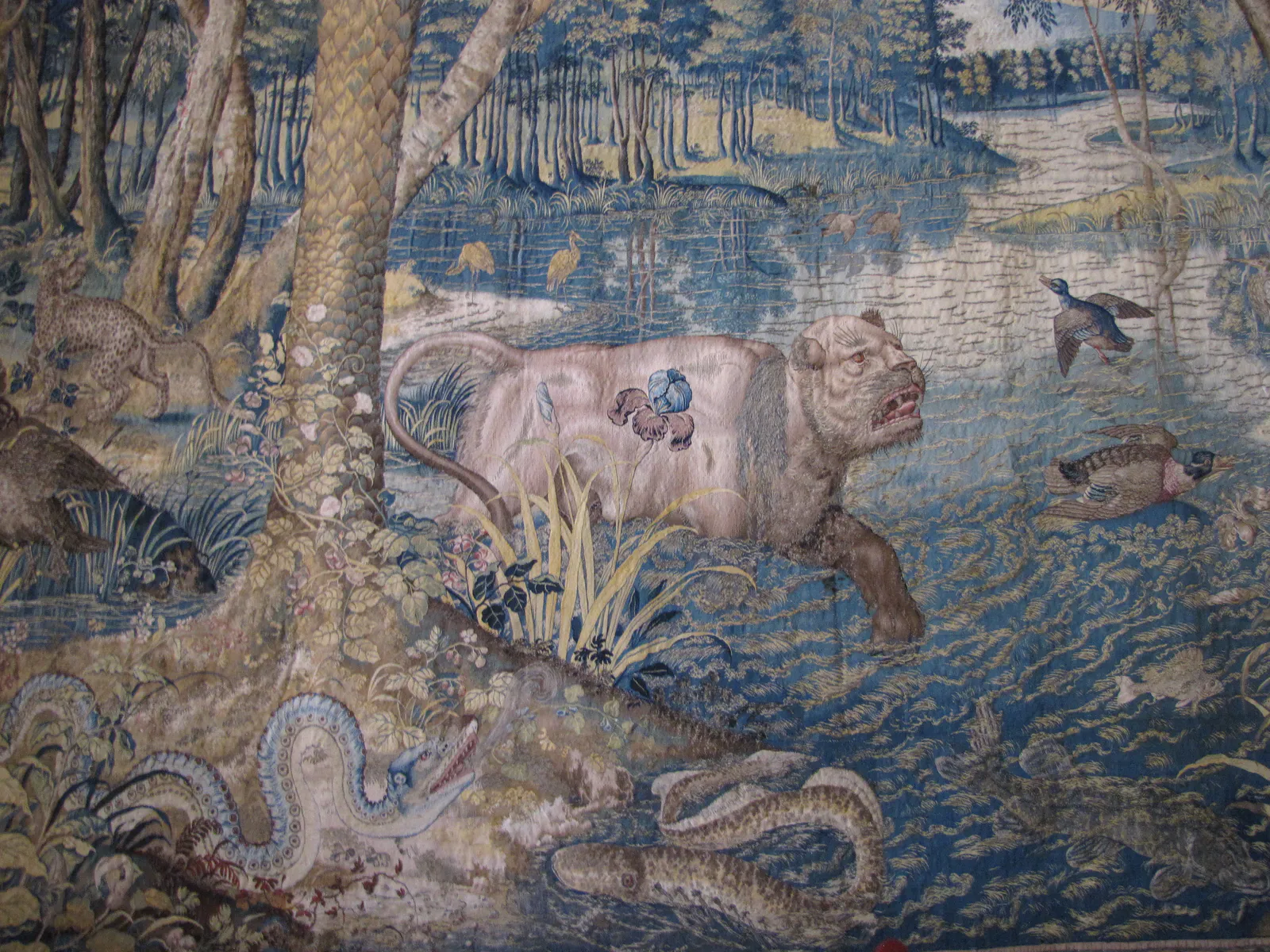
Tapestry of Fantastical Beasts in a River
Michael Coxcie
Woven in Brussels (c.1565) in a Flemish workshop according to Coxcie's design, this tapestry depicts hybrid beasts and serpents in a dense river landscape reflecting Renaissance fascination with nature’s wildness and moral allegory, symbolizing sin and chaos before divine order.
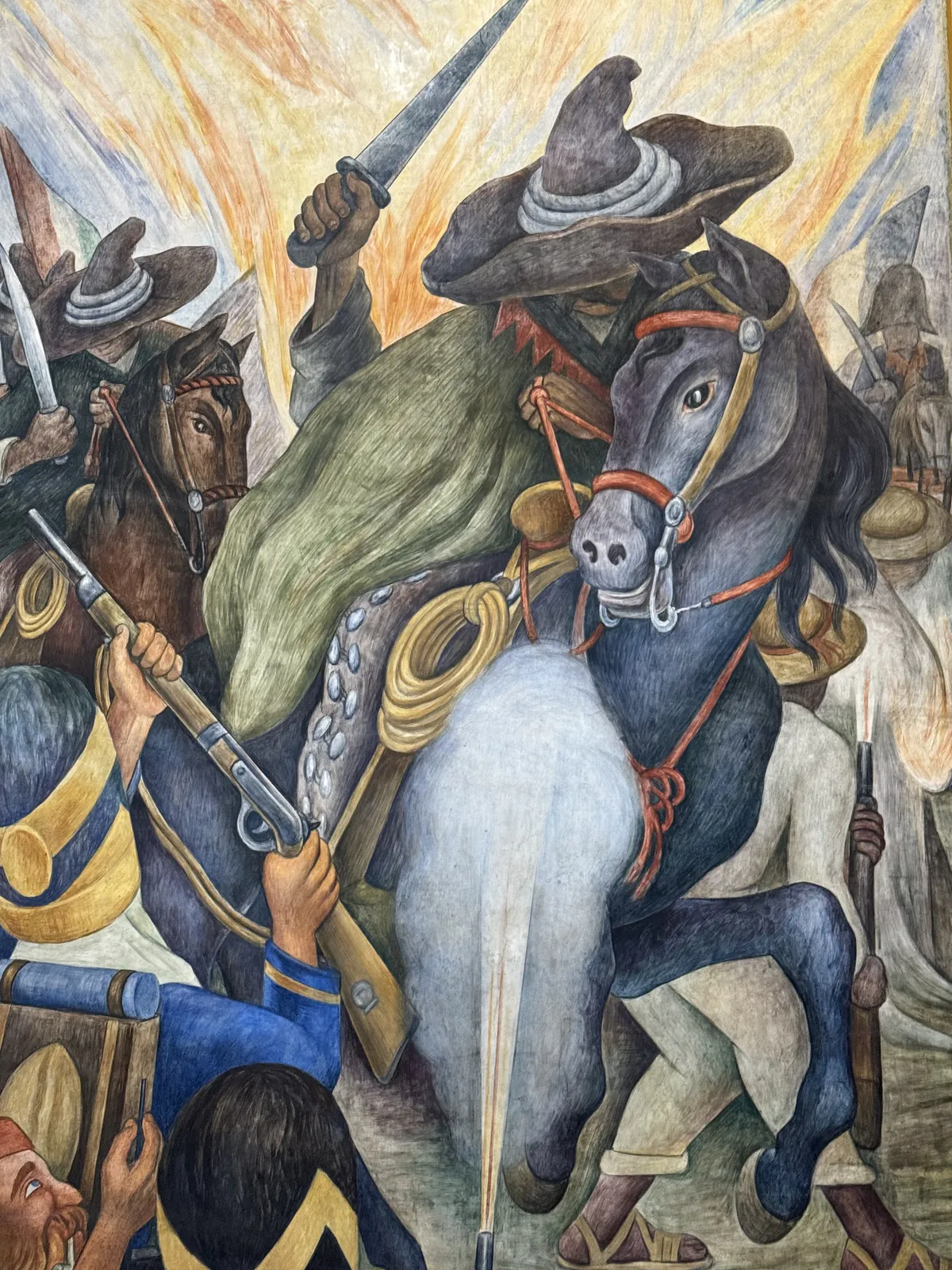
The Legend of Agustín Lorenzo (detail)
Diego Rivera
This 1936 fresco dramatizes the legendary outlaw Agustín Lorenzo as a symbol of resistance. Armed revolutionaries clash with government forces, their horses rearing amid smoke and flames. Rivera fuses myth and history, casting Lorenzo as a Mexican Robin Hood whose defiant struggle against injustice became folklore in the national imagination.
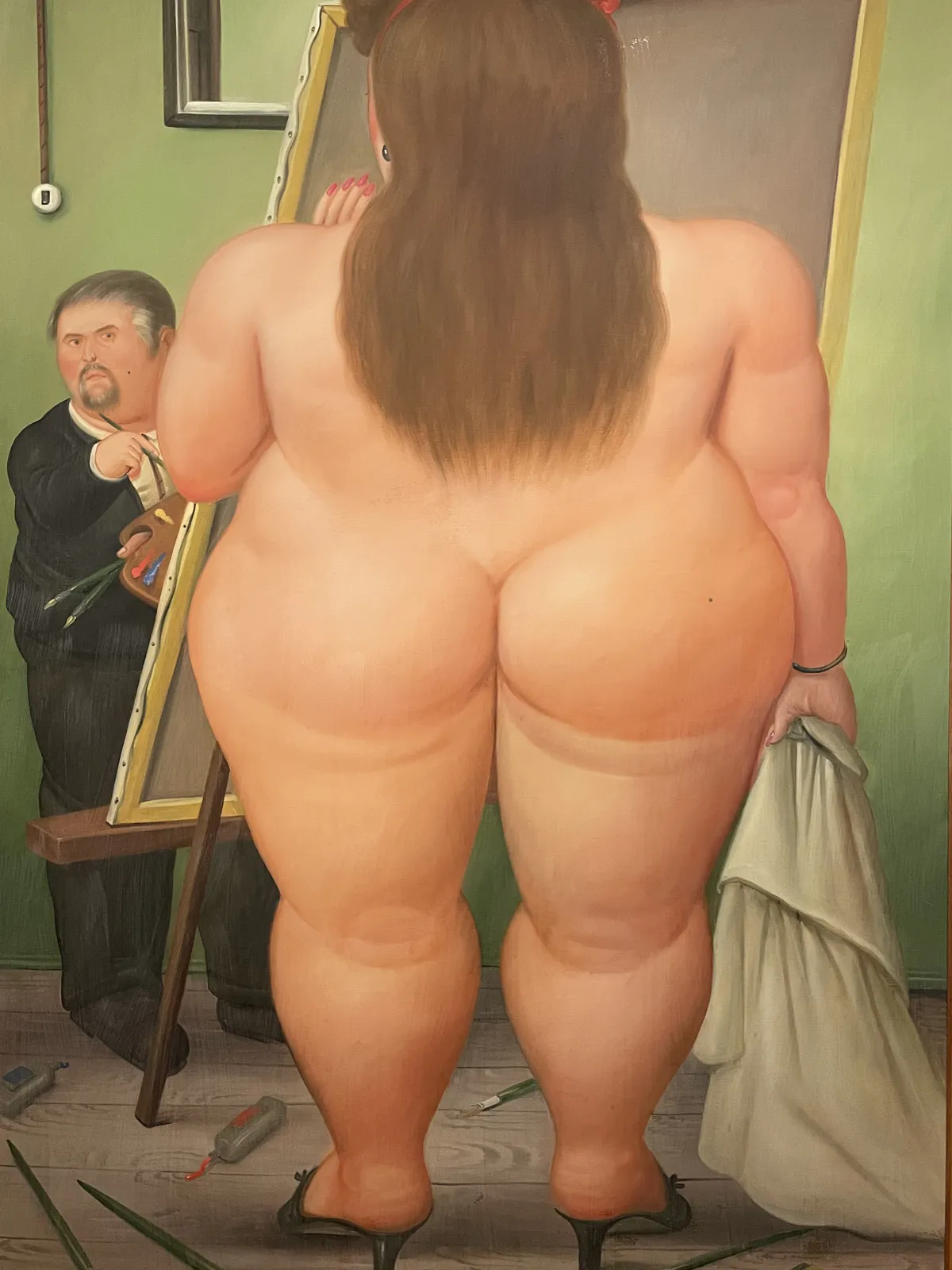
The Painter and His Model
Fernando Botero
Fernando Botero's The Painter and His Model (1984) humorously subverts the traditional artist-muse dynamic. The painting features a voluptuous nude model dominating the canvas, while the artist, dwarfed behind his easel, peers out with a palette in hand. This playful inversion highlights themes of power, beauty, and authorship, celebrating physical abundance with irony and affection. Botero's work invites reflection on the nature of artistic creation and the roles within it.
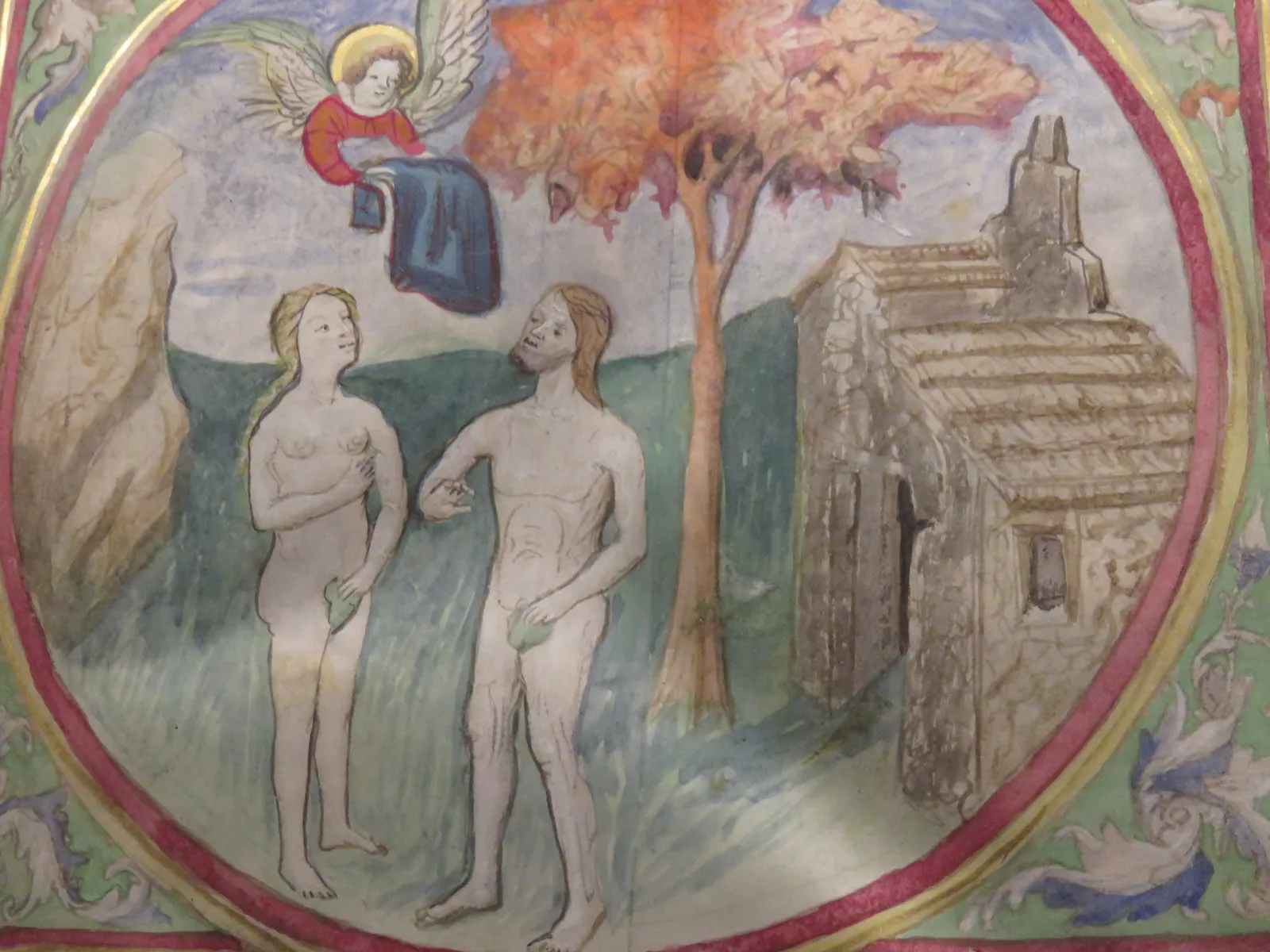
Expulsion from Eden
Maître des Médaillons
This French manuscript miniature (early 15th c.) shows Adam and Eve after the Fall, modestly covering themselves with leaves. An angel descends with a robe, while the Tree of Knowledge burns red above them. To the right stands a stone building, symbolizing exile from Paradise. The vivid colors and fine detail reflect late medieval devotional art.
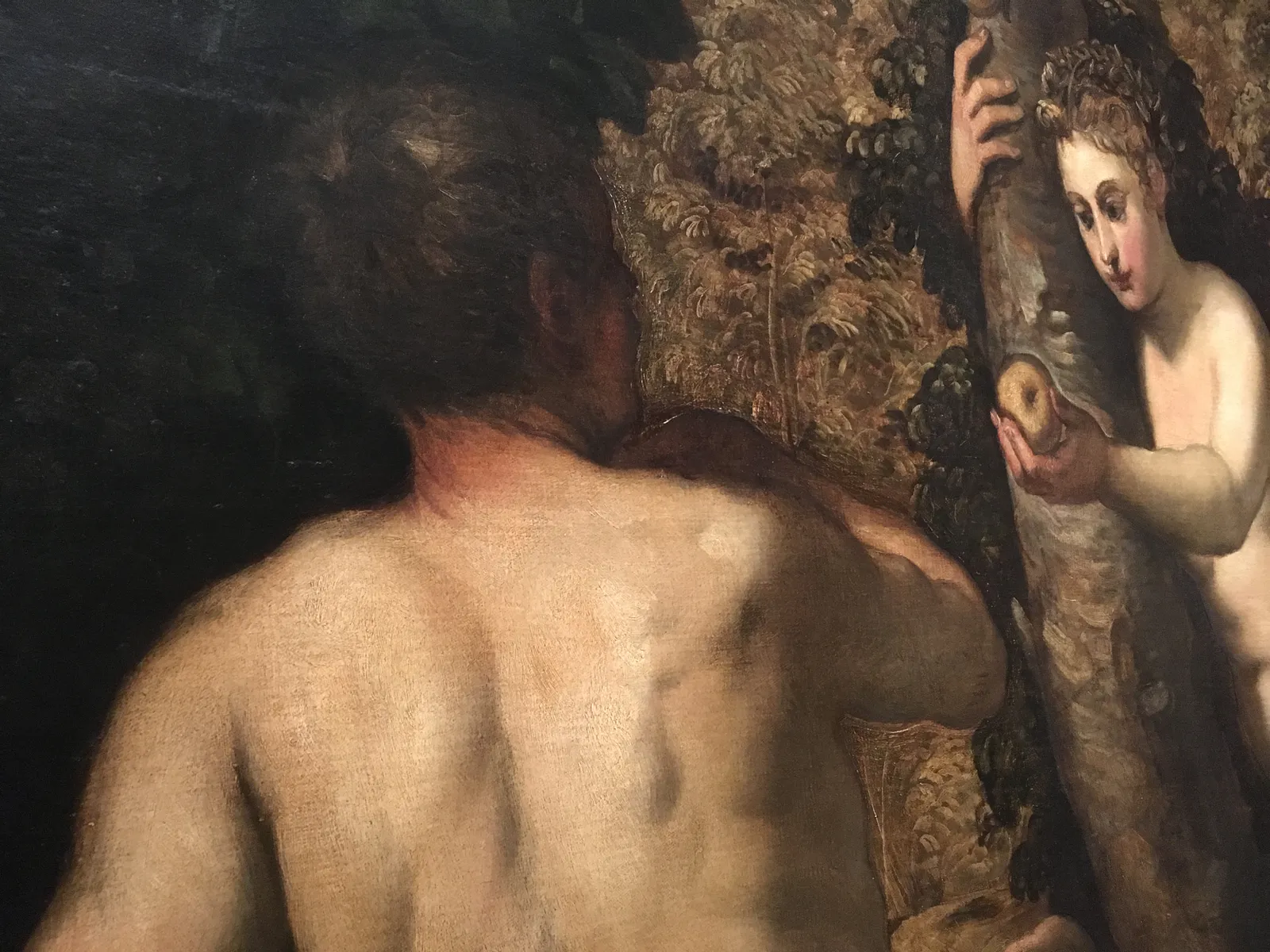
Adam and Eve
Tintoretto
Tintoretto’s painting (1550–53) depicts the biblical scene of temptation in the Garden of Eden. Eve offers the forbidden fruit to Adam, with their expulsion illustrated in the background. Influenced by Michelangelo, the composition emphasizes the nude figures and employs oblique lines to structure the landscape. This work reflects the Renaissance interest in human form and moral themes.
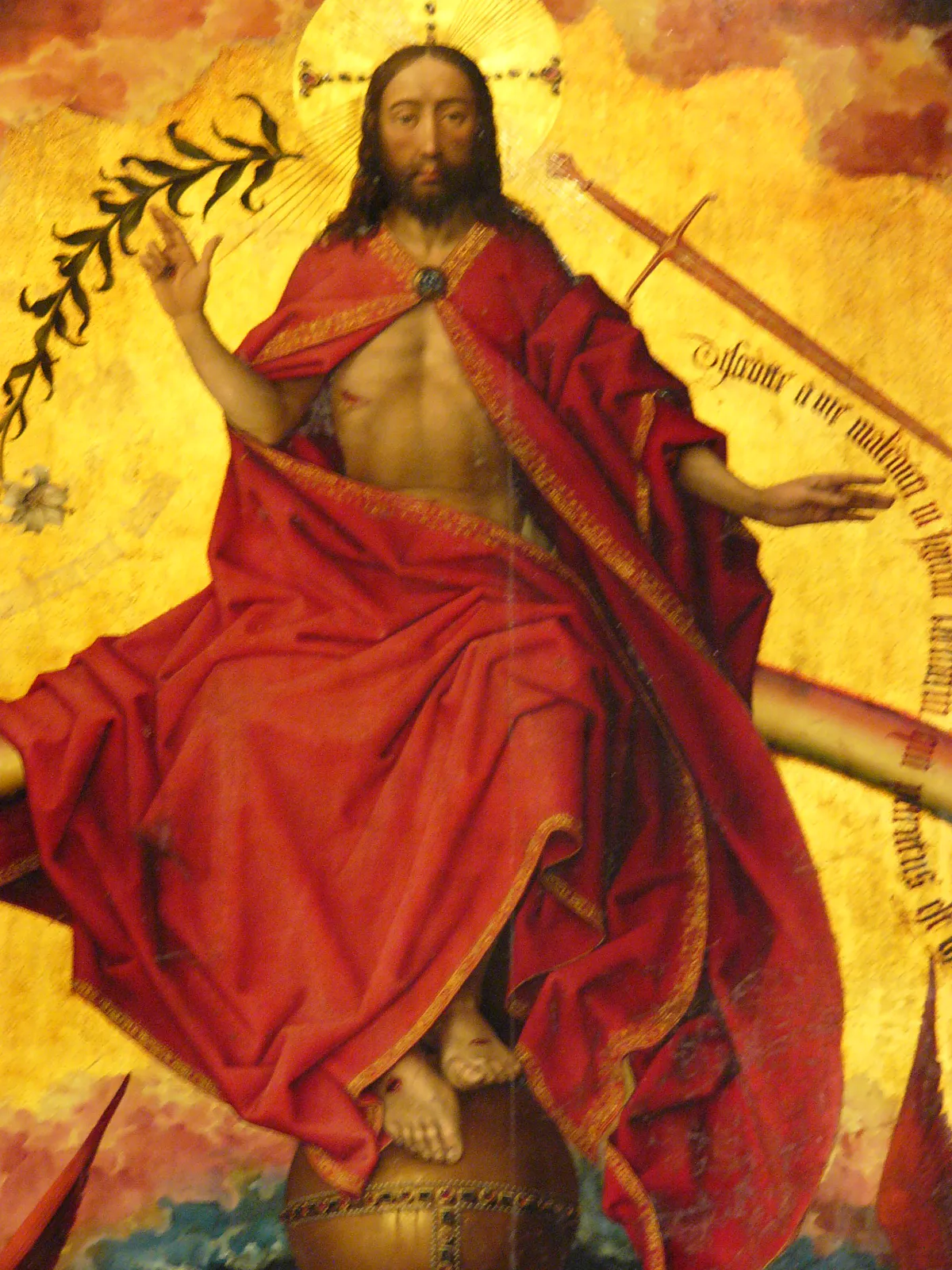
Christ the Judge
Rogier van der Weyden
At the summit of the Last Judgment Altarpiece (1445–50), Christ sits enthroned on a rainbow, resting his feet on a golden globe that symbolizes dominion over the world. He raises his right hand in blessing, while his left gestures toward judgment. The sword and lily flanking him signify justice and mercy, balancing wrath with compassion. Draped in vivid red, Christ embodies divine authority, anchoring the entire altarpiece in the promise of eternal judgment and salvation.
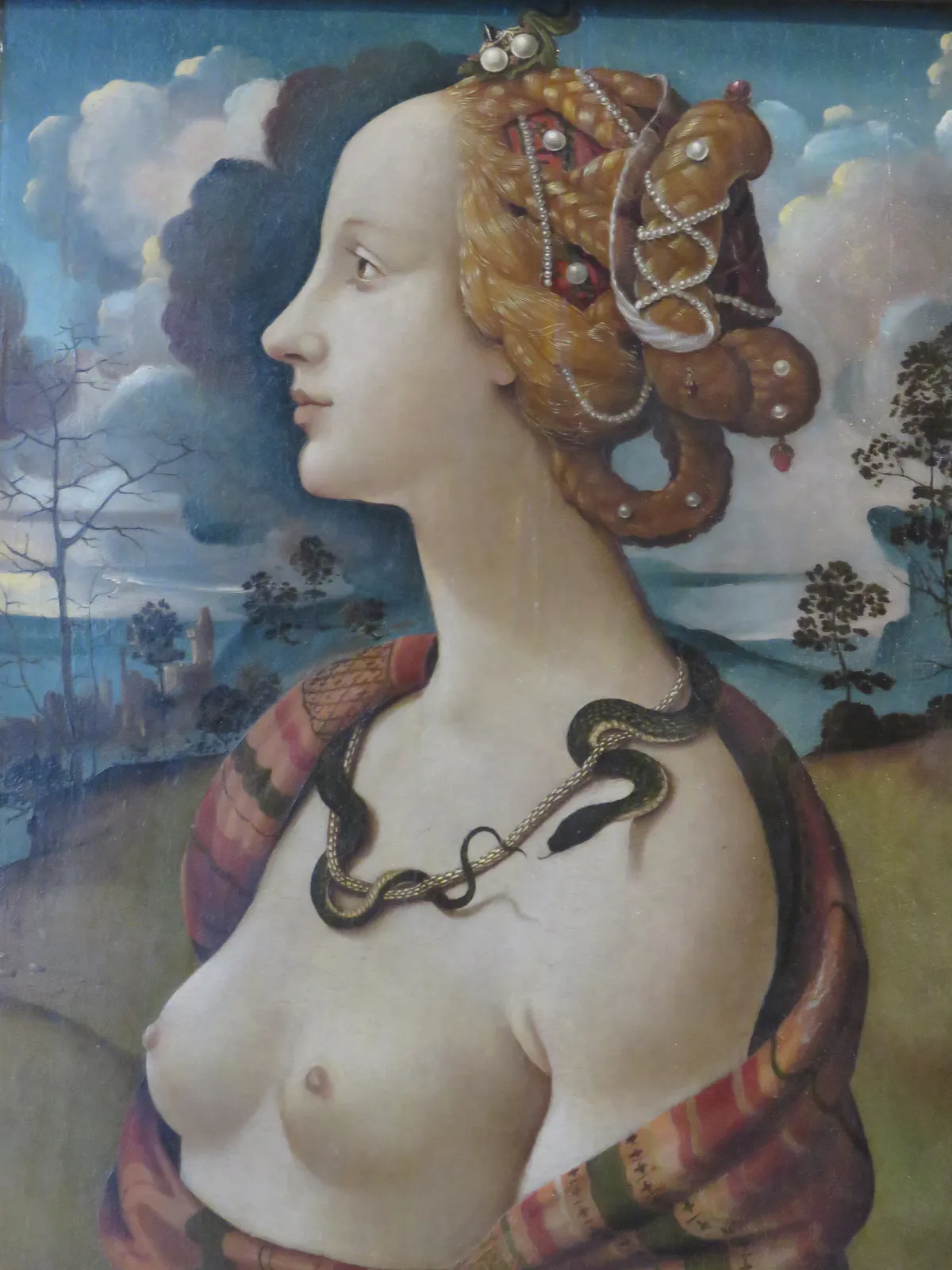
Simonetta Vespucci as Cleopatra
Piero di Cosimo
This painting (c. 1480) by di Cosimo depicts Simonetta Vespucci as Cleopatra, with an asp coiled around her neck. Created posthumously, it honors Vespucci’s beauty; she died in 1476 at 23. The profile view echoes medal portraits, while the snake may symbolize her death from tuberculosis. The serene landscape and sky enhance her ethereal presence, making this work a poignant tribute.
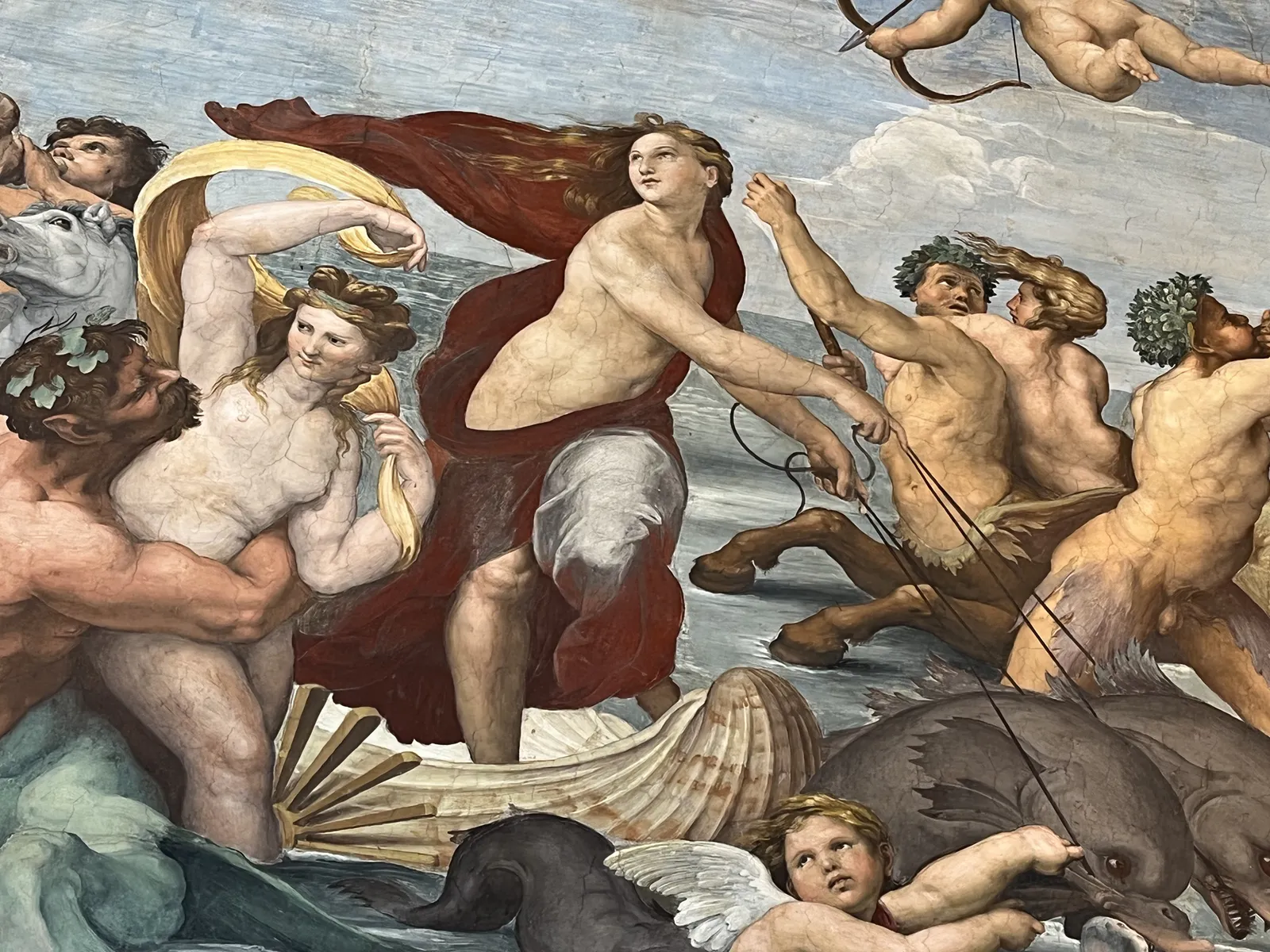
Triumph of Galatea (detail)
Raphael
Painted by Raphael’s workshop (1511–1512), this fragment depicts the sea nymph Galatea triumphantly riding a shell chariot, drawn by dolphins and surrounded by marine gods. Inspired by classical mythology, the scene celebrates ideal beauty, love, and movement, blending Renaissance harmony with dynamic mythological fantasy.
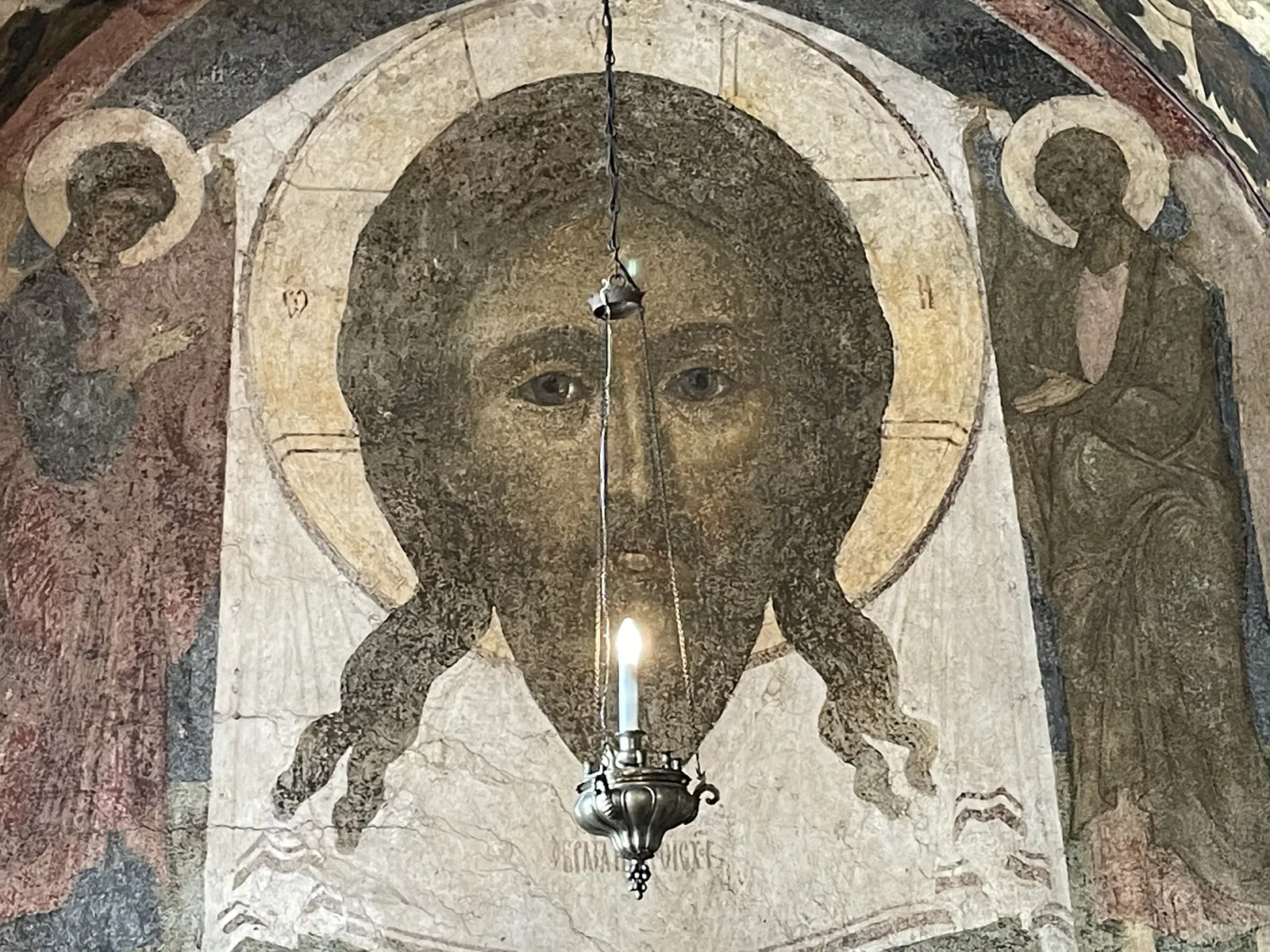
The Saviour Not Made by Hand
Simon Ushakov
This mid–late 17th-c. fresco depicts Spas Nerukotvorny (The Saviour Not Made by Hand), an image understood as a direct imprint of Christ’s face and a sign of his enduring presence. Ushakov follows Byzantine conventions yet introduces soft modeling and spatial depth drawn from Western art. The work reflects a moment when Moscow blended inherited Orthodox forms with new artistic influences to express religious renewal.
“When the path is beautiful, do not ask where it leads.” — Zen proverb
Welcome to my travel photography!
“When the path is beautiful, do not ask where it leads.” — Zen proverb
Welcome to my travel photography!
For as long as I can remember, my path has been one of discovery—seeking beauty, timelessness, and connection in every corner of the world. It has also been a journey of deep learning and understanding. I’ve been an avid traveler (or perhaps a travel addict?) for most of my life. My love for travel began long before I ever left home: as a child, I drew a fantasy map of my grandparents’ apartment and “traveled” through it with my cousin Sonya, imagining adventures in every corner. Nearly 90 countries and countless moments of awe later, I’m excited to share this journey with you.
Thanks to the tireless and ingenious programming of Diagilev, we’re now able to present about fifteen percent of the images I’ve accumulated over the years. More will be released in small batches depending on your interest. While the first release leans toward museum photography, later ones will include more nature, architecture, culture, and general travel experiences. If you’d like to receive email notifications about new releases, feel free to reach out—no commercial use, ever.
Throughout my travels, I’ve been drawn to two intertwined kinds of discovery. One is intellectual: learning why the world is the way it is. History became my guide, shaping my perspective and filling my camera roll with museums and old buildings. To me, history is not the past—it is the key to understanding the present and how the world became what it is. The other is emotional: seeking moments of elevation—spirituality, beauty, harmony—often found in nature, monasteries, and ancient sacred spaces. Together, these impulses shape my photography. It invites you to learn, admire, and soar—to rise above the mundane and see the world through a lens of curiosity and wonder.
Much of my later travel became possible thanks to my job with Delta Air Lines, but the wanderlust began years earlier. By the time I joined the industry, I had already visited over 35 countries and lived in several—largely thanks to a backpacking journey around the world with Luis León, whose face appears in many early photos. I grew up in Ufa in the USSR, and since leaving it I have lived, studied, and worked in Latvia, the United States, France, South Korea, Canada, Spain, Italy, Brazil, Japan, and Colombia.
A life of near-constant movement may seem a little crazy, but it has deepened my understanding of the world and produced the photography you are about to see. Over the years, my style has evolved—more intentional, more refined—yet its core remains the same: a search for understanding, timeless beauty, and a connection to those who walked this earth long before us.
I hope these photos stir something in your soul, just as they did in mine. I’d love to hear from you—whether reactions, suggestions, corrections, or a request to be added to the email list for new releases (no commercial use, I promise). You can learn more about my travels here, and my academic life here.
Enjoy our shared journey!