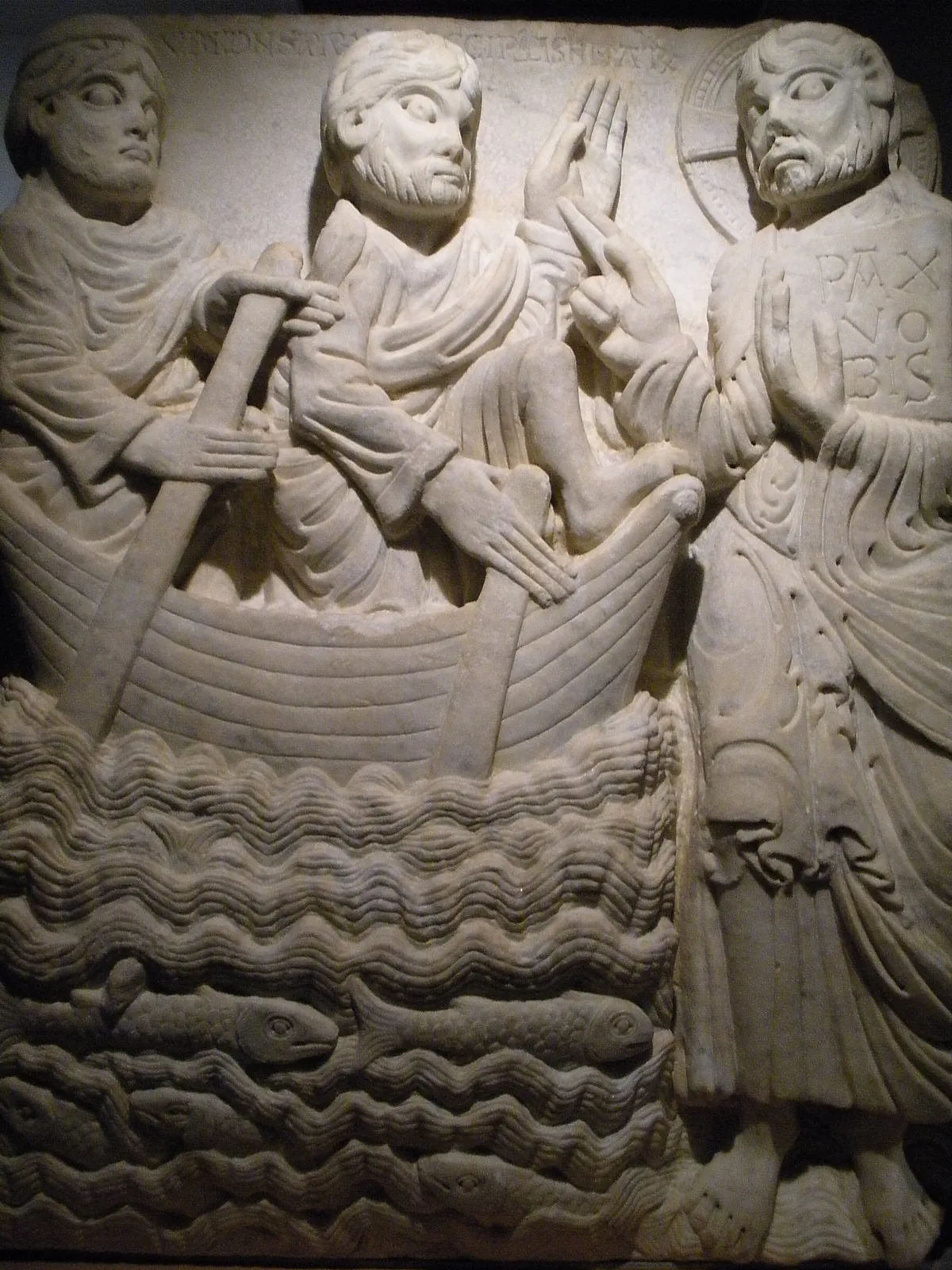
The Appearance of Christ to the Disciples
Master of Cabestany
This 12th-c. Romanesque sculpture by the Master of Cabestany depicts Christ revealing himself to his disciples after the resurrection. The artist is known for figures with large heads, flat foreheads, long noses, and almond-shaped eyes. Likely from the monastery of Sant Pere de Rodes, the work exemplifies the Master of Cabestany’s influence across Southern Europe, from Tuscany to Navarre.
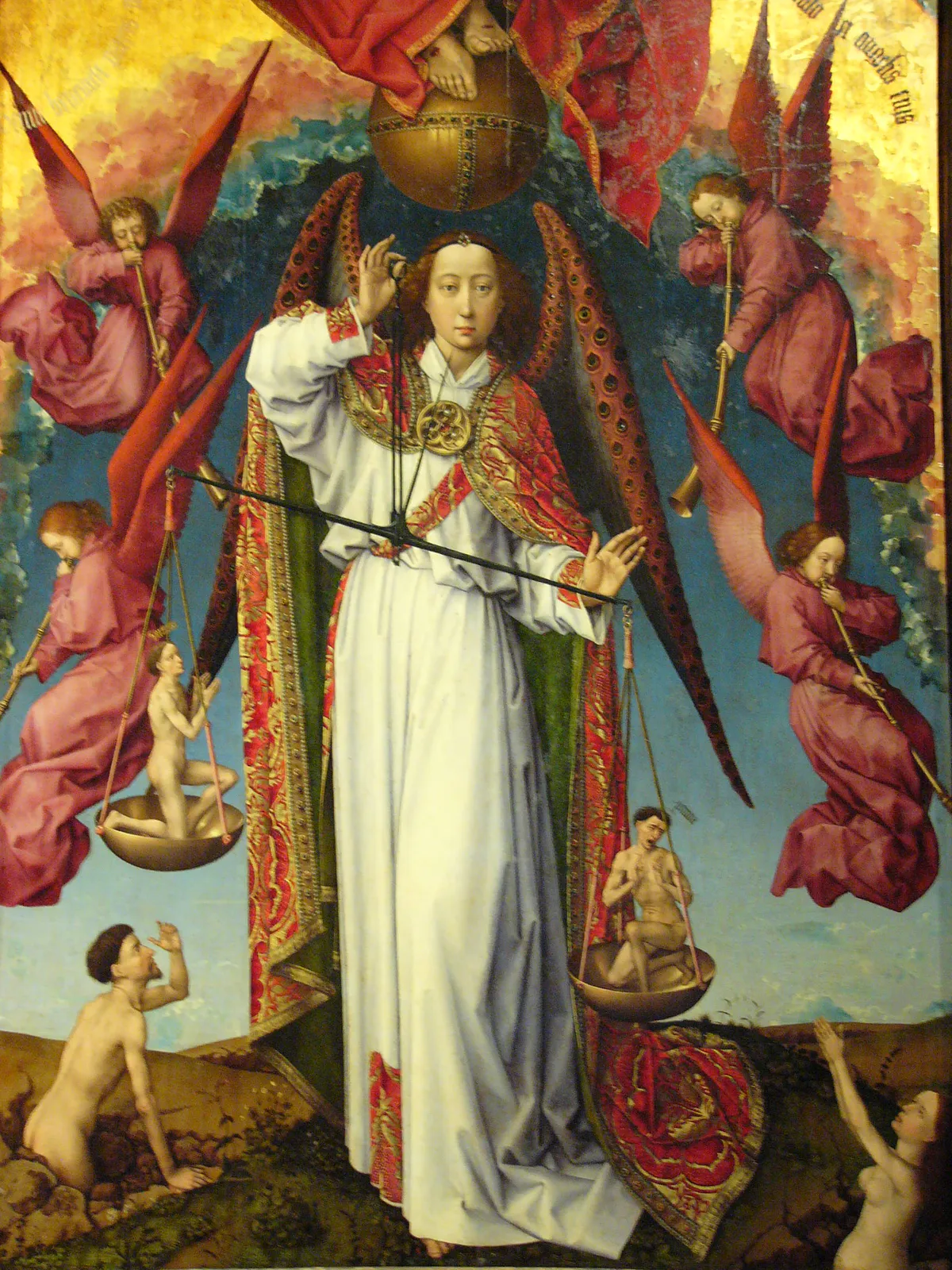
Archangel Michael Weighing Souls
Rogier van der Weyden
In this panel from the Last Judgment Altarpiece (1445–50), Archangel Michael dominates the scene, balancing souls in golden scales as Christ presides above. Trumpeting angels herald resurrection while the blessed and damned await their fate. Painted for Beaune’s Hôtel-Dieu, the work reminded patients that earthly suffering was framed within the ultimate hope of divine justice and salvation.
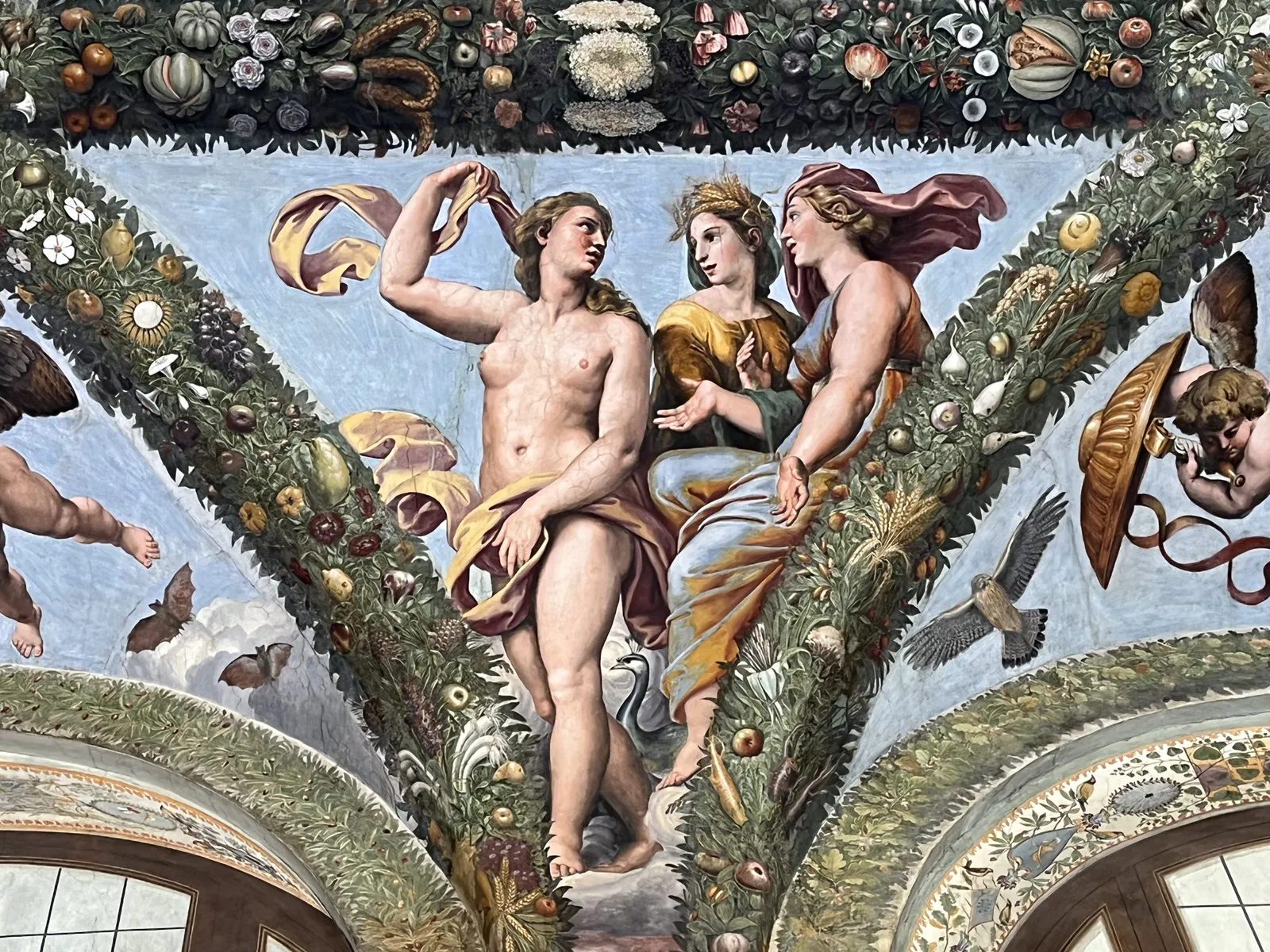
Venus Appeals to Ceres and Juno
Raphael, Giovanni da Udine
In this scene (1518), Raphael depicts Venus appealing to Ceres and Juno for vengeance on Psyche, but both goddesses refuse. The fresco illustrates the tension between divine power and mortal love. Da Udine’s elaborate botanical festoons frame the composition, enhancing its Renaissance richness.
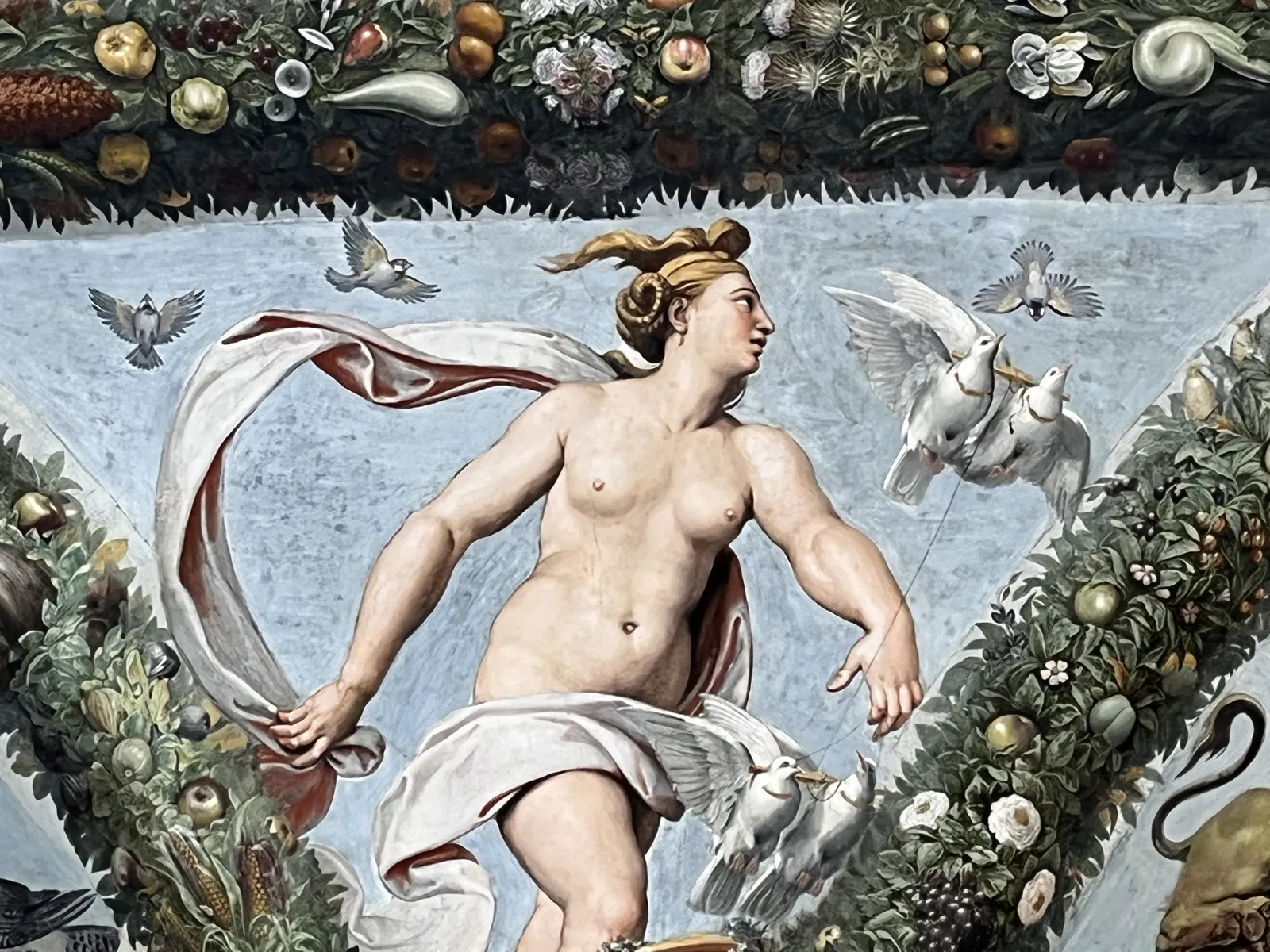
Venus and the Doves
Raphael
In this fresco (1518), Raphael presents Venus, goddess of love, gracefully accompanied by doves, her sacred birds. The flowing ribbon emphasizes her divine beauty and motion, while the doves allude to purity and erotic desire. The image echoes Venus’ central role in the myth of Cupid and Psyche, where love governs both divine and mortal fates.
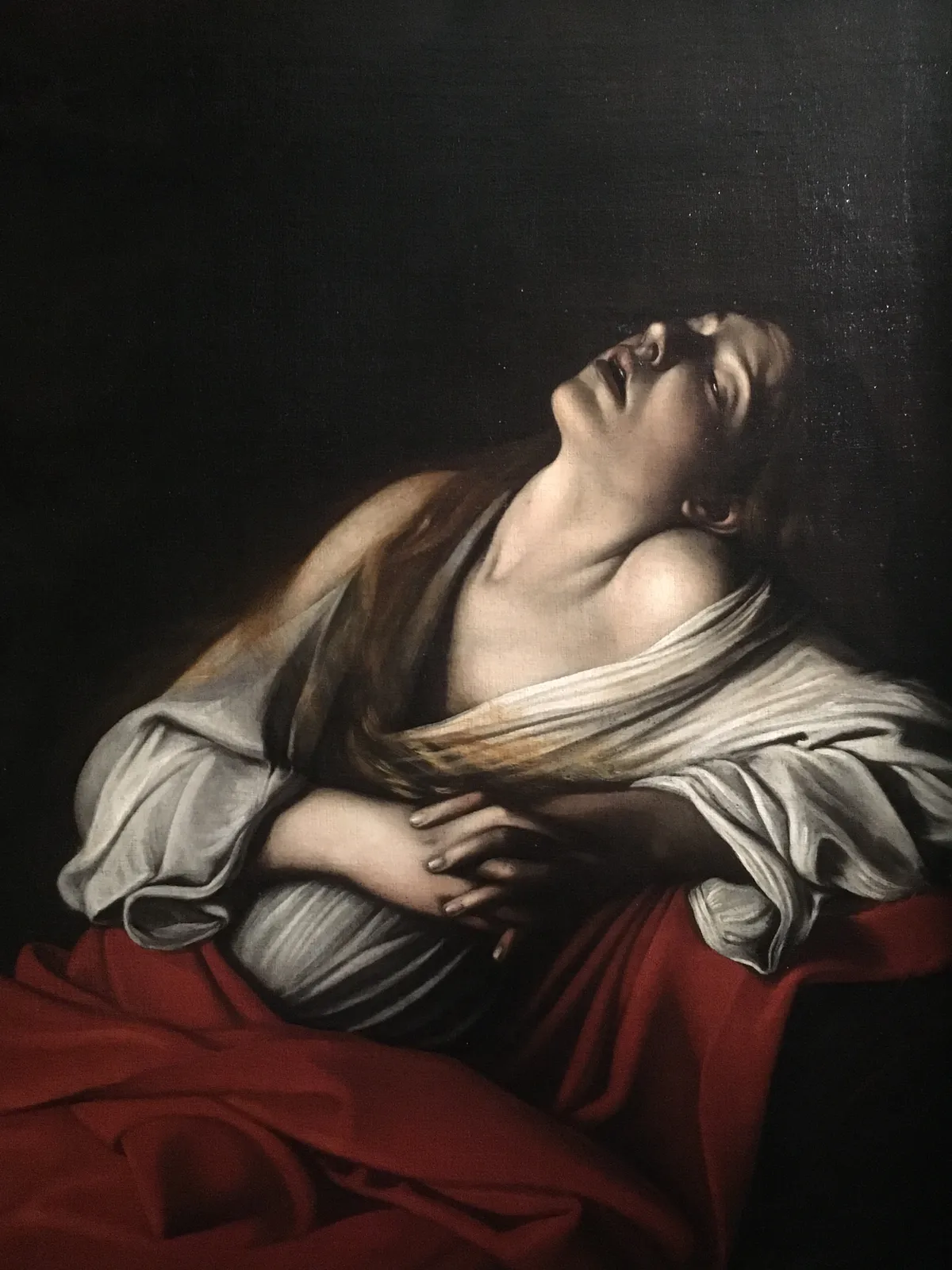
The Penitent Magdalene
Caravaggio
This painting (1594–95) shows Mary Magdalene seated in repentance, jewels cast aside at her feet. With downcast eyes and folded hands, she embodies both sensual beauty and spiritual transformation. Caravaggio merges naturalism with sacred symbolism, turning penitence into a deeply human, intimate moment of grace.
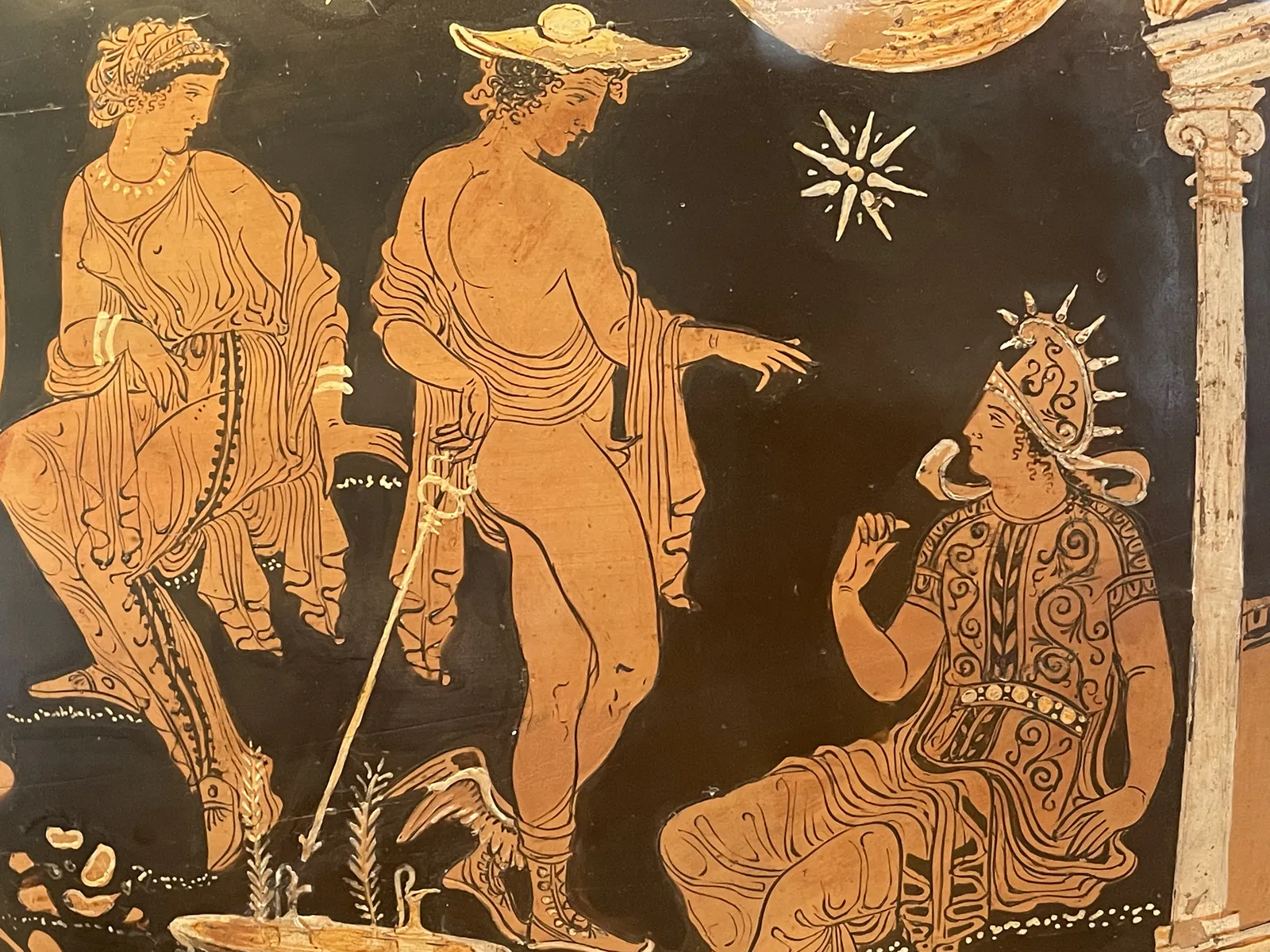
Orestes and Apollo at Delphi
Painter of the Birth of Dionysus
This Apulian red-figure volute krater (410–390 BC) depicts Apollo aiding Orestes at Delphi. After avenging Agamemnon by killing Clytemnestra, Orestes seeks refuge from the Furies. Apollo's protection symbolizes divine support for justice. This piece highlights the intersection of myth and morality in ancient Greek culture.
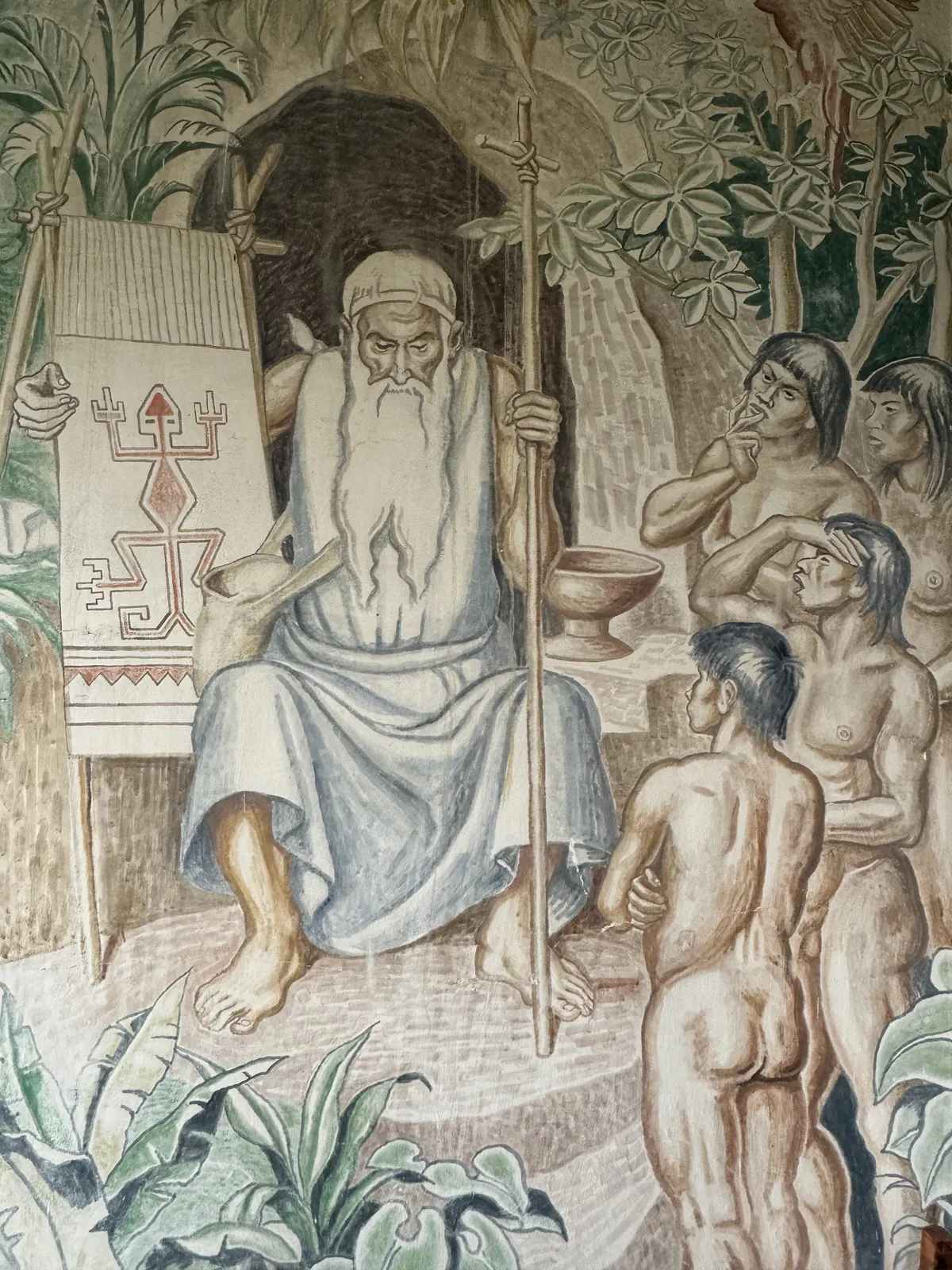
Bochica Teaching the Muisca
Luis Alberto Acuña
This 1960-70s mural depicts Bochica, the bearded sage and civilizing hero of Muisca mythology, imparting moral and spiritual lessons. Seated before young disciples, he holds symbols of power and knowledge, including a woven banner. A revered figure, Bochica was believed to have formed the Tequendama Falls and taught the Muisca how to live harmoniously.
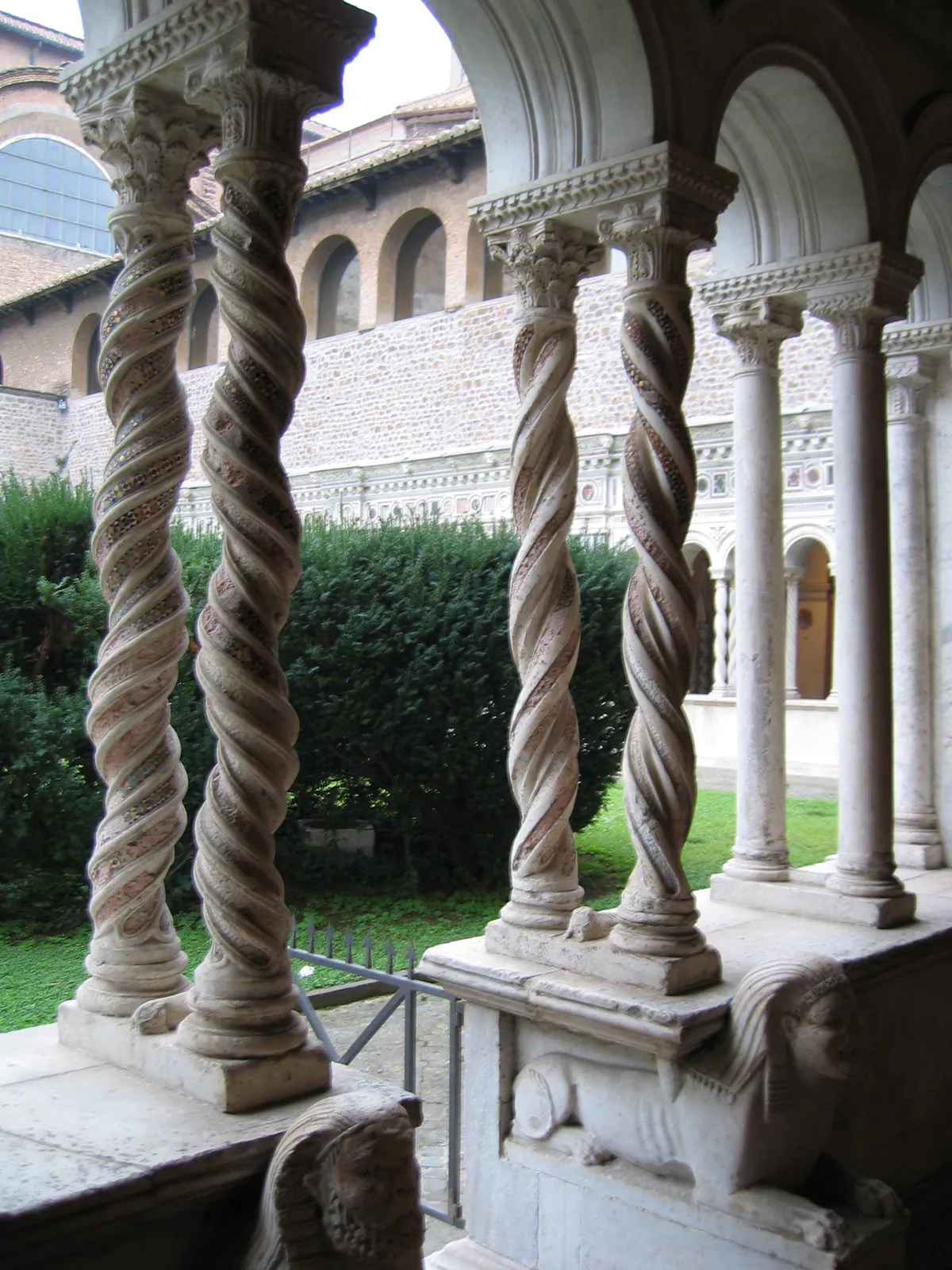
Cosmatesque Columns with Lions and Sphinxes
Vassalletto Workshop
These cloister columns (c.1215), with spiraled shafts and vivid mosaic inlays in the cosmatesque style—a Roman art blending colored marble, glass, and porphyry into geometric patterns—rest on sculpted lions and sphinxes. Crafted by the Vassalletto masters, they unite classical form and Christian meaning, embodying medieval Rome’s vision of divine order through ancient craft.
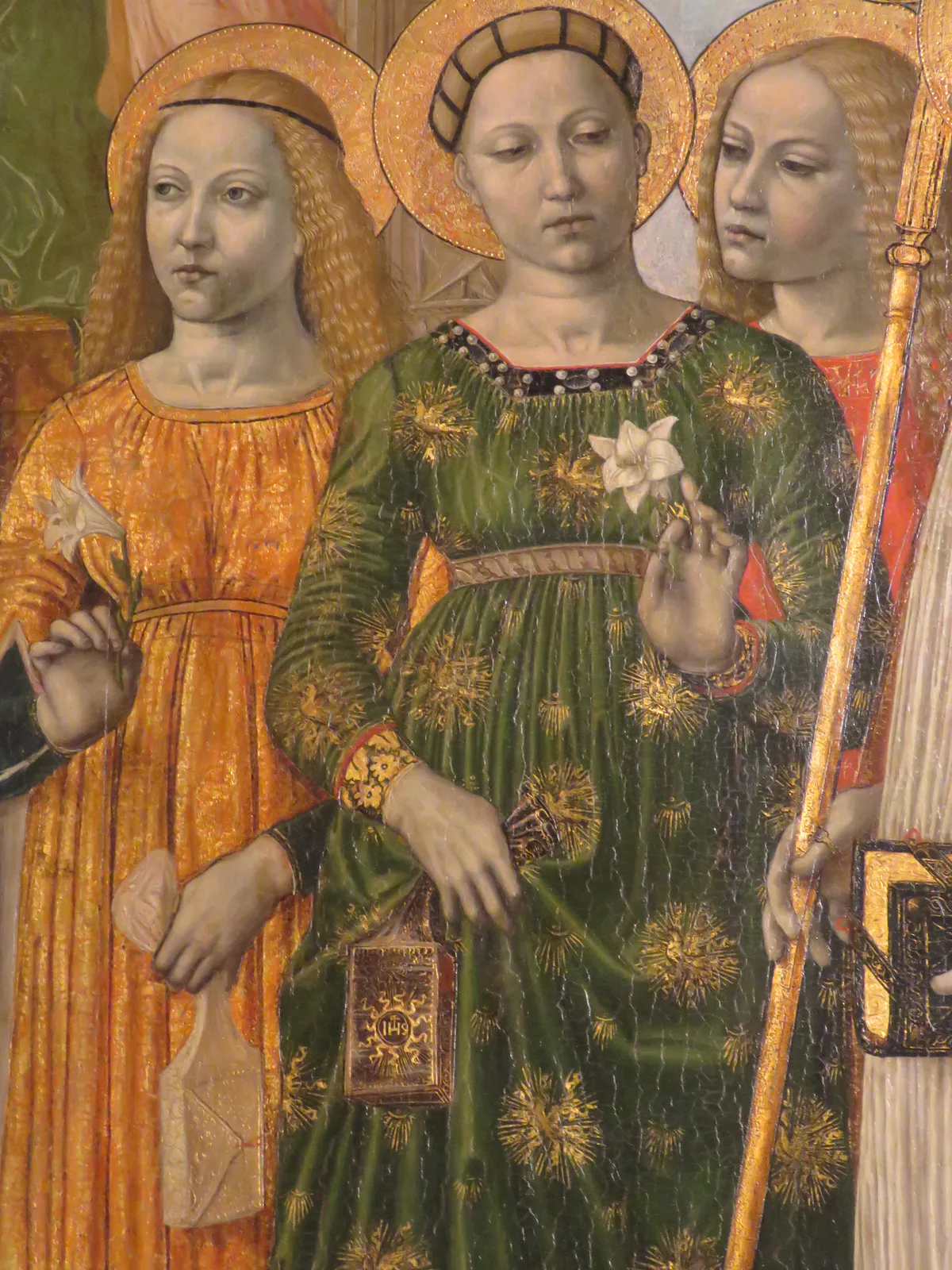
Santa Conversazione (detail)
Ambrogio Bergognone
This panel 1490-95) features a trio of female saints bearing lilies, symbolizing purity. Adorned with gold and intricate embroidery, their garments suggest sanctity and nobility. The solemn expressions and clasped books evoke wisdom and devotion, emphasizing the fusion of holiness and human dignity in late Gothic religious art.
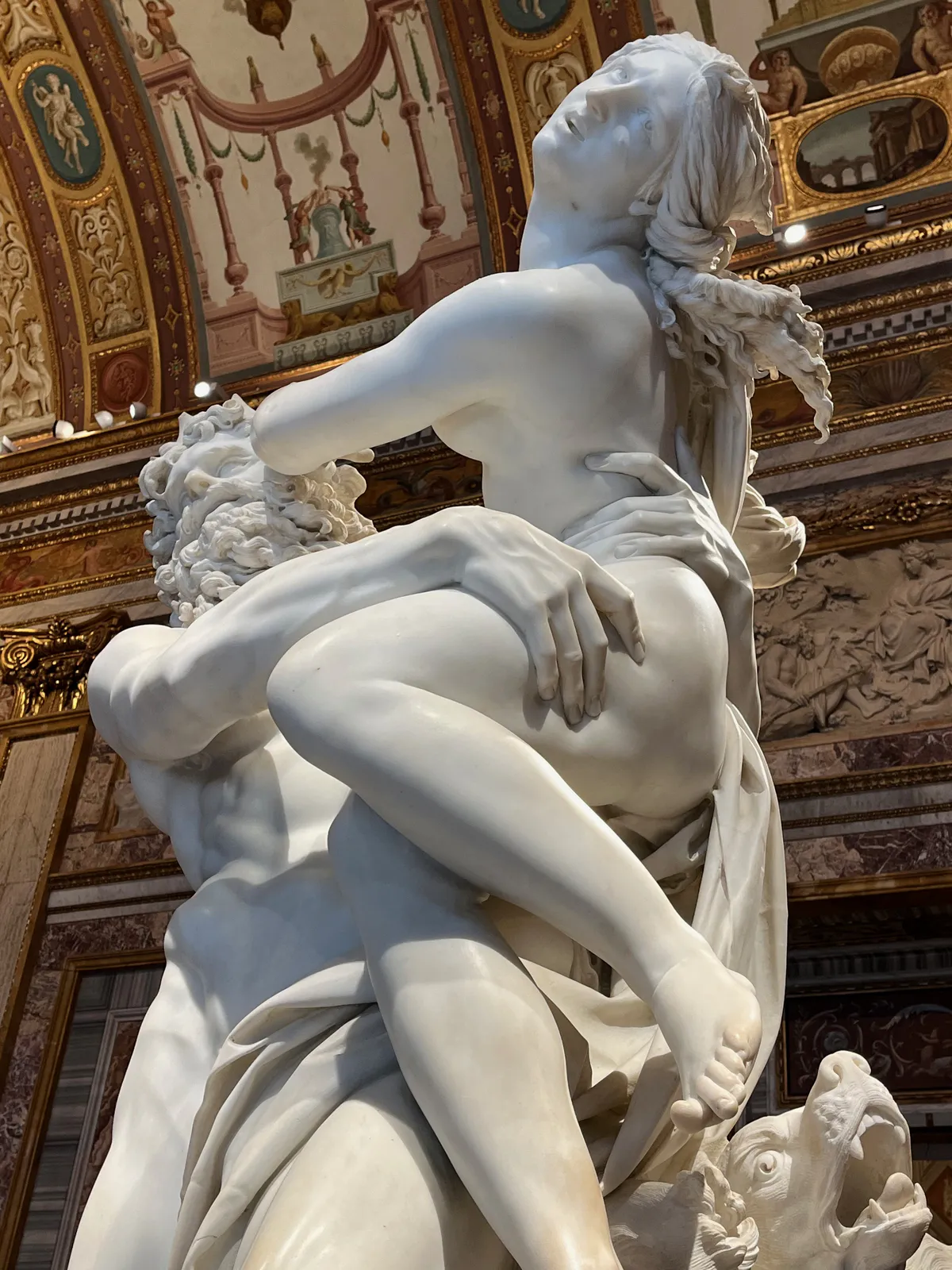
The Rape of Proserpina
Bernini
In this stunning detail of Bernini’s marble group (1621–22), Pluto’s fingers sink into Proserpina’s thigh with unnerving realism, while her twisting form and anguished face heighten the emotional intensity. The composition’s tactile illusionism and psychological drama mark a defining triumph of early Baroque sculpture.
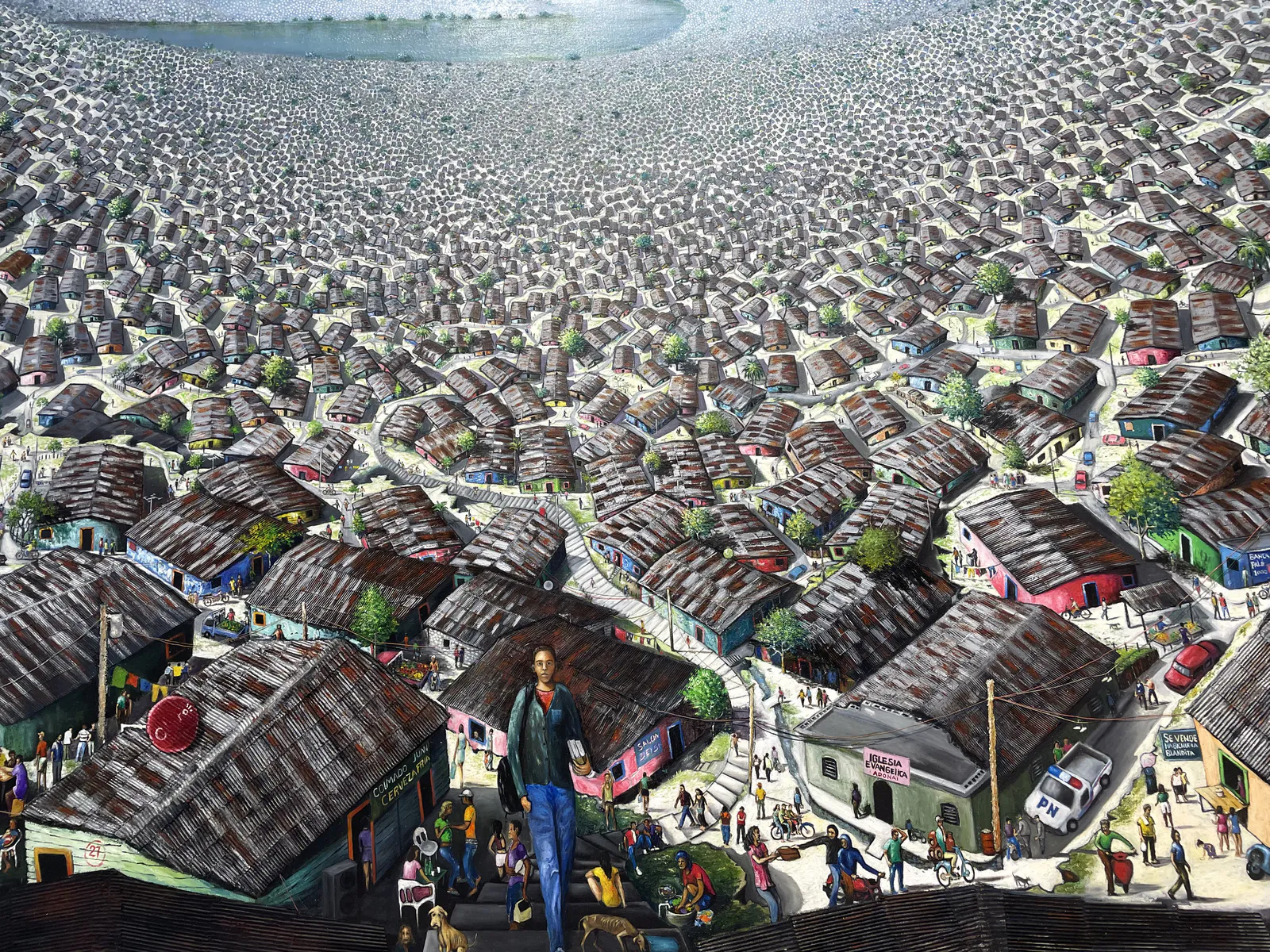
It’s Not Where You Come From, but Where You’re Going
Ramón Calcaño
This oil painting (2018), entitled No importa de dónde vienes, sino hacia dónde vas, Calcaño presents a vast view of informal housing. Central to the scene is a figure holding books, emerging from the margins. The work highlights resilience and the transformative power of education, emphasizing the pursuit of a better future beyond one's origins.
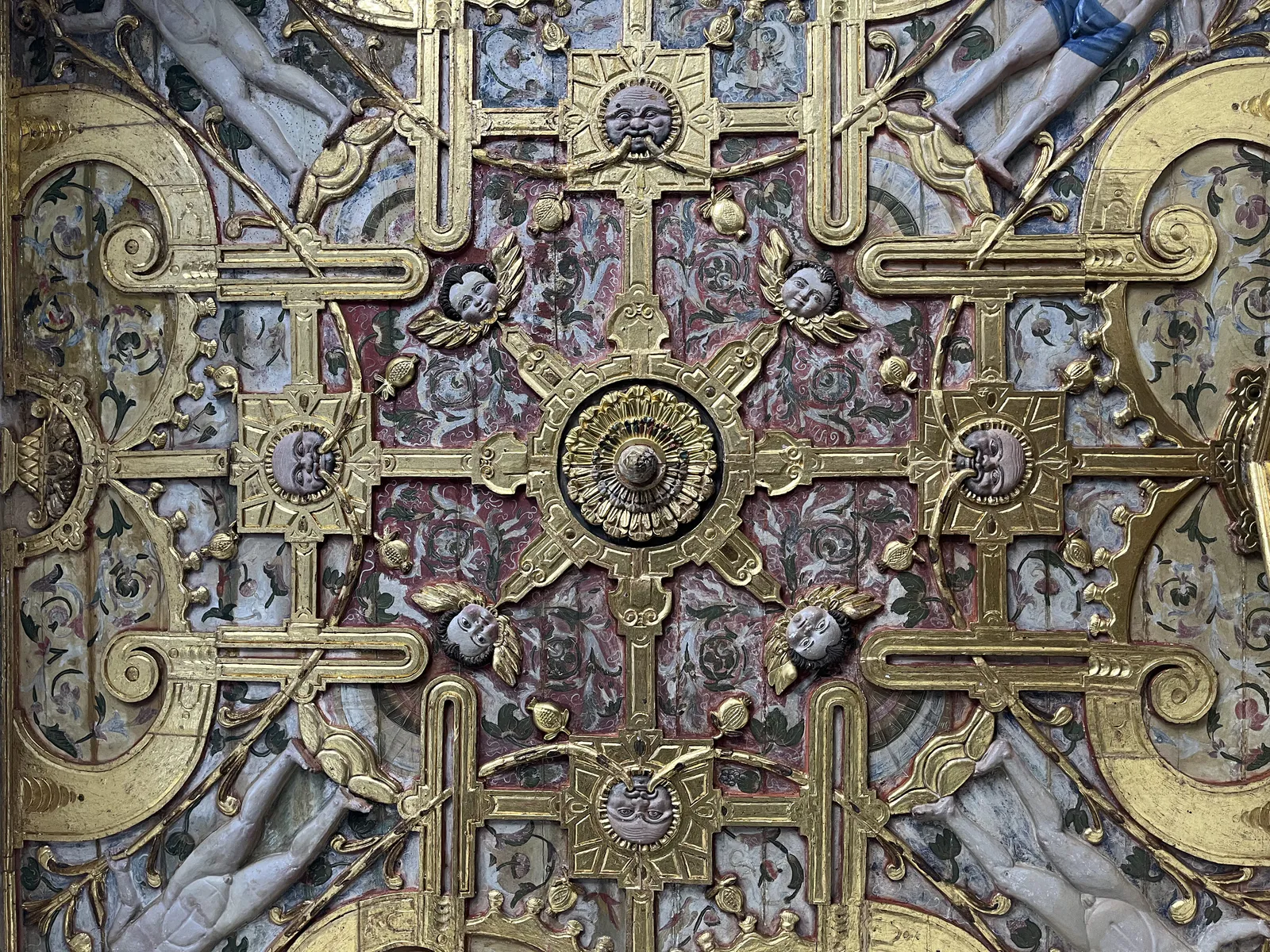
Andean Baroque Ceiling Panel
Manuel Chili (Capiscara)
This carved and gilded ceiling panel (1770–80) shows radiant faces, golden beams, and floral motifs arranged around a central sunburst. Produced in late-colonial Quito, it aligns with the Andean baroque’s celestial imagery. Caspicara joined Catholic cosmology with Indigenous conceptions of ordered, sacred geometry.
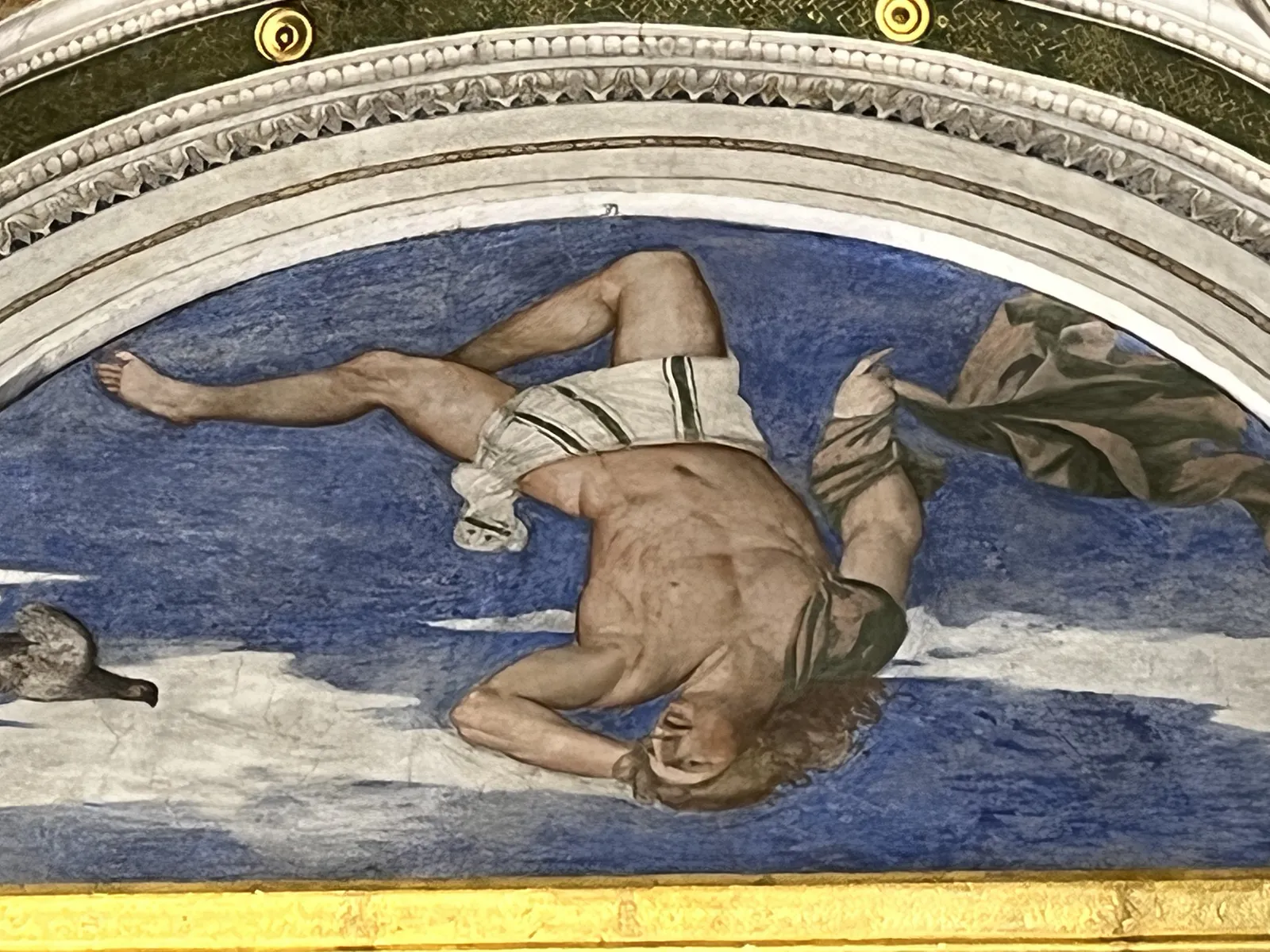
The Fall of Phaeton
Sebastiano del Piombo
This fragment (c. 1511) shows Phaeton falling from the sky after failing to control the sun chariot of his father Helios. To save the world, Zeus strikes him down. Part of Sebastiano del Piombo’s mythological cycle at Villa Farnesina, it complements Raphael’s Triumph of Galatea with a dramatic warning against hubris.
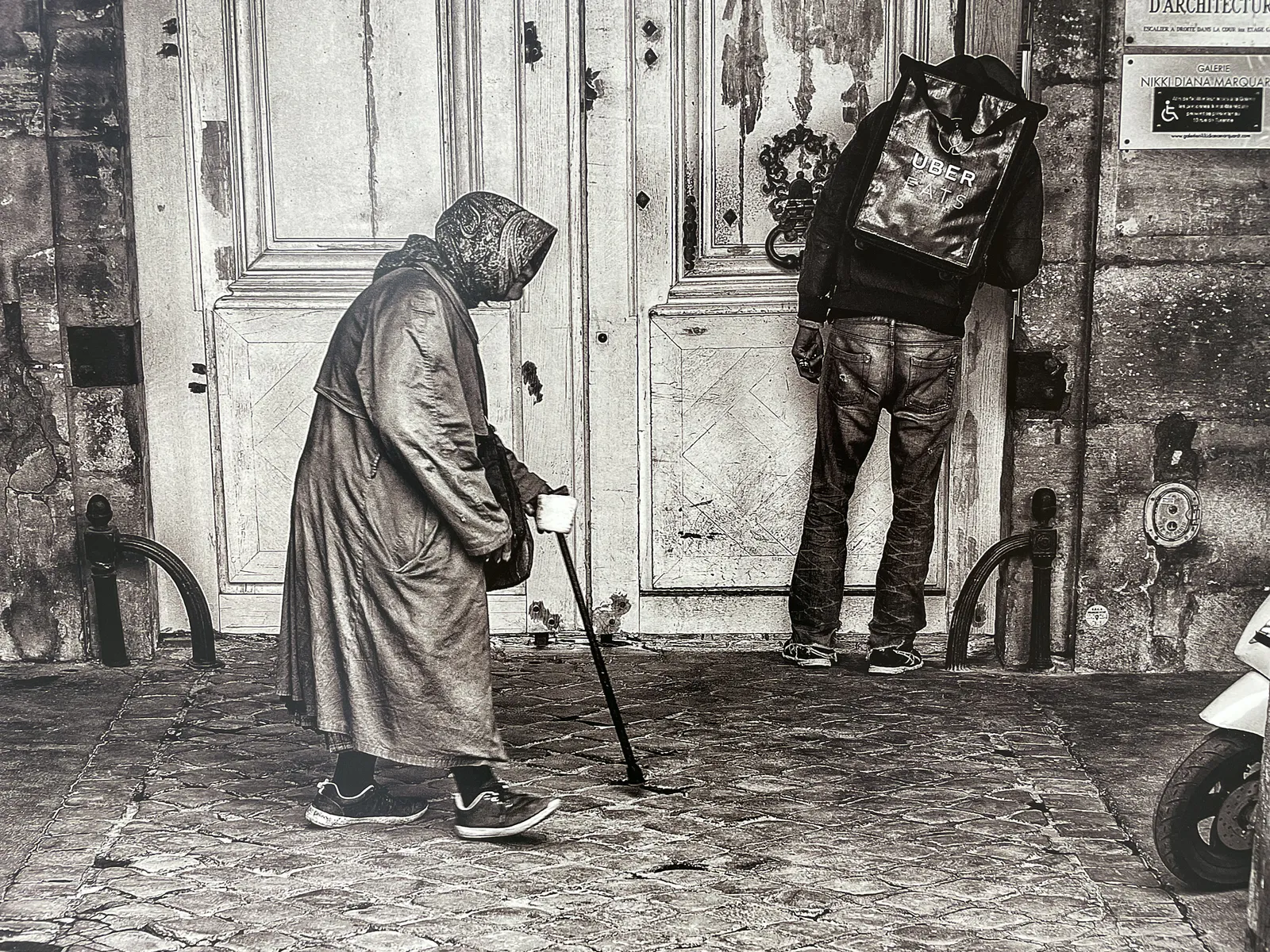
Uber Eats
Roger Zayas
This photo (2017), taken in the historic Marais district of Paris, captures a striking urban contrast: an elderly woman with a cane passes a food courier bent over a doorway. Zayas underscores generational divides and social invisibility, reflecting on aging and shifting economic realities in the European metropolis.
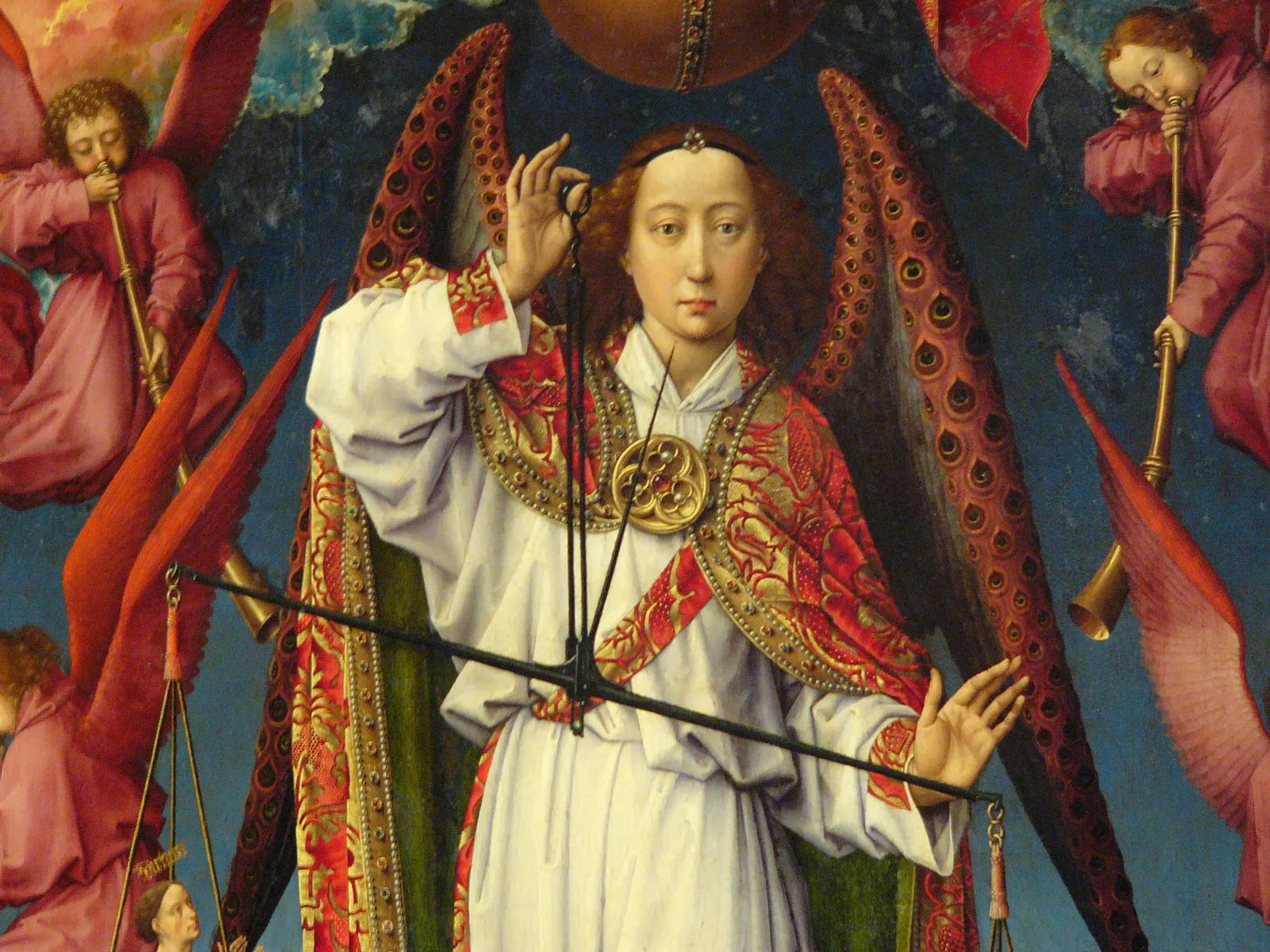
Archangel Michael Weighing Souls
Rogier van der Weyden
Detail from the Last Judgment Altarpiece (1445–50), created for Beaune’s Hôtel-Dieu. Archangel Michael holds scales to weigh souls, his calm gaze contrasting with the cosmic drama around him. Trumpeting angels herald resurrection, while Michael’s jeweled vestments and red wings embody divine authority. For the hospital’s patients, this image linked earthly suffering to the hope of eternal salvation.
“When the path is beautiful, do not ask where it leads.” — Zen proverb
Welcome to my travel photography!
“When the path is beautiful, do not ask where it leads.” — Zen proverb
Welcome to my travel photography!
For as long as I can remember, my path has been one of discovery—seeking beauty, timelessness, and connection in every corner of the world. It has also been a journey of deep learning and understanding. I’ve been an avid traveler (or perhaps a travel addict?) for most of my life. My love for travel began long before I ever left home: as a child, I drew a fantasy map of my grandparents’ apartment and “traveled” through it with my cousin Sonya, imagining adventures in every corner. Nearly 90 countries and countless moments of awe later, I’m excited to share this journey with you.
Thanks to the tireless and ingenious programming of Diagilev, we’re now able to present about fifteen percent of the images I’ve accumulated over the years. More will be released in small batches depending on your interest. While the first release leans toward museum photography, later ones will include more nature, architecture, culture, and general travel experiences. If you’d like to receive email notifications about new releases, feel free to reach out—no commercial use, ever.
Throughout my travels, I’ve been drawn to two intertwined kinds of discovery. One is intellectual: learning why the world is the way it is. History became my guide, shaping my perspective and filling my camera roll with museums and old buildings. To me, history is not the past—it is the key to understanding the present and how the world became what it is. The other is emotional: seeking moments of elevation—spirituality, beauty, harmony—often found in nature, monasteries, and ancient sacred spaces. Together, these impulses shape my photography. It invites you to learn, admire, and soar—to rise above the mundane and see the world through a lens of curiosity and wonder.
Much of my later travel became possible thanks to my job with Delta Air Lines, but the wanderlust began years earlier. By the time I joined the industry, I had already visited over 35 countries and lived in several—largely thanks to a backpacking journey around the world with Luis León, whose face appears in many early photos. I grew up in Ufa in the USSR, and since leaving it I have lived, studied, and worked in Latvia, the United States, France, South Korea, Canada, Spain, Italy, Brazil, Japan, and Colombia.
A life of near-constant movement may seem a little crazy, but it has deepened my understanding of the world and produced the photography you are about to see. Over the years, my style has evolved—more intentional, more refined—yet its core remains the same: a search for understanding, timeless beauty, and a connection to those who walked this earth long before us.
I hope these photos stir something in your soul, just as they did in mine. I’d love to hear from you—whether reactions, suggestions, corrections, or a request to be added to the email list for new releases (no commercial use, I promise). You can learn more about my travels here, and my academic life here.
Enjoy our shared journey!