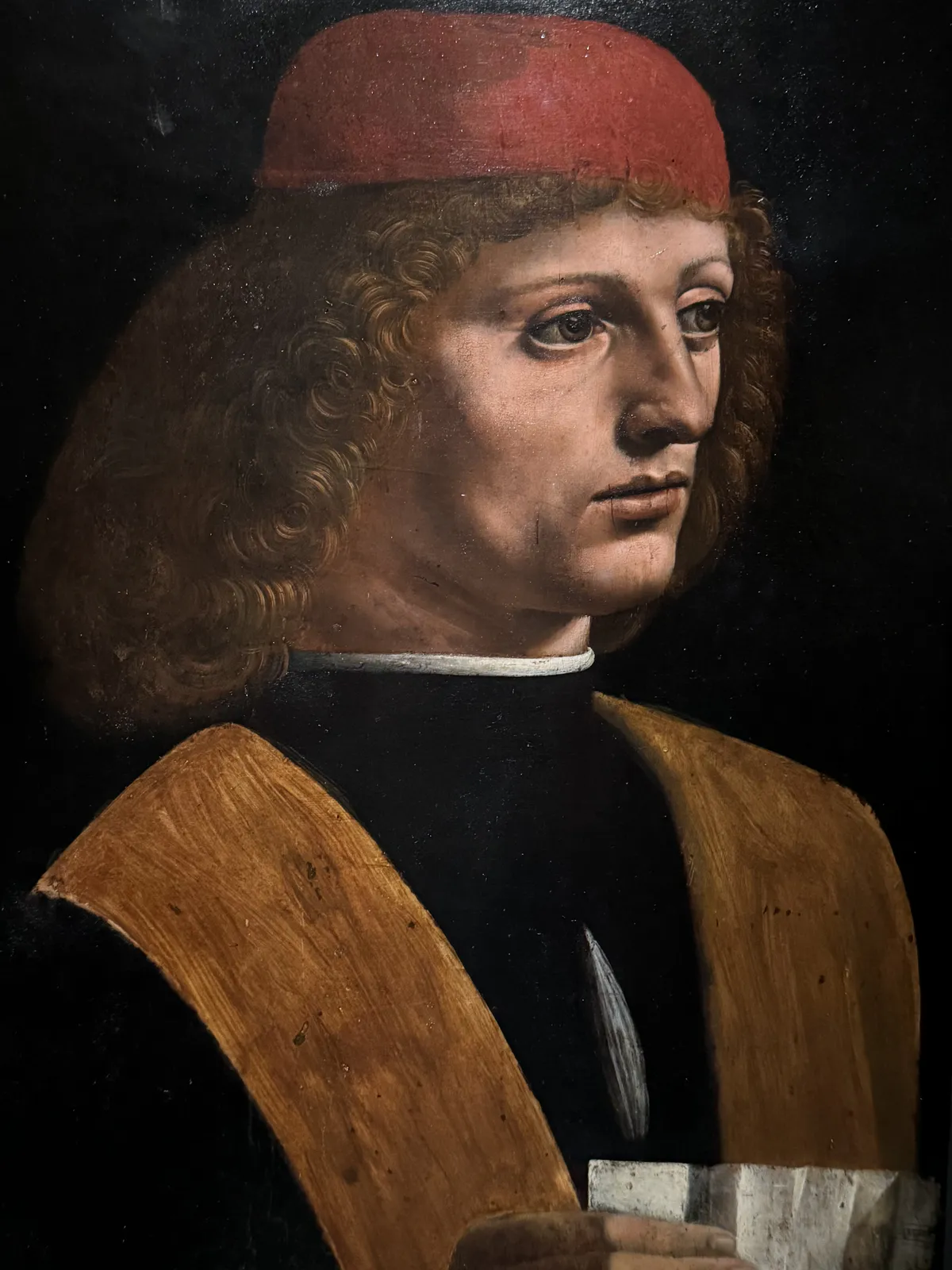
Portrait of a Musician
Leonardo da Vinci
This intimate oil on panel (c. 1485) is Leonardo da Vinci’s only known male portrait. Likely depicting a court musician in Milan, the sitter clutches a sheet of music, suggesting both profession and intellect. The unfinished lower section contrasts with the intense gaze, highlighting Leonardo’s interest in capturing psychological presence over ornamental finish.
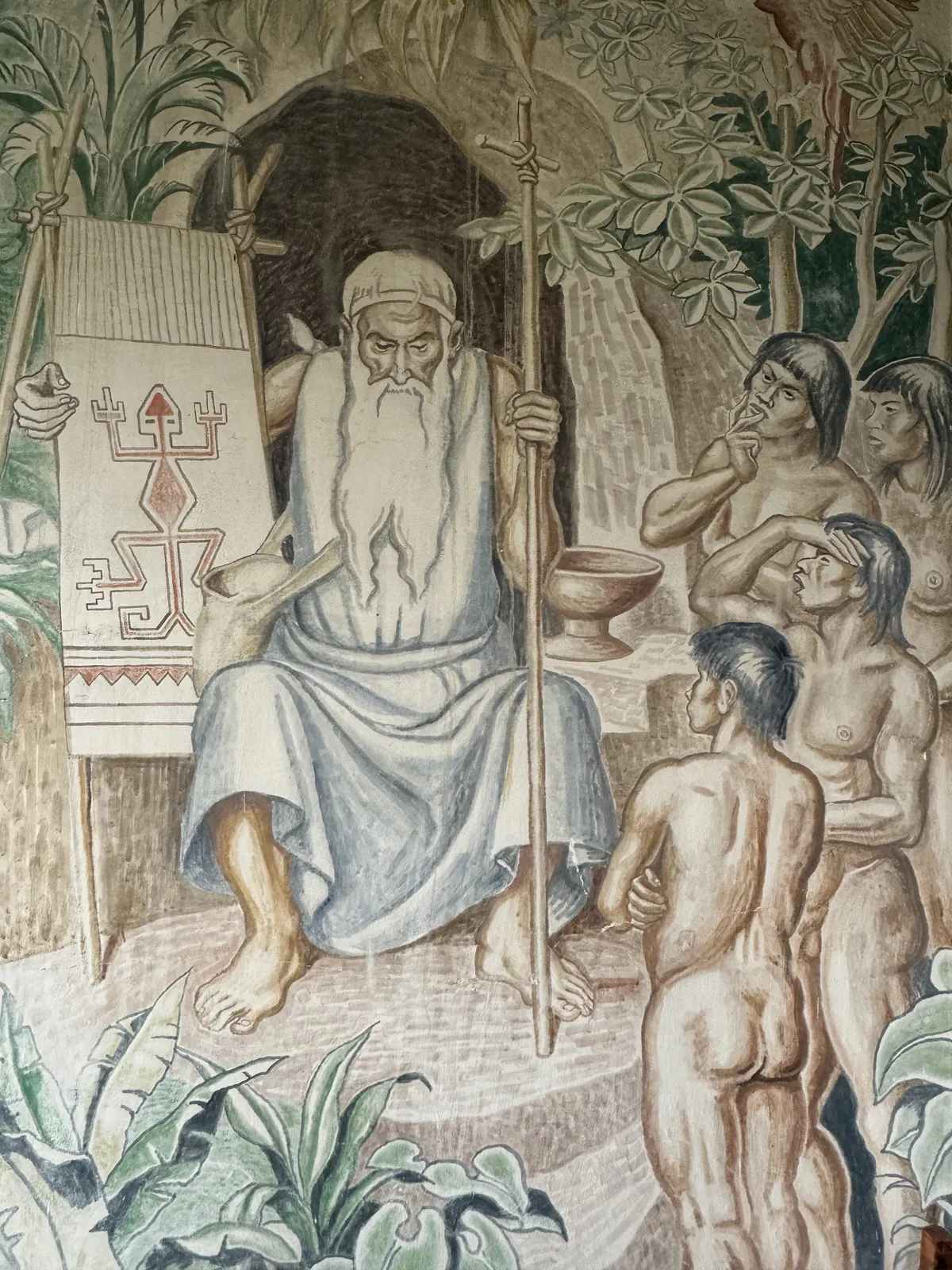
Bochica Teaching the Muisca
Luis Alberto Acuña
This 1960-70s mural depicts Bochica, the bearded sage and civilizing hero of Muisca mythology, imparting moral and spiritual lessons. Seated before young disciples, he holds symbols of power and knowledge, including a woven banner. A revered figure, Bochica was believed to have formed the Tequendama Falls and taught the Muisca how to live harmoniously.
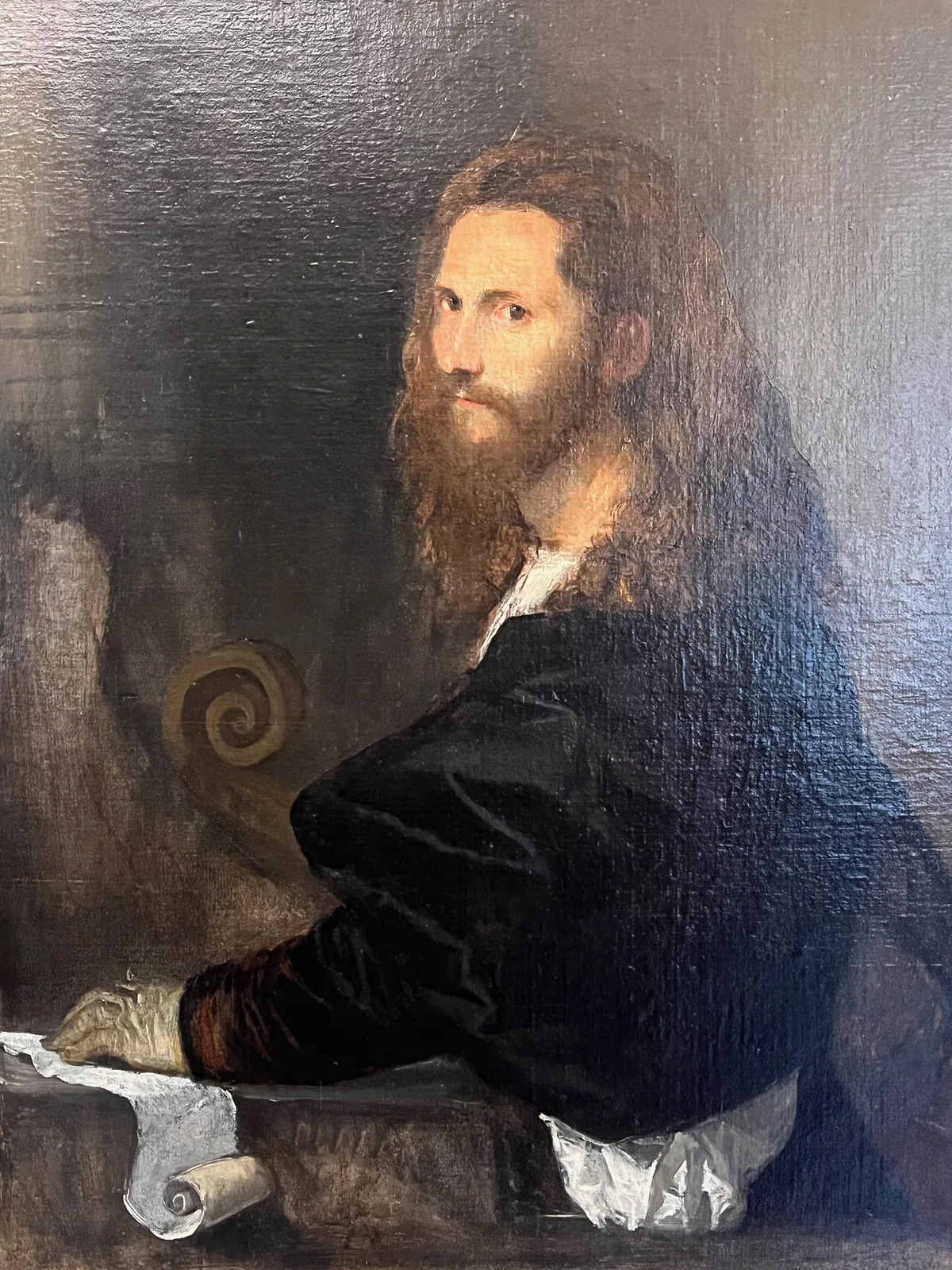
A Man with a Glove
Titian
This introspective portrait (c. 1515) captures a bearded man in mid-turn, scroll in hand, his gaze piercing yet reserved. Rendered with Venetian richness, the work highlights the sitter’s intellect and social poise. The subtle play of light on fabric and flesh reveals Titian’s early mastery of psychological depth and painterly nuance.
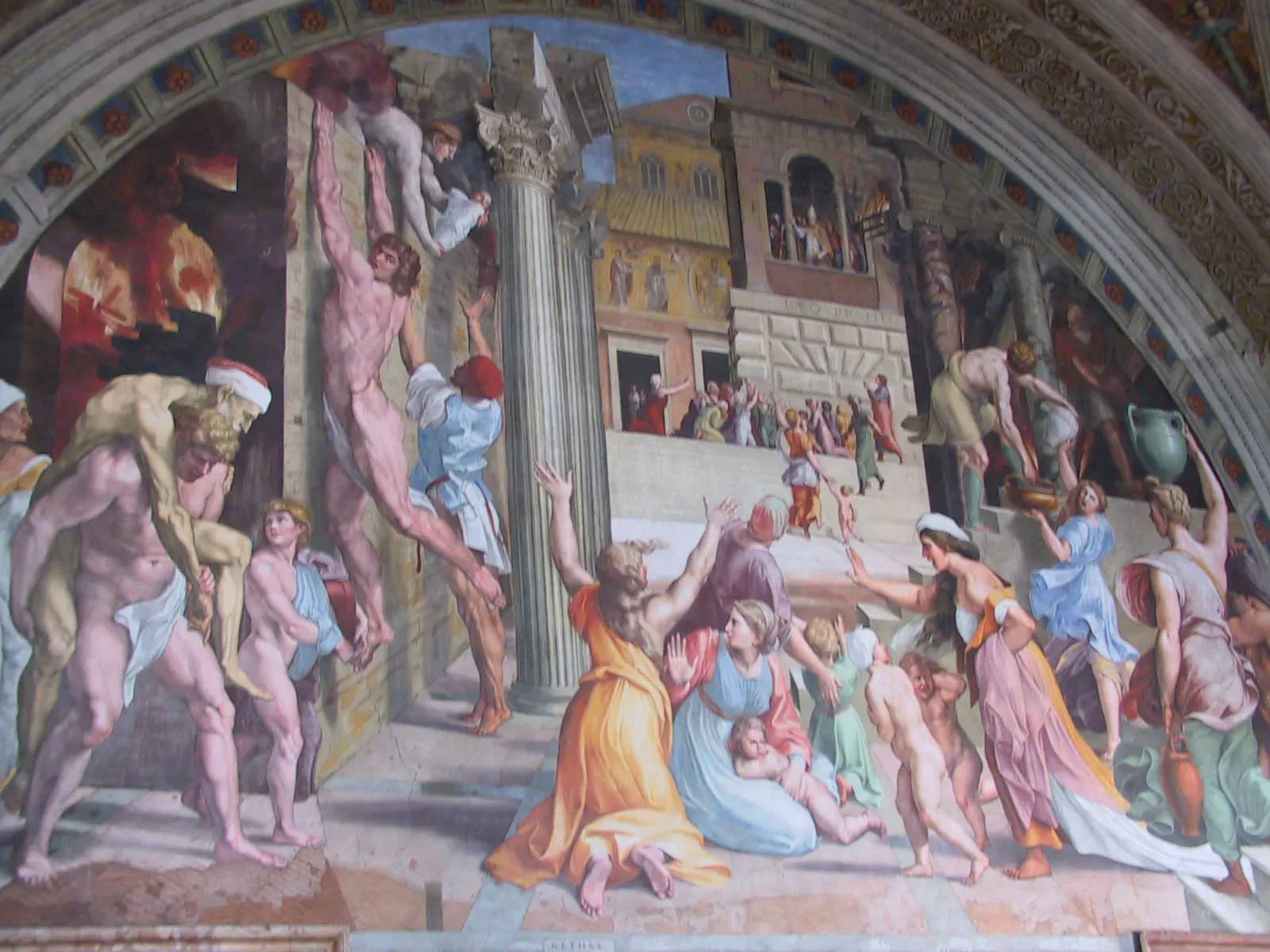
Fire in the Borgo
Rapahael and Giulio Romano
This fresco (1514) captures a legendary fire in Rome's Borgo district, illustrating divine intervention through Pope Leo IV's prayer. The fresco, part of the Raphael Rooms in the Vatican, blends classical and Renaissance elements, showcasing dynamic figures and architectural precision. This work reflects the era's belief in the power of faith and the church's central role in societal protection and order.
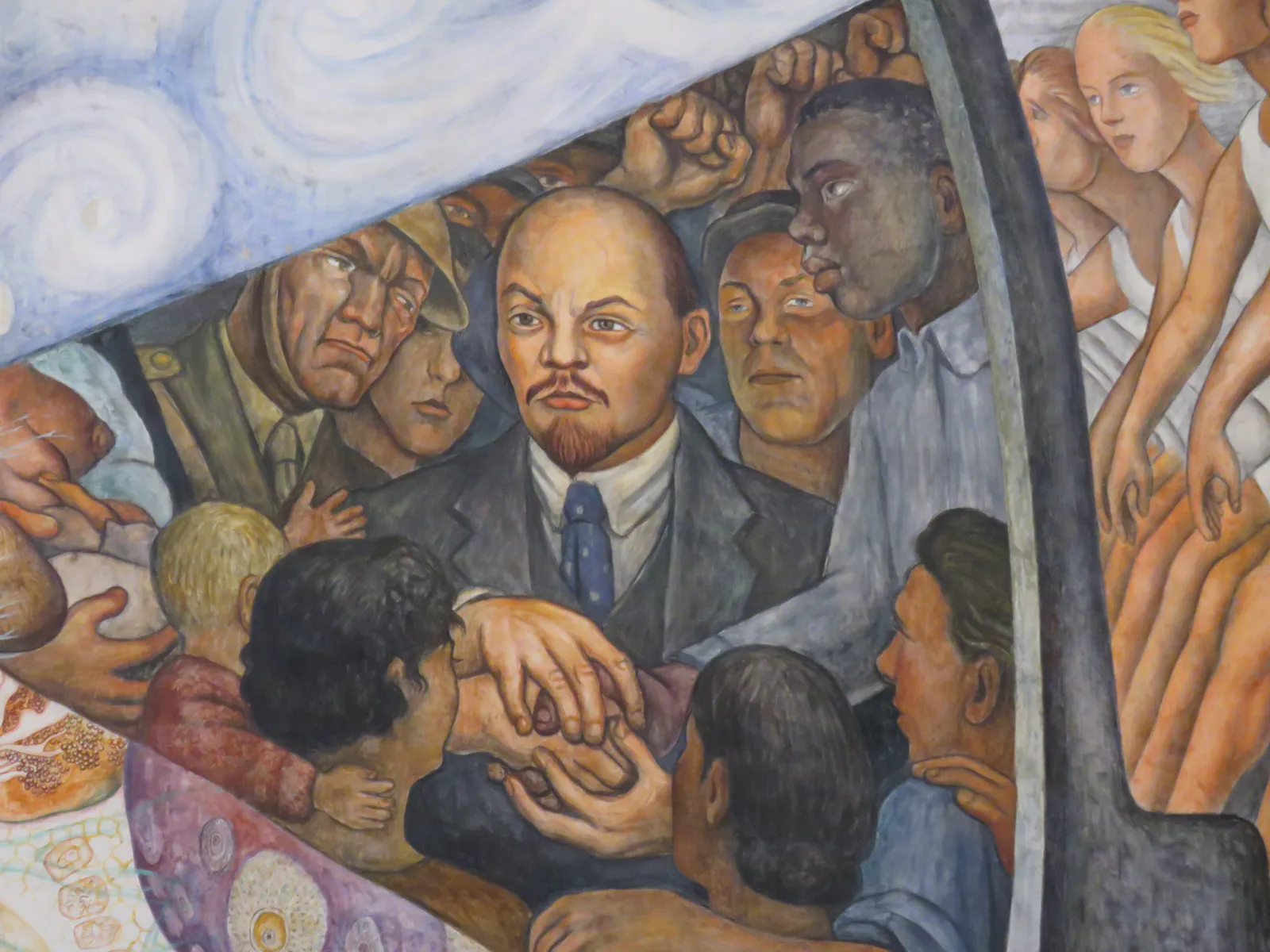
Lenin
Diego Rivera
This mural fragment (1934) shows Vladimir Lenin at the center, joining the hands of workers of different races in a dense crowd. The scene comes from Rivera’s Man at the Crossroads mural destroyed at Rockefeller Center, whose inclusion of Lenin provoked its removal. By recreating the composition at the Palacio de Bellas Artes, Rivera reaffirmed his Marxist political stance.
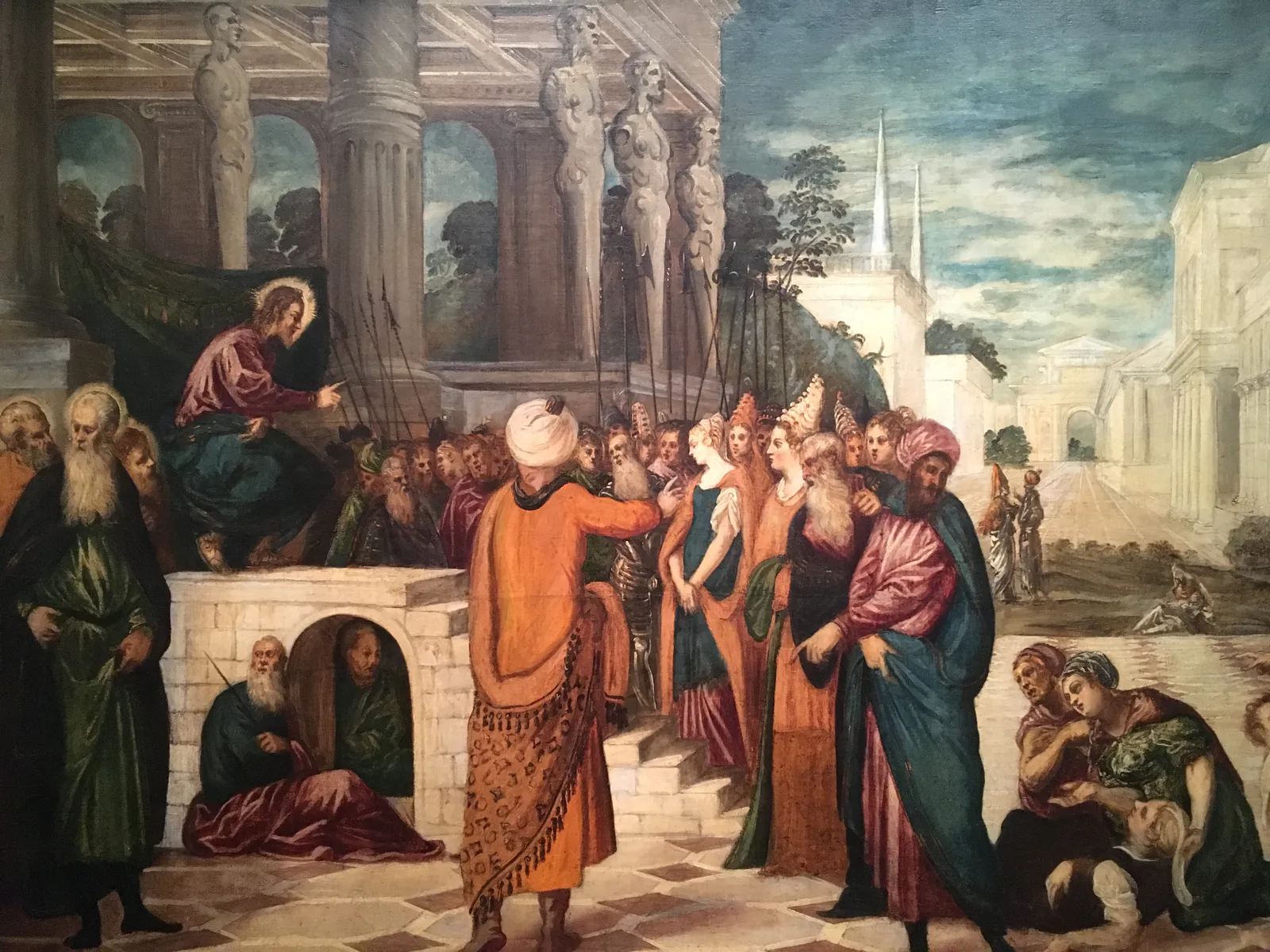
Christ and the Adulteress
Tintoretto
This scene (c. 1555) is from the Gospel of John: Jesus responds to scribes and Pharisees demanding judgment on an adulterous woman. His challenge—inviting the sinless to cast the first stone—teaches mercy over condemnation. Tintoretto’s dynamic style appears in the sharp contrasts of light and shadow, elongated figures, and oblique spatial arrangement that intensify the moral tension. Classical architectural elements frame the encounter, emphasizing the conflict between legalism and redemption.
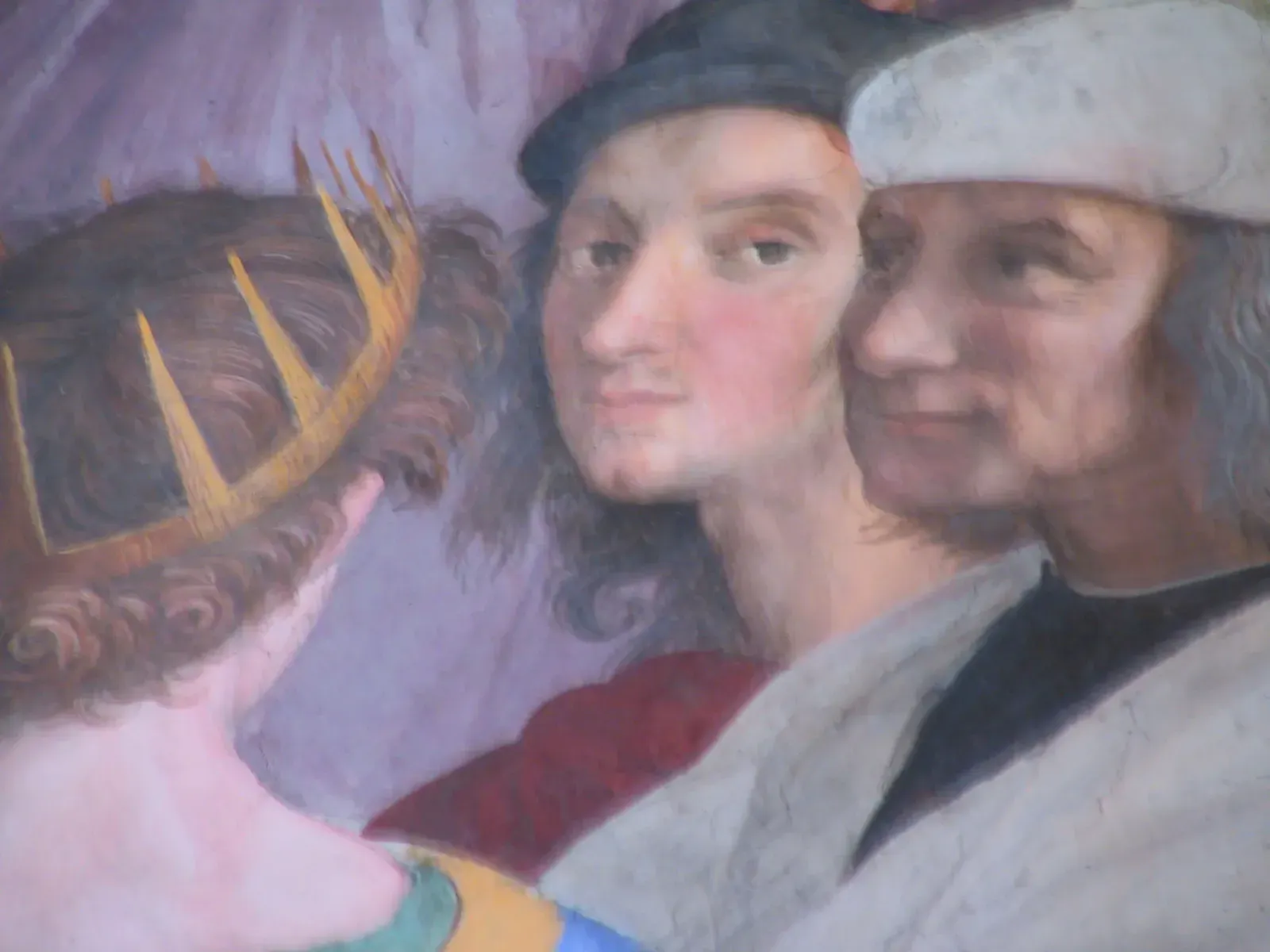
Raphael and Perugino (detail)
Raphael
This section of The School of Athens (1509-11) features a rare self-portrait of Raphael (center) alongside his teacher Perugino (right). Originating from the Italian High Renaissance, the work subtly inserts the artist into the legacy of classical knowledge, aligning painters with philosophers as bearers of intellectual ideals.
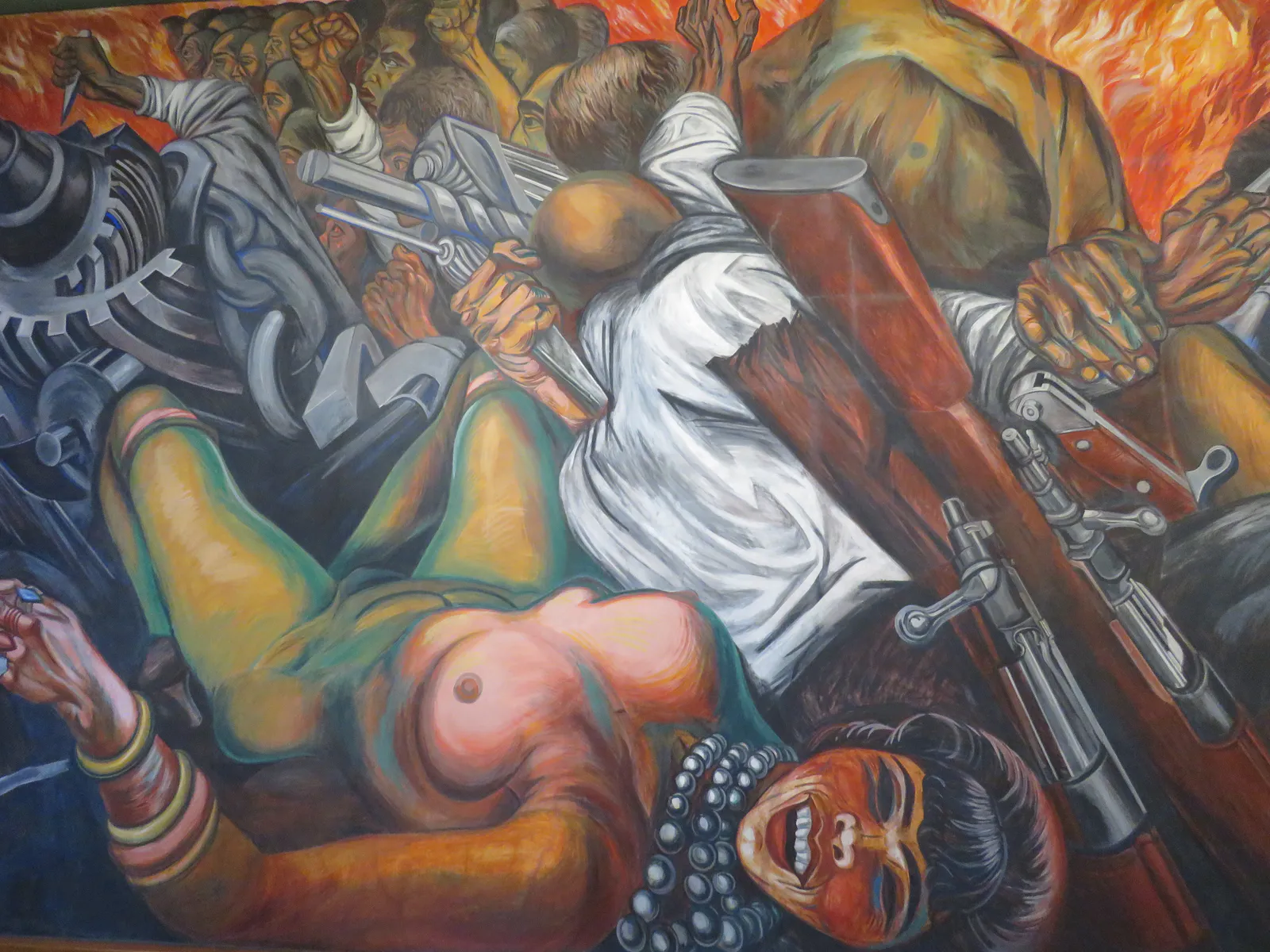
Katharsis (detail)
José Clemente Orozco
This explosive mural section (1934) fuses war, lust, and revolution into a single convulsion. Clashing fists, rifles, and machines crush bodies into chaos. The nude woman evokes both violence and moral decay, while fire and protest surge behind. Orozco presents modernity as an inferno—only through destruction can truth emerge.
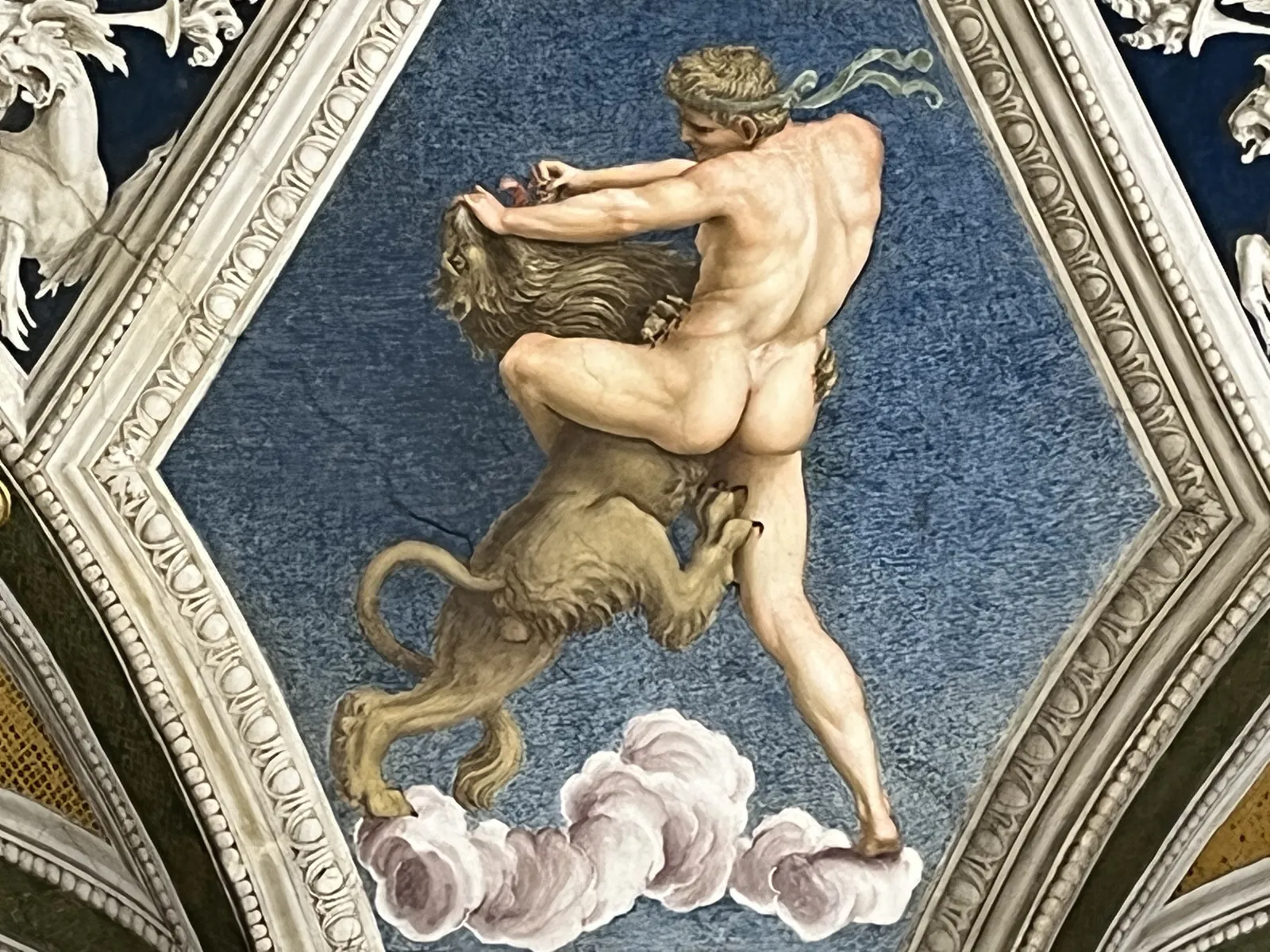
Hercules Defeating the Nemean Lion
Baldassare Peruzzi
This fresco (c. 1511) in the Loggia of Galatea shows Hercules wrestling the invulnerable Nemean Lion, one of his Twelve Labors. The hero’s twisting nude body and the lion’s straining muscles emphasize physical struggle and controlled force. As part of a zodiac cycle, the scene represents the sign of Leo and links mythological heroism to Renaissance interests in astrology and humanist virtue.
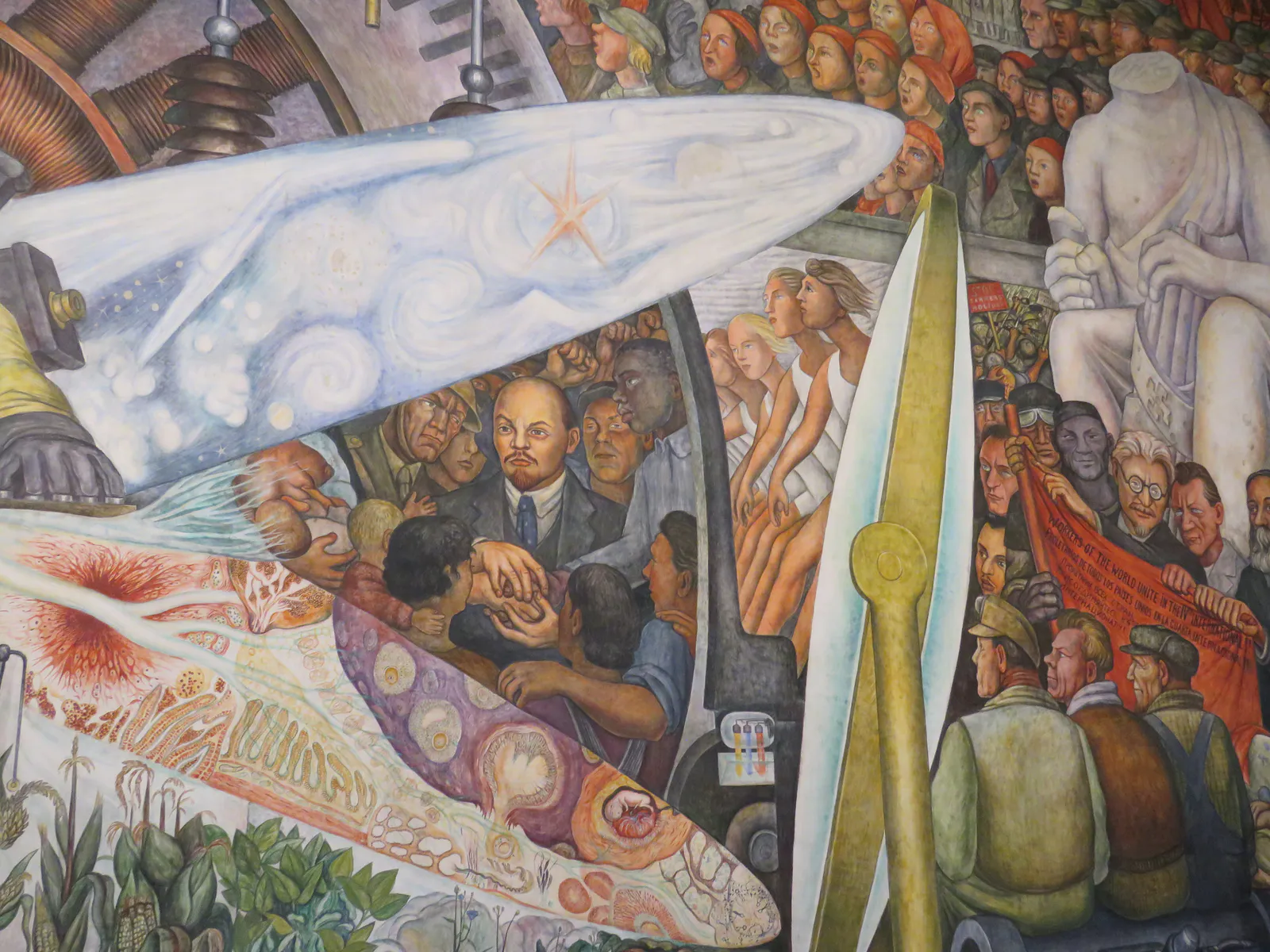
Man, Controller of the Universe (detail)
Diego Rivera
This section of Rivera’s 1934 recreated mural shows Lenin uniting workers of different races and nations, flanked by scientific, agricultural, and cosmic imagery. It contrasts socialism’s collective promise with capitalist individualism. The original was destroyed at Rockefeller Center.
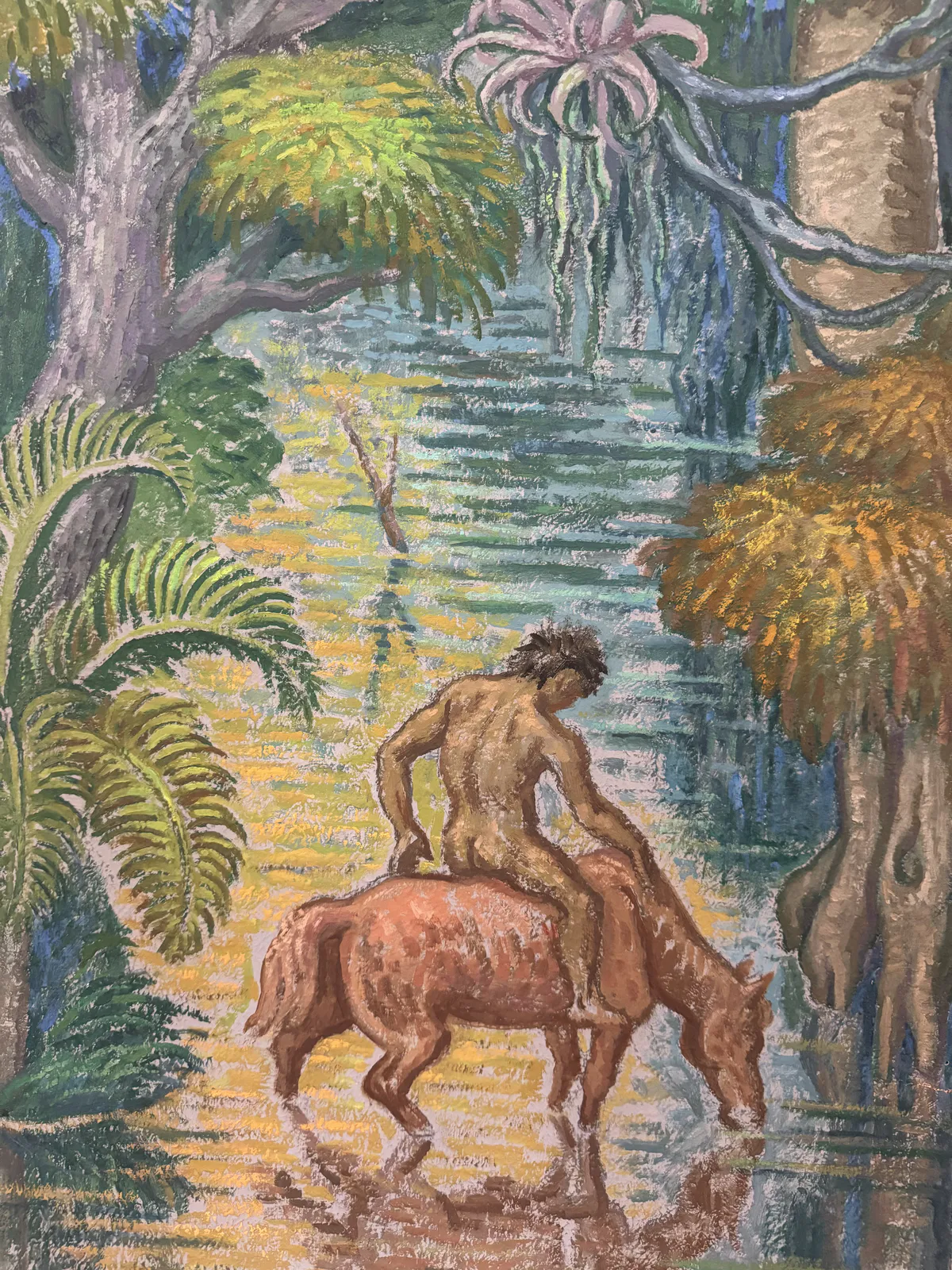
Indo-American Scene
Luis Alberto Acuña
A lone, naked rider on horseback drinks from a forest stream, immersed in a lush tropical setting. Acuña's painting (1950-60s) evokes a primordial connection between Indigenous people and the natural world, blending mythic and symbolic elements into a vision of harmony, solitude, and ancestral presence.
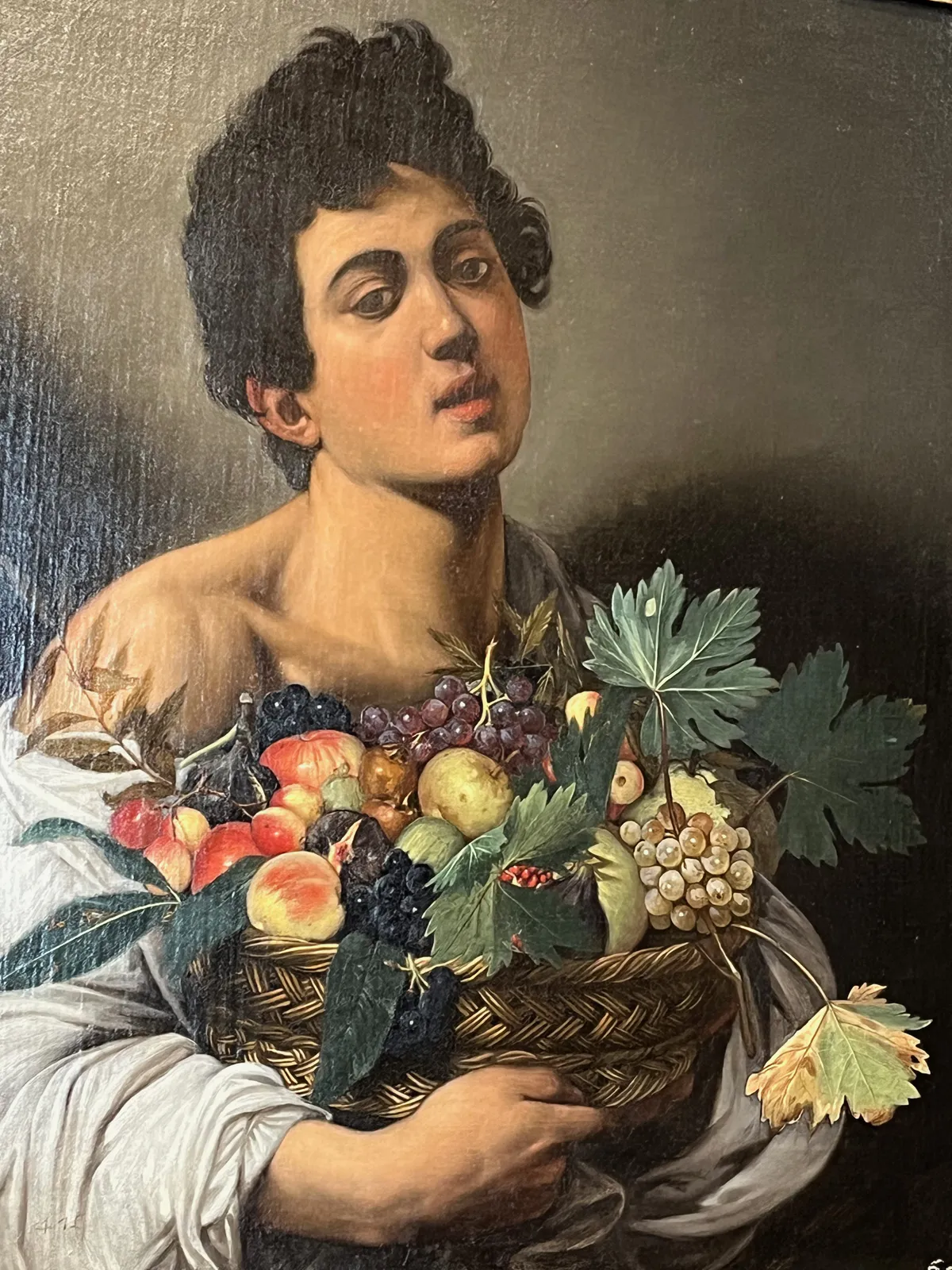
Boy with a Basket of Fruit
Caravaggio
This early Baroque painting (c. 1593) merges portraiture with still life, showing Mario Minniti holding a basket of overripe fruit. Caravaggio renders blemishes and textures with unflinching realism. The sensual posture and decaying abundance evoke themes of youthful beauty, ephemerality, and temptation.
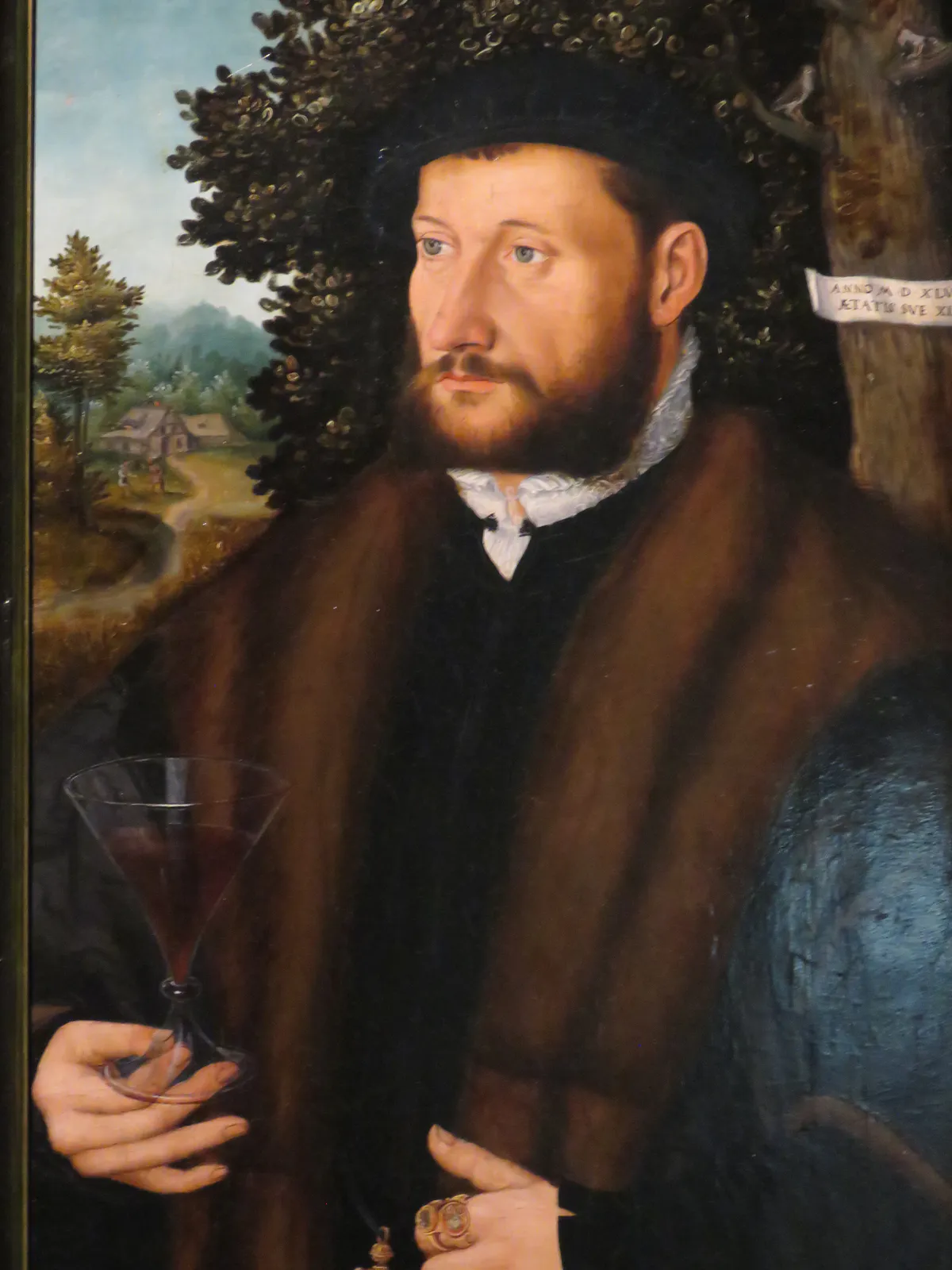
Male Portrait
Hans Muelich
This portrait (c. 1550) reflects the refined realism of the German Renaissance. The sitter’s composed gaze, luxurious attire, and elegant glass signify affluence and cultured leisure. The distant path and village in the background may allude to the subject’s journey, social standing, or inner world.
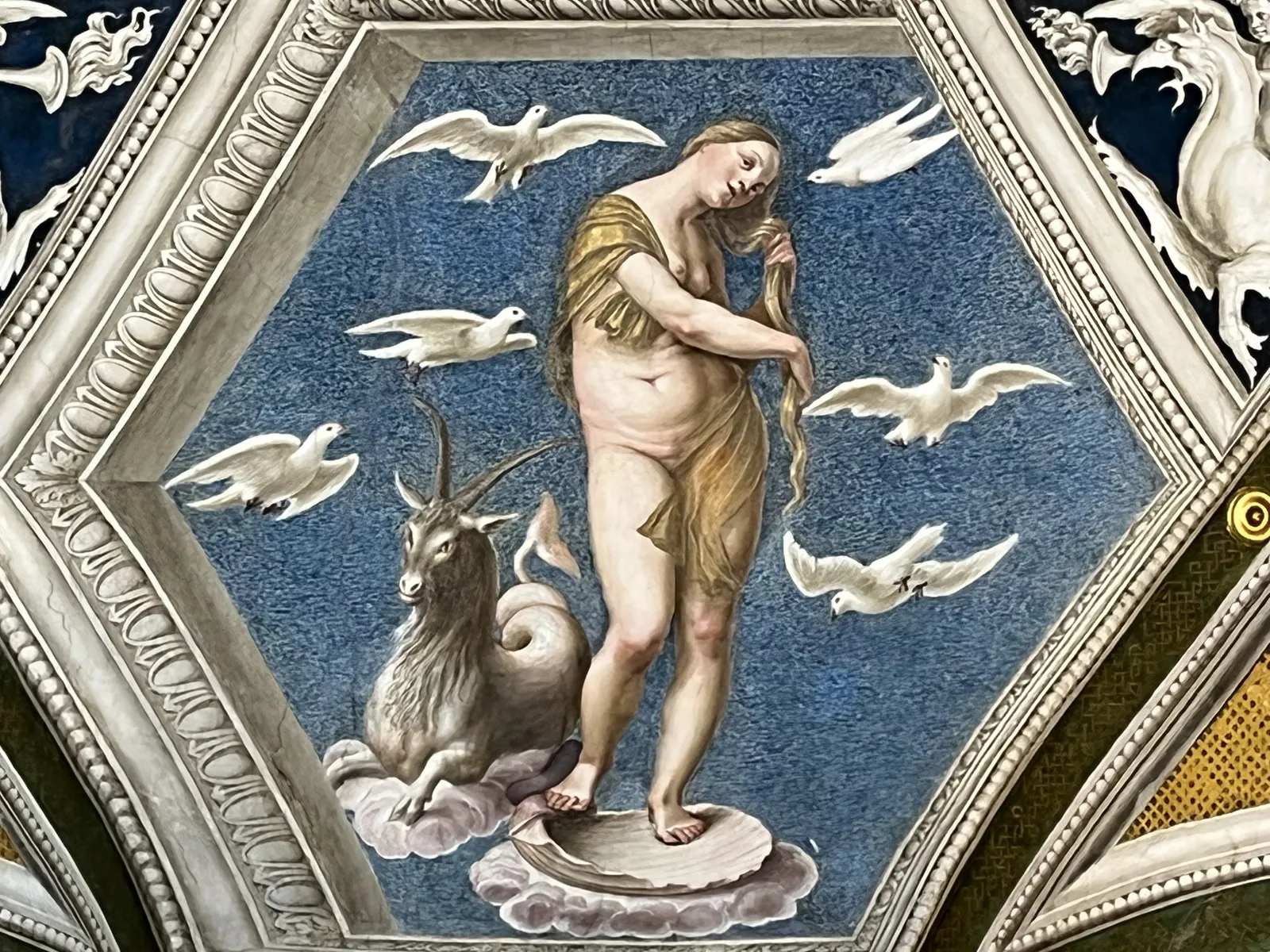
Venus and Capricorn
Baldassarre Peruzzi
The painting (c.1511) in the Loggia of Galatea depicts Venus, the goddess of love, on a shell surrounded by doves, symbols of love. Beside her, Capricorn, a hybrid creature, represents astrological wisdom. This artwork merges mythological beauty with cosmic symbolism, reflecting the Renaissance fascination with harmony between earthly and celestial realms. The inclusion of Capricorn underscores the era's belief in astrology's influence on human affairs.
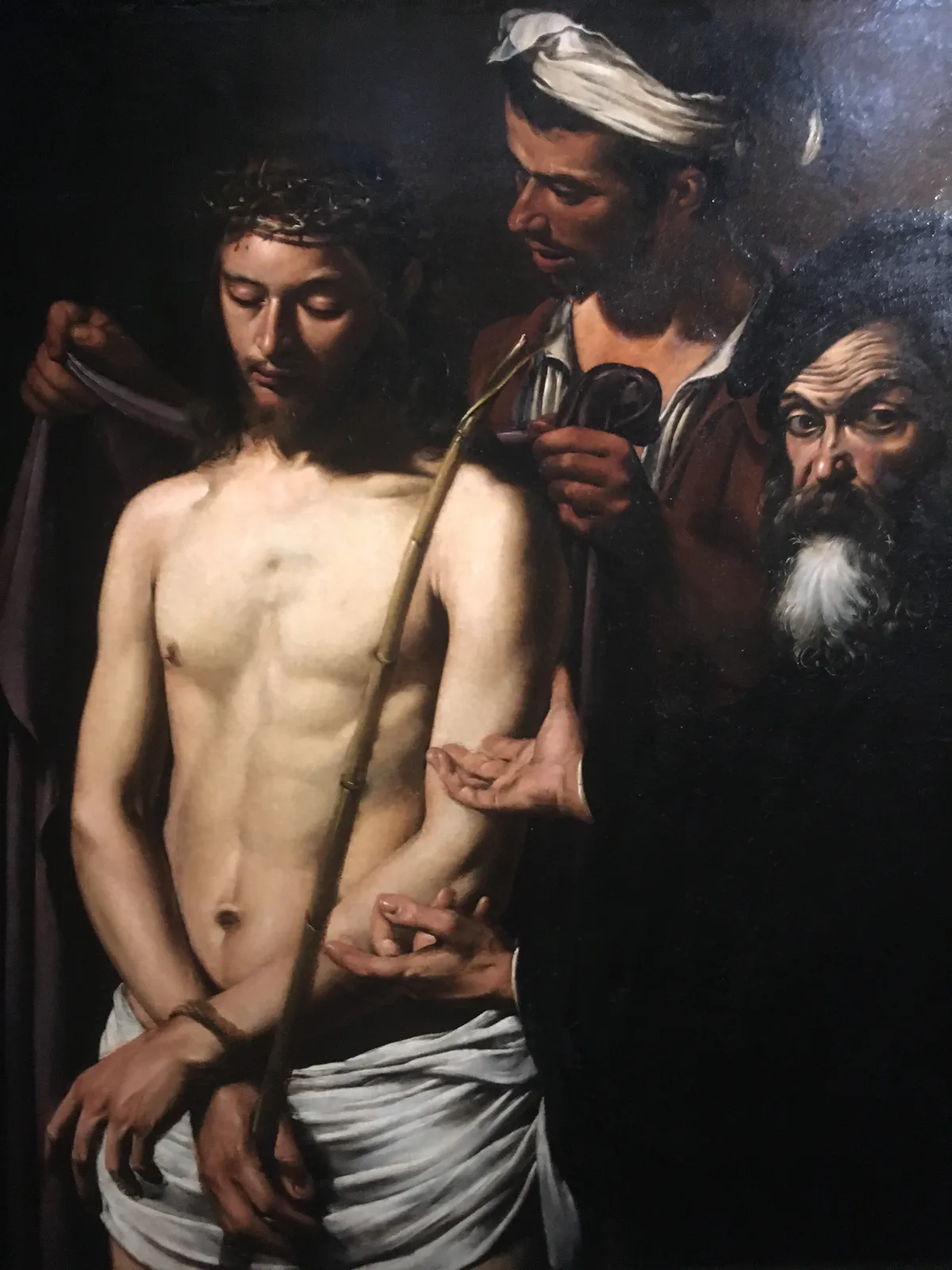
The Crowning with Thorns
Caravaggio
This painting (1602–04) depicts Christ humiliated before crucifixion. Crowned with thorns and bound, he stands in silent suffering as soldiers force the reed into his hand and mock him as king. Caravaggio’s harsh chiaroscuro strips away grandeur, presenting raw cruelty and dignity in contrast. The work confronts viewers with the violence of power and the endurance of faith.
“When the path is beautiful, do not ask where it leads.” — Zen proverb
Welcome to my travel photography!
“When the path is beautiful, do not ask where it leads.” — Zen proverb
Welcome to my travel photography!
For as long as I can remember, my path has been one of discovery—seeking beauty, timelessness, and connection in every corner of the world. It has also been a journey of deep learning and understanding. I’ve been an avid traveler (or perhaps a travel addict?) for most of my life. My love for travel began long before I ever left home: as a child, I drew a fantasy map of my grandparents’ apartment and “traveled” through it with my cousin Sonya, imagining adventures in every corner. Nearly 90 countries and countless moments of awe later, I’m excited to share this journey with you.
Thanks to the tireless and ingenious programming of Diagilev, we’re now able to present about fifteen percent of the images I’ve accumulated over the years. More will be released in small batches depending on your interest. While the first release leans toward museum photography, later ones will include more nature, architecture, culture, and general travel experiences. If you’d like to receive email notifications about new releases, feel free to reach out—no commercial use, ever.
Throughout my travels, I’ve been drawn to two intertwined kinds of discovery. One is intellectual: learning why the world is the way it is. History became my guide, shaping my perspective and filling my camera roll with museums and old buildings. To me, history is not the past—it is the key to understanding the present and how the world became what it is. The other is emotional: seeking moments of elevation—spirituality, beauty, harmony—often found in nature, monasteries, and ancient sacred spaces. Together, these impulses shape my photography. It invites you to learn, admire, and soar—to rise above the mundane and see the world through a lens of curiosity and wonder.
Much of my later travel became possible thanks to my job with Delta Air Lines, but the wanderlust began years earlier. By the time I joined the industry, I had already visited over 35 countries and lived in several—largely thanks to a backpacking journey around the world with Luis León, whose face appears in many early photos. I grew up in Ufa in the USSR, and since leaving it I have lived, studied, and worked in Latvia, the United States, France, South Korea, Canada, Spain, Italy, Brazil, Japan, and Colombia.
A life of near-constant movement may seem a little crazy, but it has deepened my understanding of the world and produced the photography you are about to see. Over the years, my style has evolved—more intentional, more refined—yet its core remains the same: a search for understanding, timeless beauty, and a connection to those who walked this earth long before us.
I hope these photos stir something in your soul, just as they did in mine. I’d love to hear from you—whether reactions, suggestions, corrections, or a request to be added to the email list for new releases (no commercial use, I promise). You can learn more about my travels here, and my academic life here.
Enjoy our shared journey!