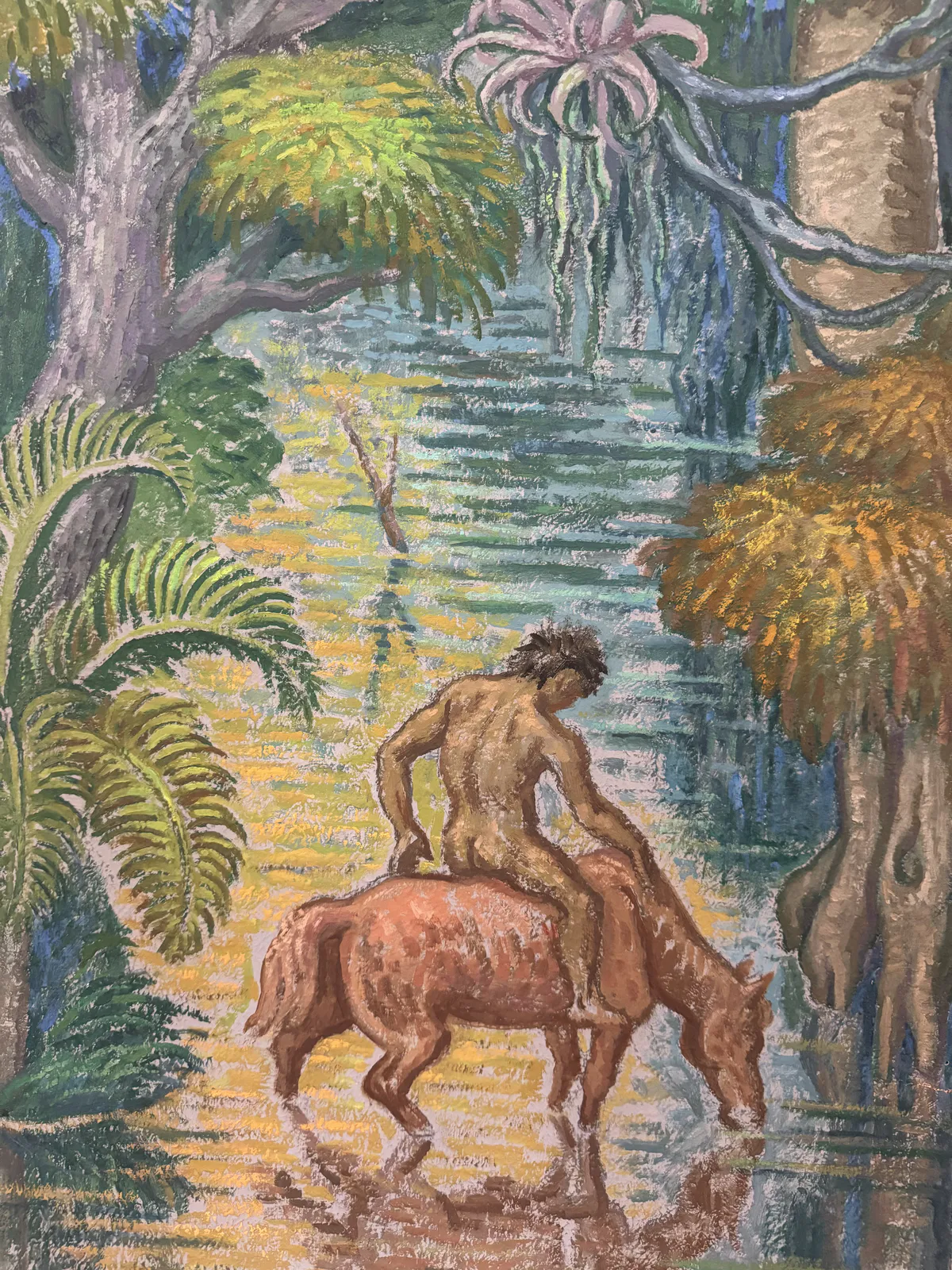
Indo-American Scene
Luis Alberto Acuña
A lone, naked rider on horseback drinks from a forest stream, immersed in a lush tropical setting. Acuña's painting (1950-60s) evokes a primordial connection between Indigenous people and the natural world, blending mythic and symbolic elements into a vision of harmony, solitude, and ancestral presence.
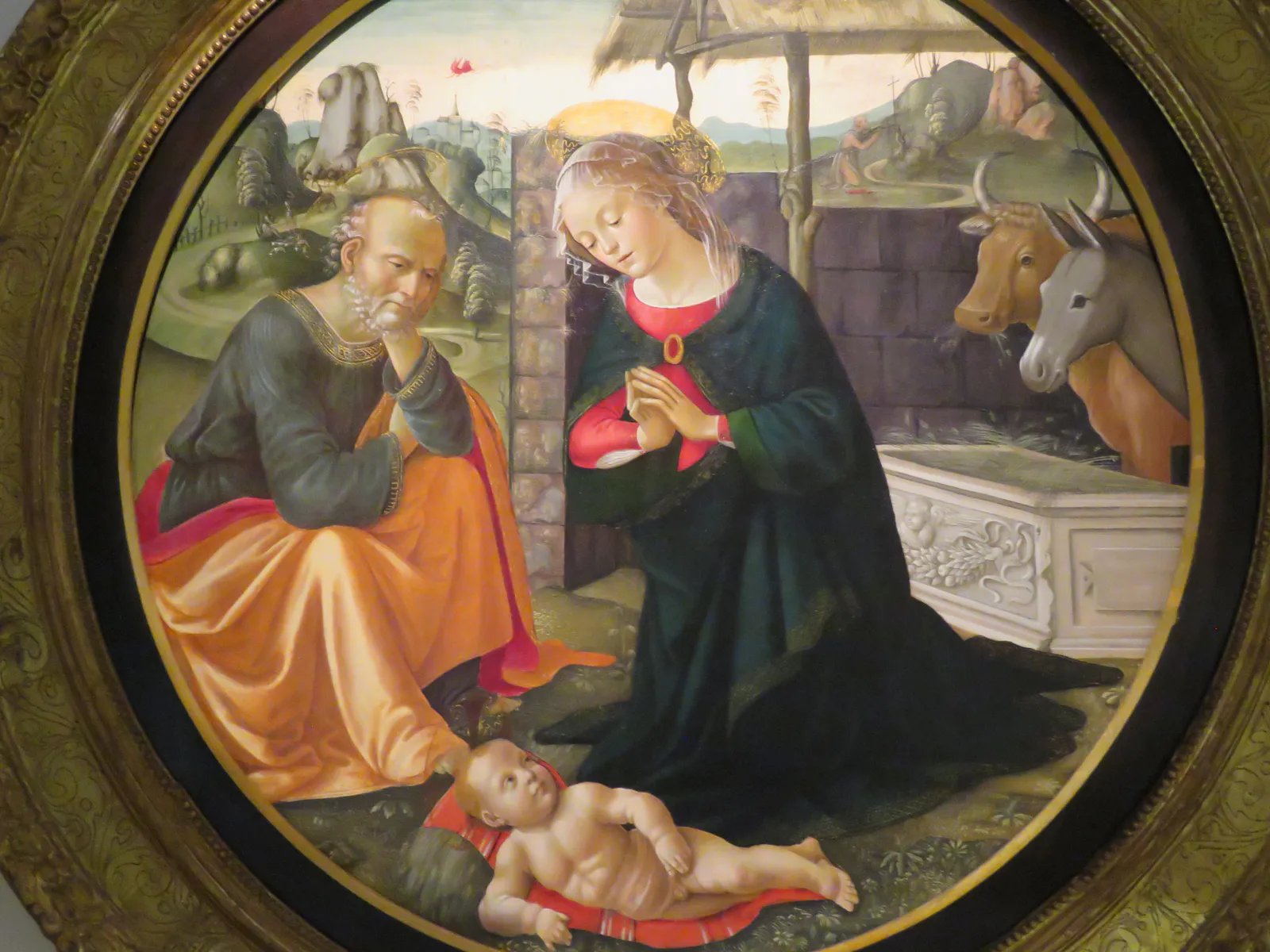
Adoration of the Christ Child
Workshop of Domenico Ghirlandaio
This tondo (c. 1485–1490) shows Mary and Joseph adoring the infant Christ, lying humbly on the earth. The sarcophagus-like manger prefigures his Passion, while the ox and donkey fulfill Isaiah and Habakkuk’s prophecy of animals recognizing the Lord. The scene binds intimacy, humility, and cosmic redemption.
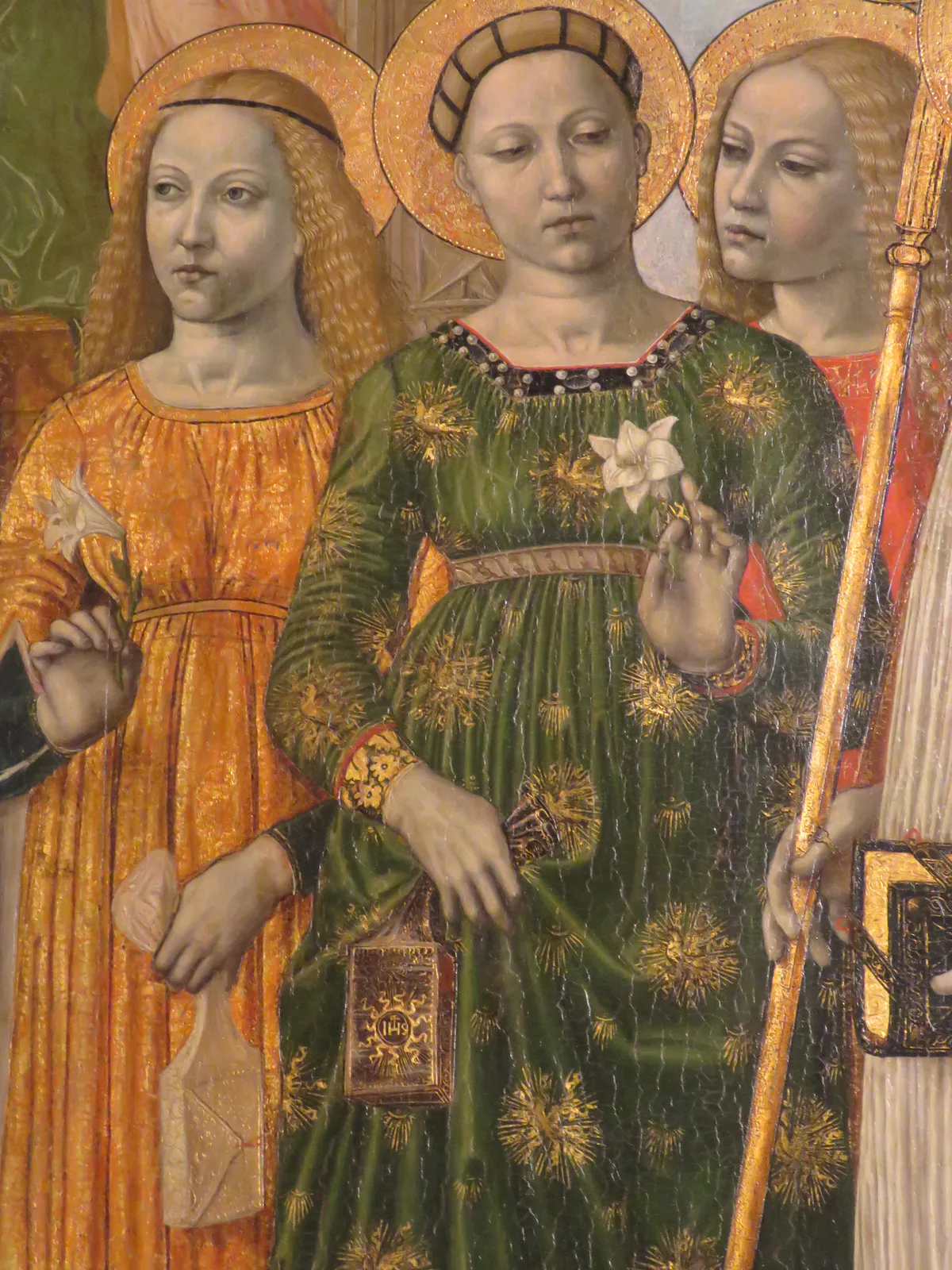
Santa Conversazione (detail)
Ambrogio Bergognone
This panel 1490-95) features a trio of female saints bearing lilies, symbolizing purity. Adorned with gold and intricate embroidery, their garments suggest sanctity and nobility. The solemn expressions and clasped books evoke wisdom and devotion, emphasizing the fusion of holiness and human dignity in late Gothic religious art.
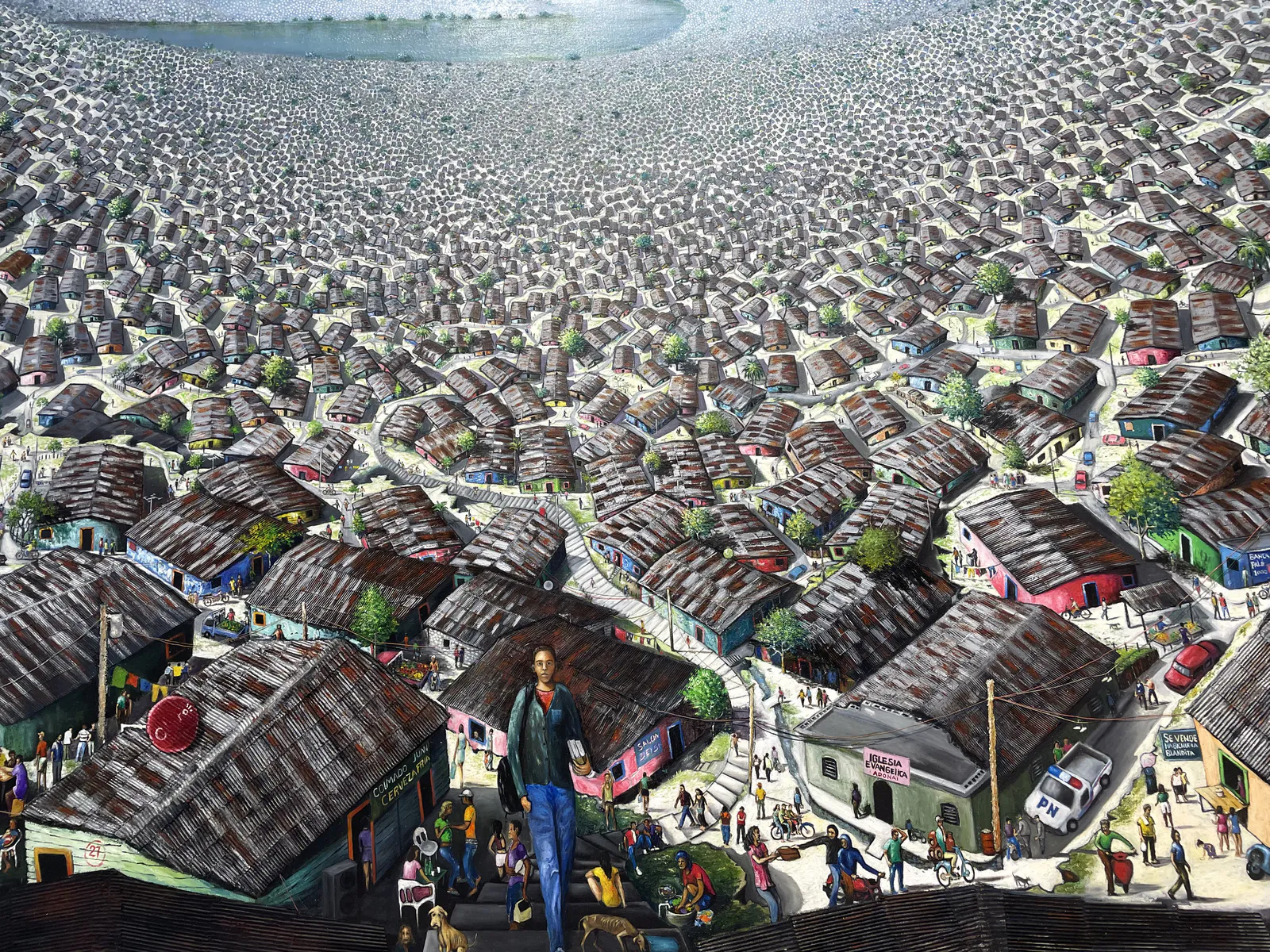
It’s Not Where You Come From, but Where You’re Going
Ramón Calcaño
This oil painting (2018), entitled No importa de dónde vienes, sino hacia dónde vas, Calcaño presents a vast view of informal housing. Central to the scene is a figure holding books, emerging from the margins. The work highlights resilience and the transformative power of education, emphasizing the pursuit of a better future beyond one's origins.
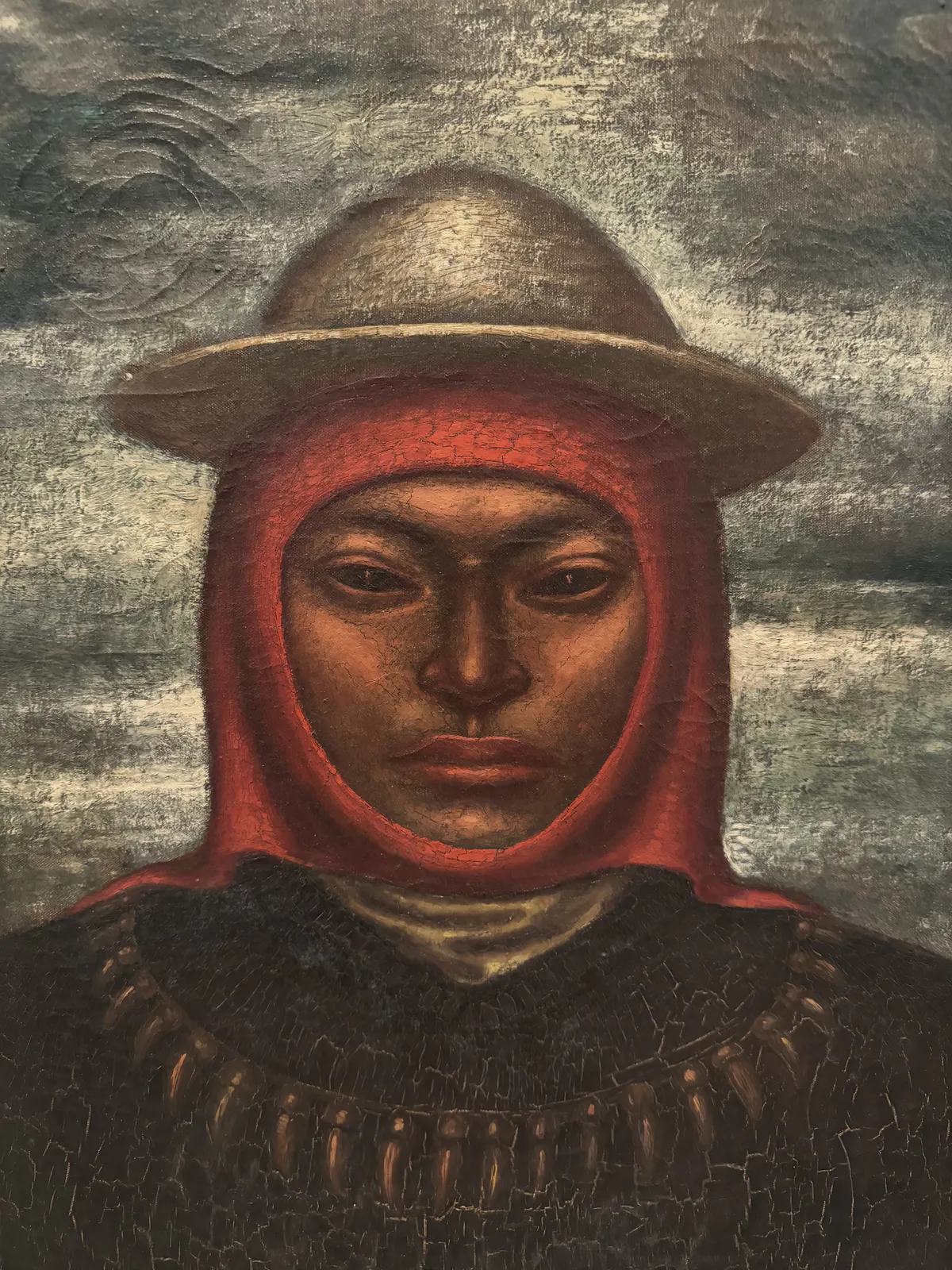
Portrait of Indigenous Person
Luis Alberto Acuña
This striking 1934 oil painting reflects the artist’s deep engagement with indigenous identity and pre-Columbian heritage. The stoic, symmetrical face, wrapped in a red hood beneath a wide-brimmed hat, evokes dignity and resilience. Acuña, a key figure in Colombian modernism, often highlighted native ancestry as a counter-narrative to Eurocentric ideals.
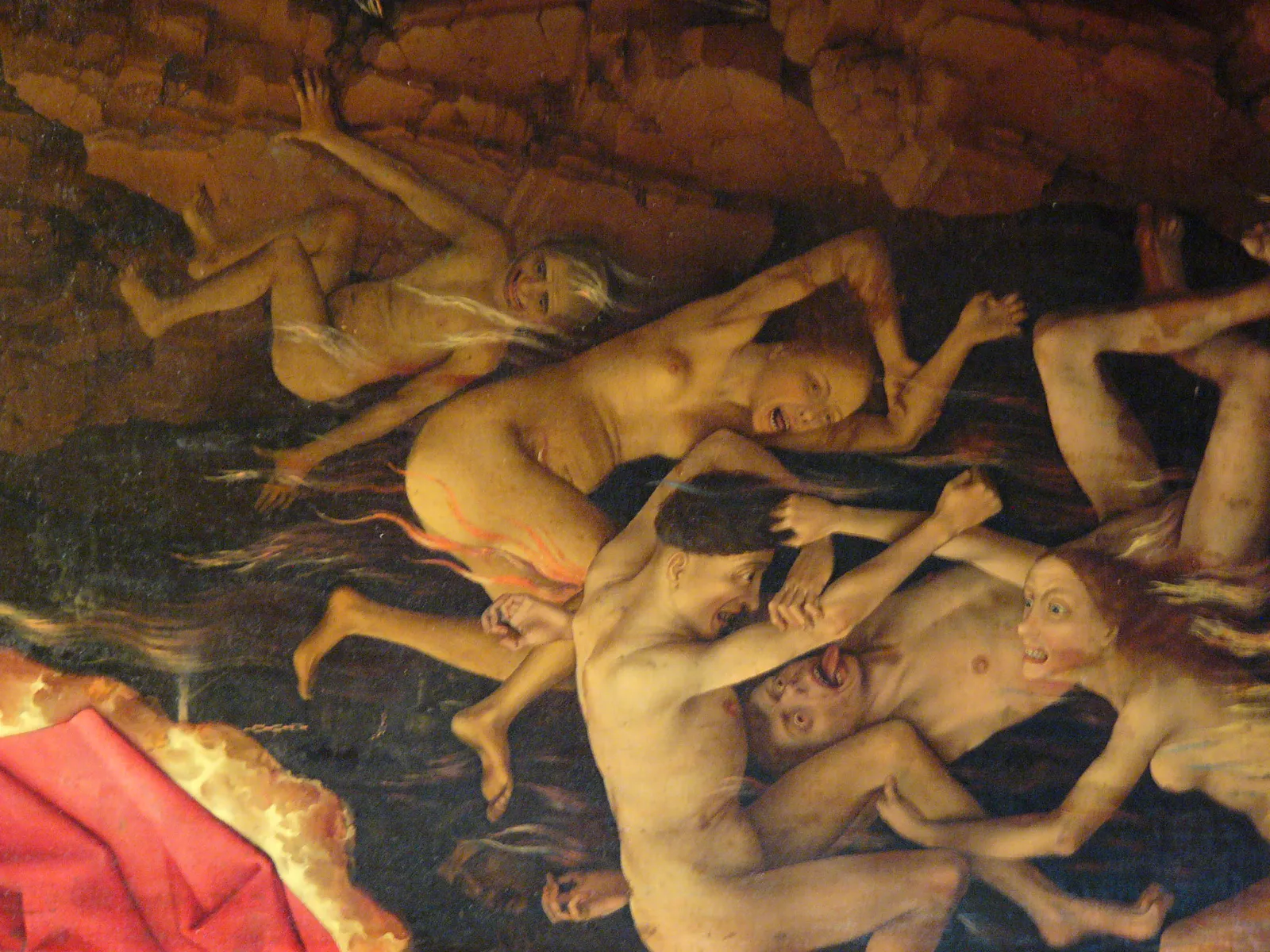
The Damned in Torment
Rogier van der Weyden
This detail from the Last Judgment Altarpiece (1445–50) intensifies the vision of damnation. Naked figures twist and collide as they plunge into dark flames, their limbs tangled in chaotic knots. Strained muscles and distorted faces display a studied range of terror and despair. For patients and caregivers at the Hôtel-Dieu, such visceral imagery sharpened awareness of sin, repentance, and the uncertainty of salvation.
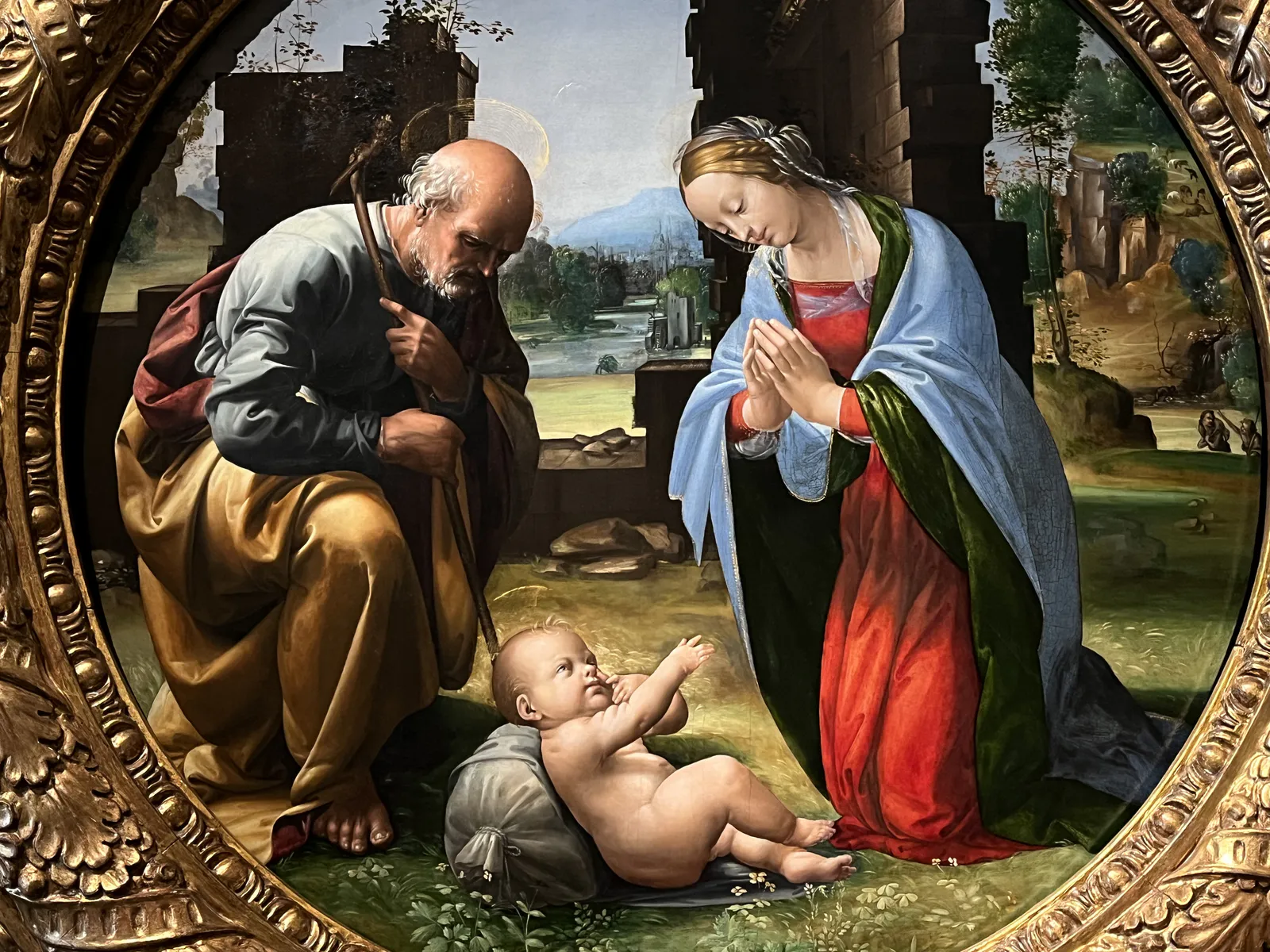
Adoration of the Child (detail)
Fra Bartolomeo
This tondo or circular painting (c.1495), Mary and Joseph kneel in reverence before the infant Christ, who rests on a sack amid delicate vegetation. The ruined architecture behind them symbolizes the fall of paganism, while the balanced composition and radiant palette reflect Bartolomeo’s early embrace of Renaissance ideals.
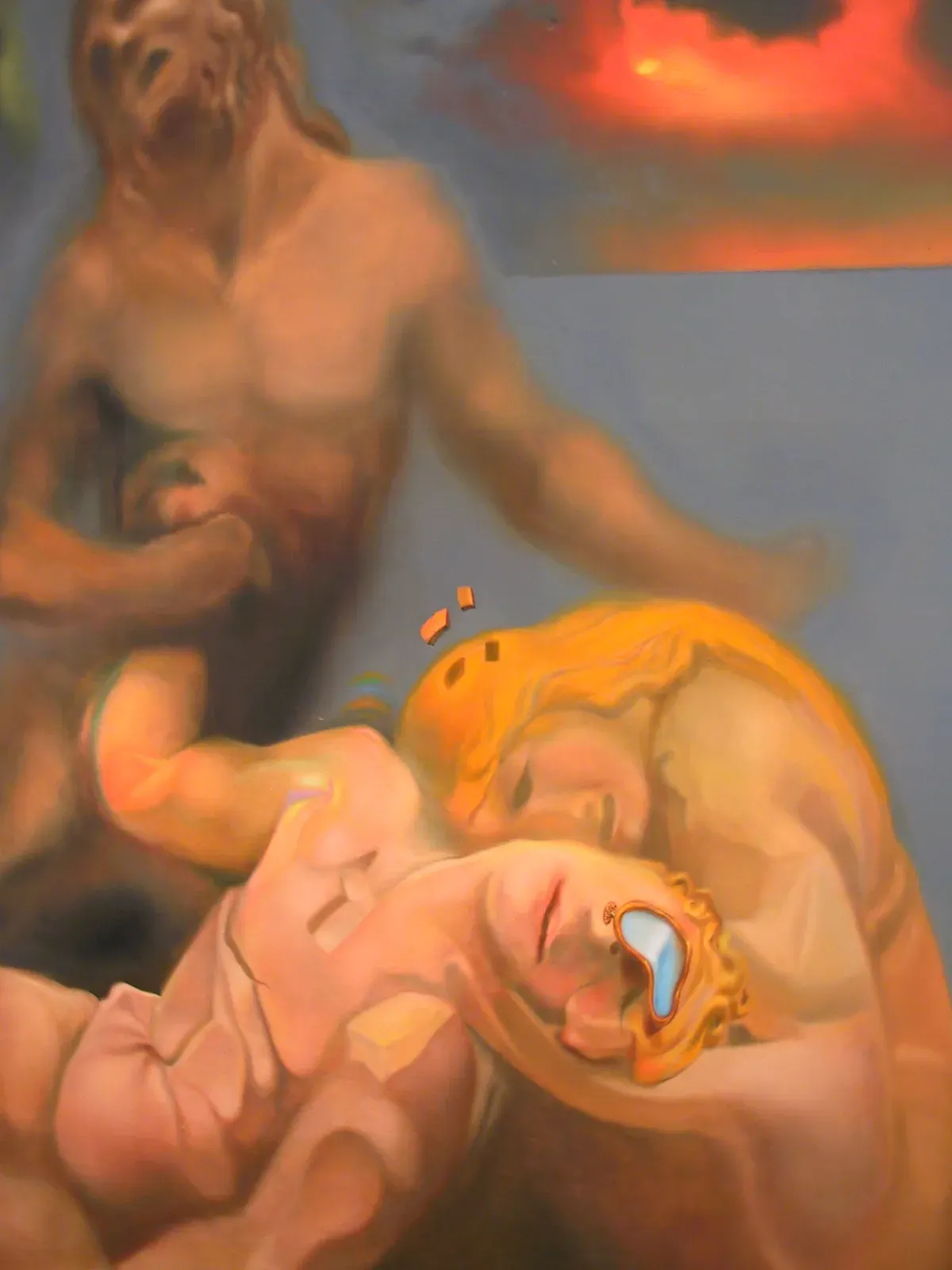
A Soft Watch to Cause a Young Ephebe to Die
Salvador Dalí
Dalí’s 1971 painting explores surrealist themes of time and mortality. A lifeless youth draped in a melting clock symbolizes the decay of ideal beauty. Hovering figures and a burning sky enhance the dreamlike tragedy, reflecting Dalí’s interest in the collapse of classical ideals. The work underscores his preoccupation with the relentless passage of time and its impact on human existence.
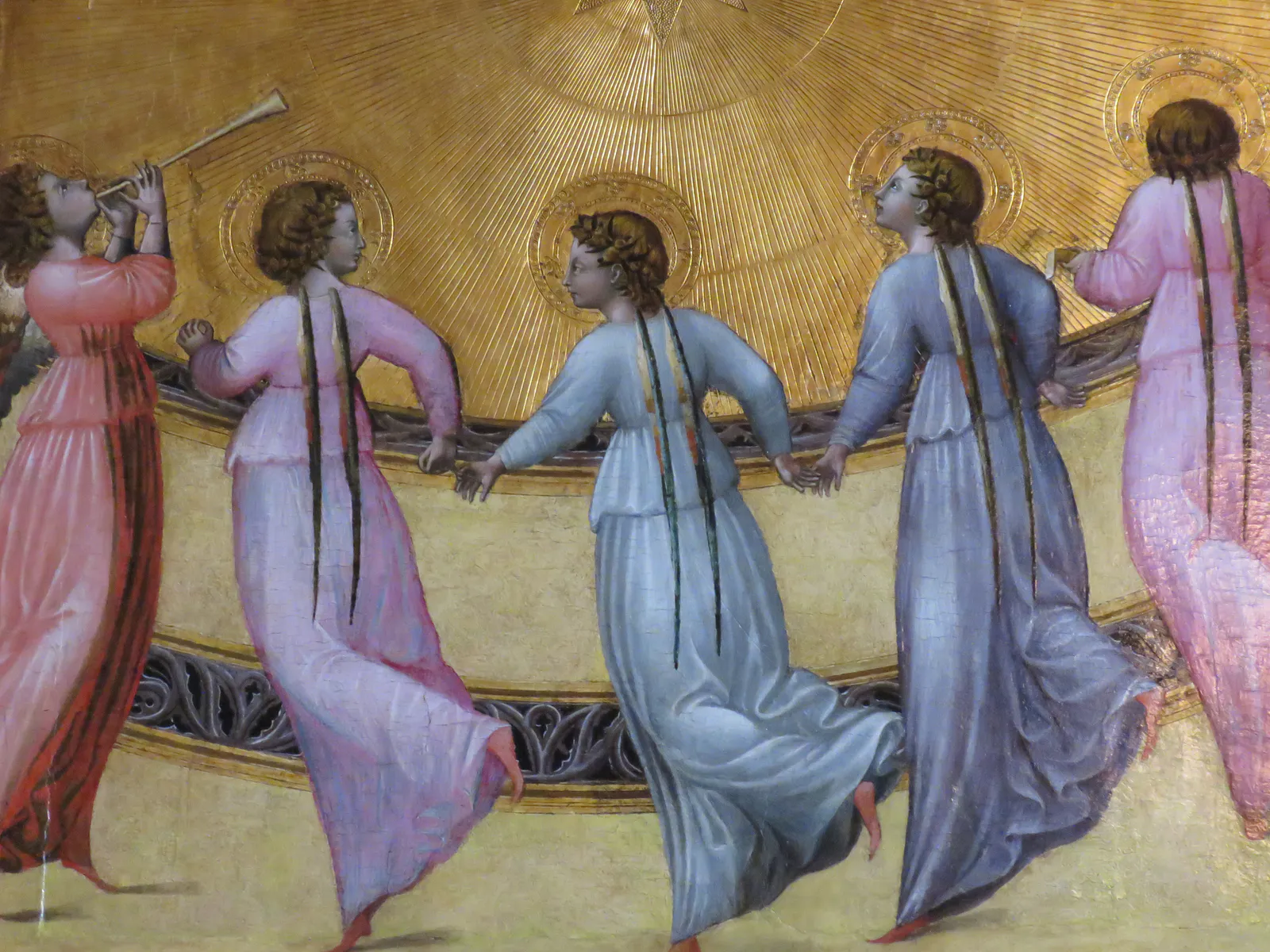
Five Dancing Angels (detail)
Giovanni di Paolo
This detail (c.1436) comes from Giovanni di Paolo’s Five Dancing Angels. Here, three angels join hands in a celestial dance while another plays the trumpet before a golden sun, symbolizing God. Their flowing robes and rhythmic gestures convey divine harmony, reflecting the spiritual intensity of 15th-c. Sienese art.
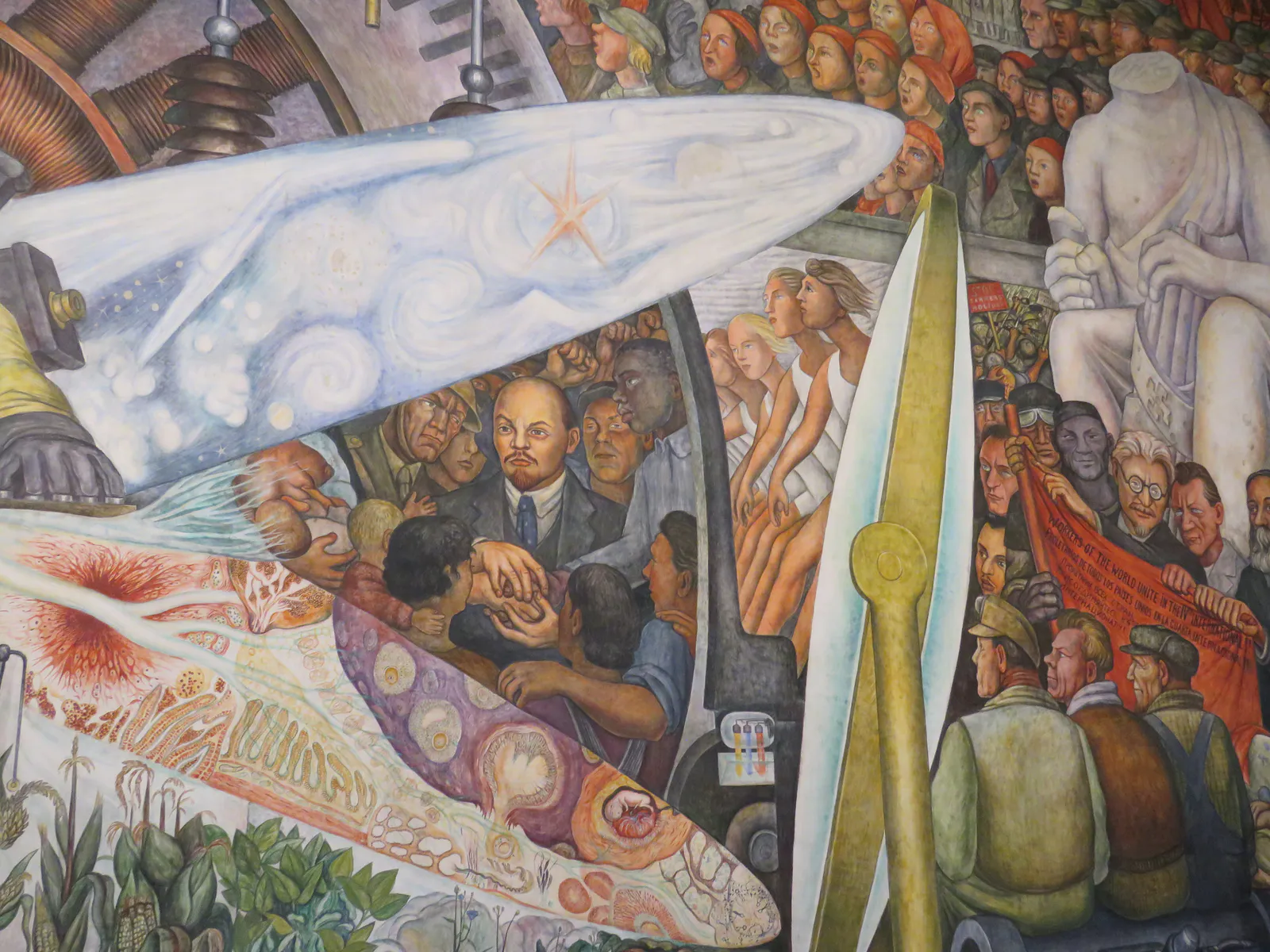
Man, Controller of the Universe (detail)
Diego Rivera
This section of Rivera’s 1934 recreated mural shows Lenin uniting workers of different races and nations, flanked by scientific, agricultural, and cosmic imagery. It contrasts socialism’s collective promise with capitalist individualism. The original was destroyed at Rockefeller Center.
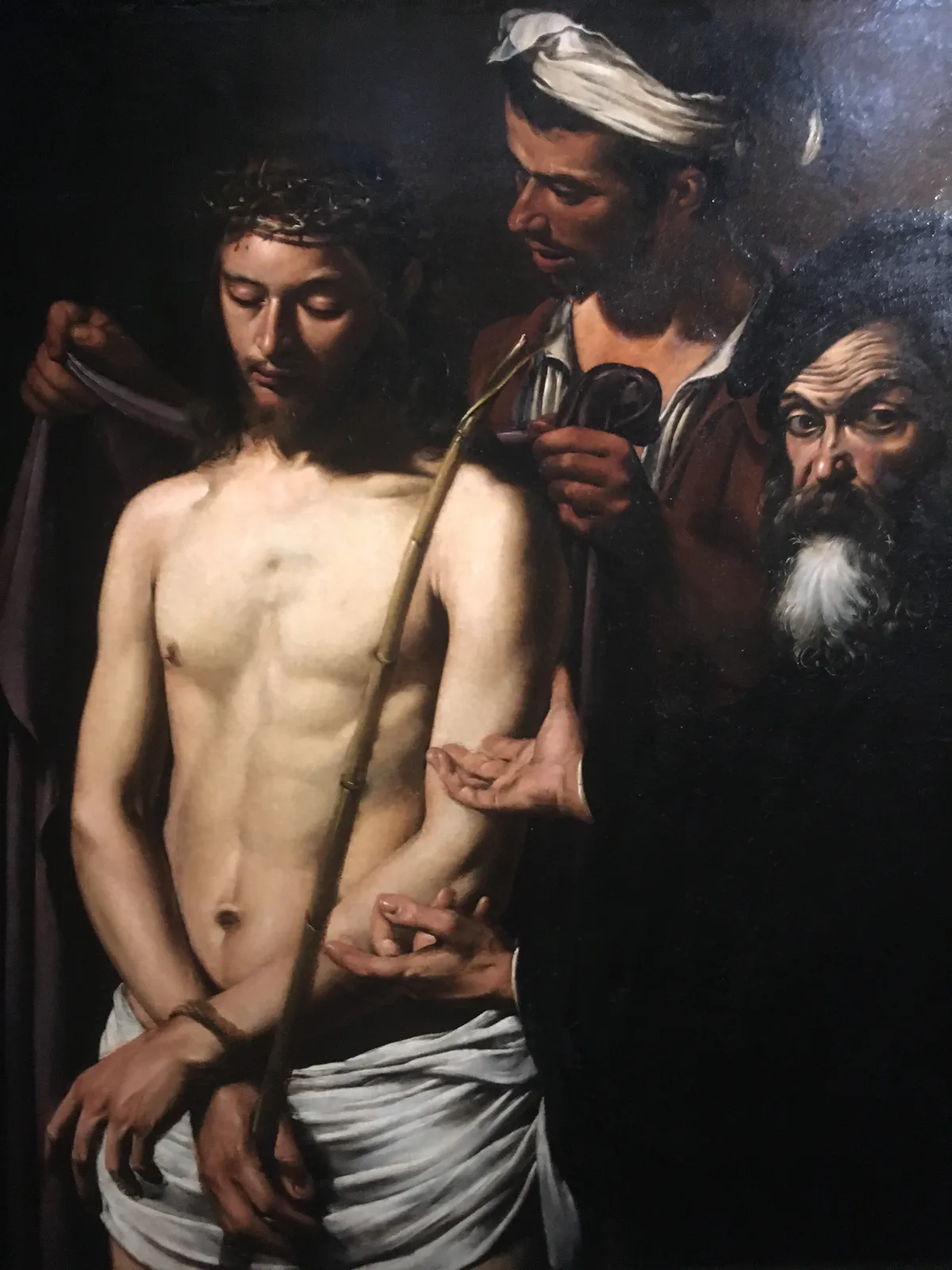
The Crowning with Thorns
Caravaggio
This painting (1602–04) depicts Christ humiliated before crucifixion. Crowned with thorns and bound, he stands in silent suffering as soldiers force the reed into his hand and mock him as king. Caravaggio’s harsh chiaroscuro strips away grandeur, presenting raw cruelty and dignity in contrast. The work confronts viewers with the violence of power and the endurance of faith.
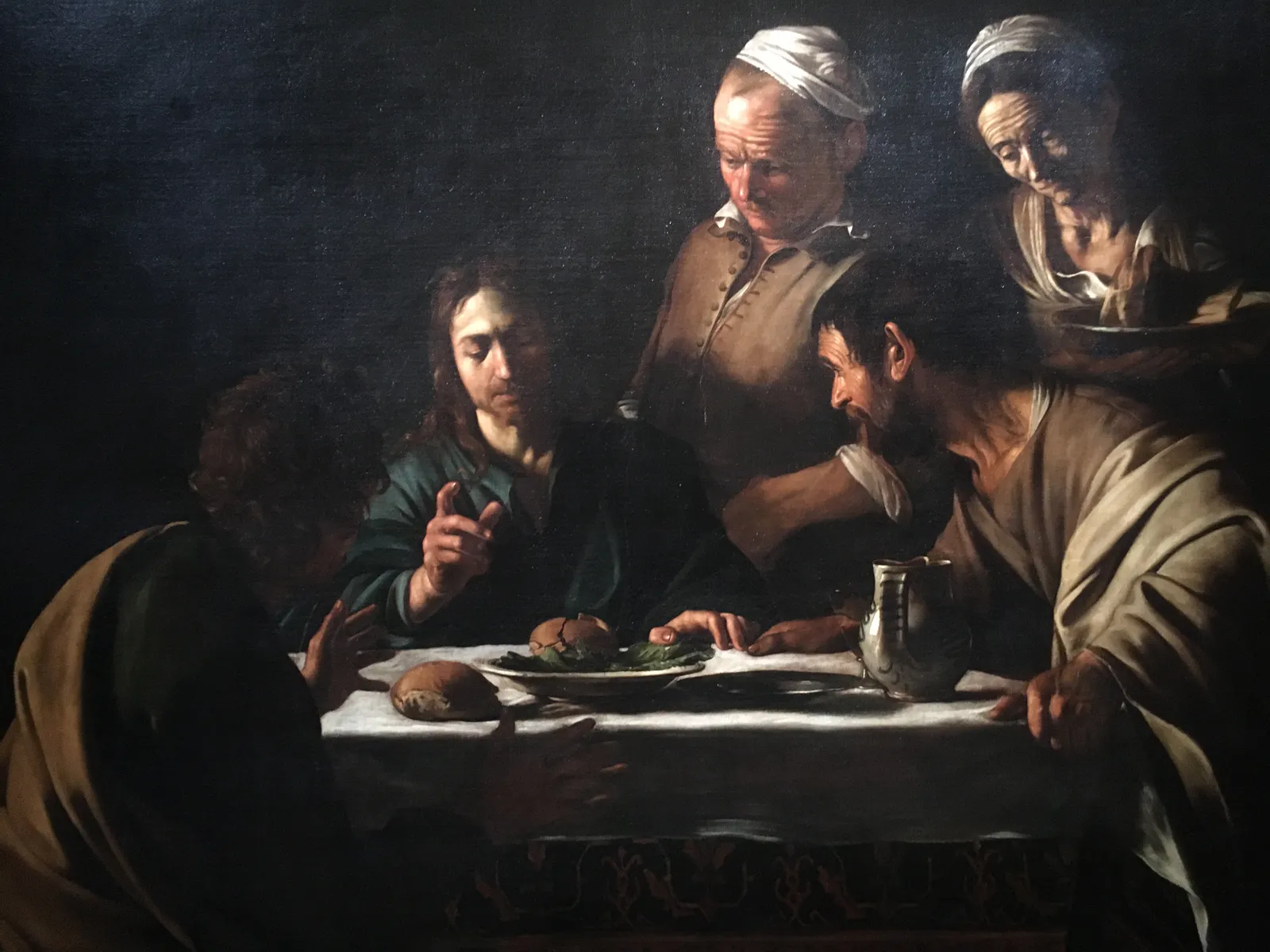
The Supper at Emmaus
Caravaggio
This painting (c.1606) was created after Caravaggio fled Rome for Naples. It depicts Christ revealing himself in Emmaus at the blessing of bread. Unlike Caravaggio’s earlier 1601 version, gestures are subdued and the table almost bare. In this darker vision, the recognition of the divine comes not in spectacle but in shadow and silence.
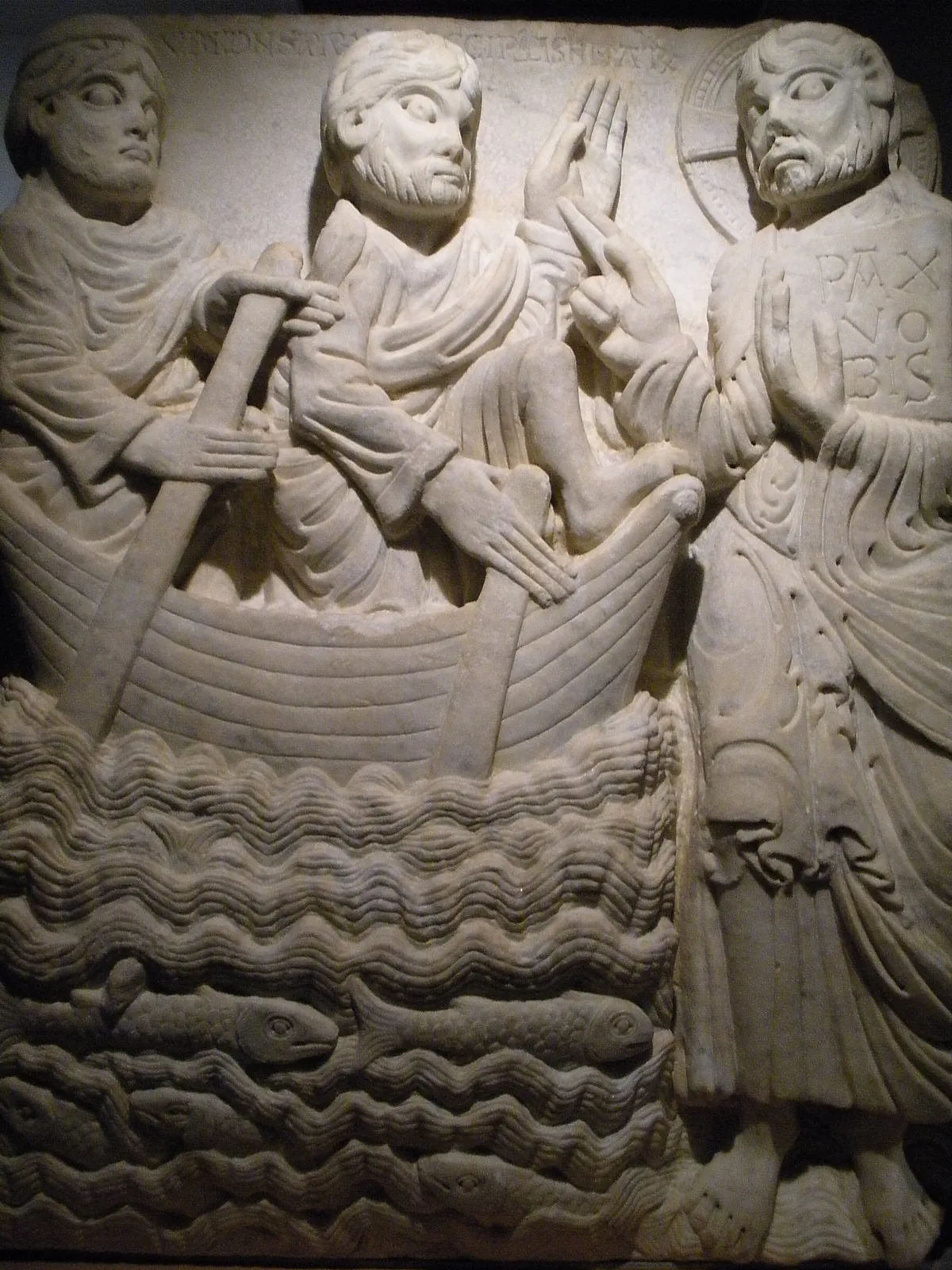
The Appearance of Christ to the Disciples
Master of Cabestany
This 12th-c. Romanesque sculpture by the Master of Cabestany depicts Christ revealing himself to his disciples after the resurrection. The artist is known for figures with large heads, flat foreheads, long noses, and almond-shaped eyes. Likely from the monastery of Sant Pere de Rodes, the work exemplifies the Master of Cabestany’s influence across Southern Europe, from Tuscany to Navarre.
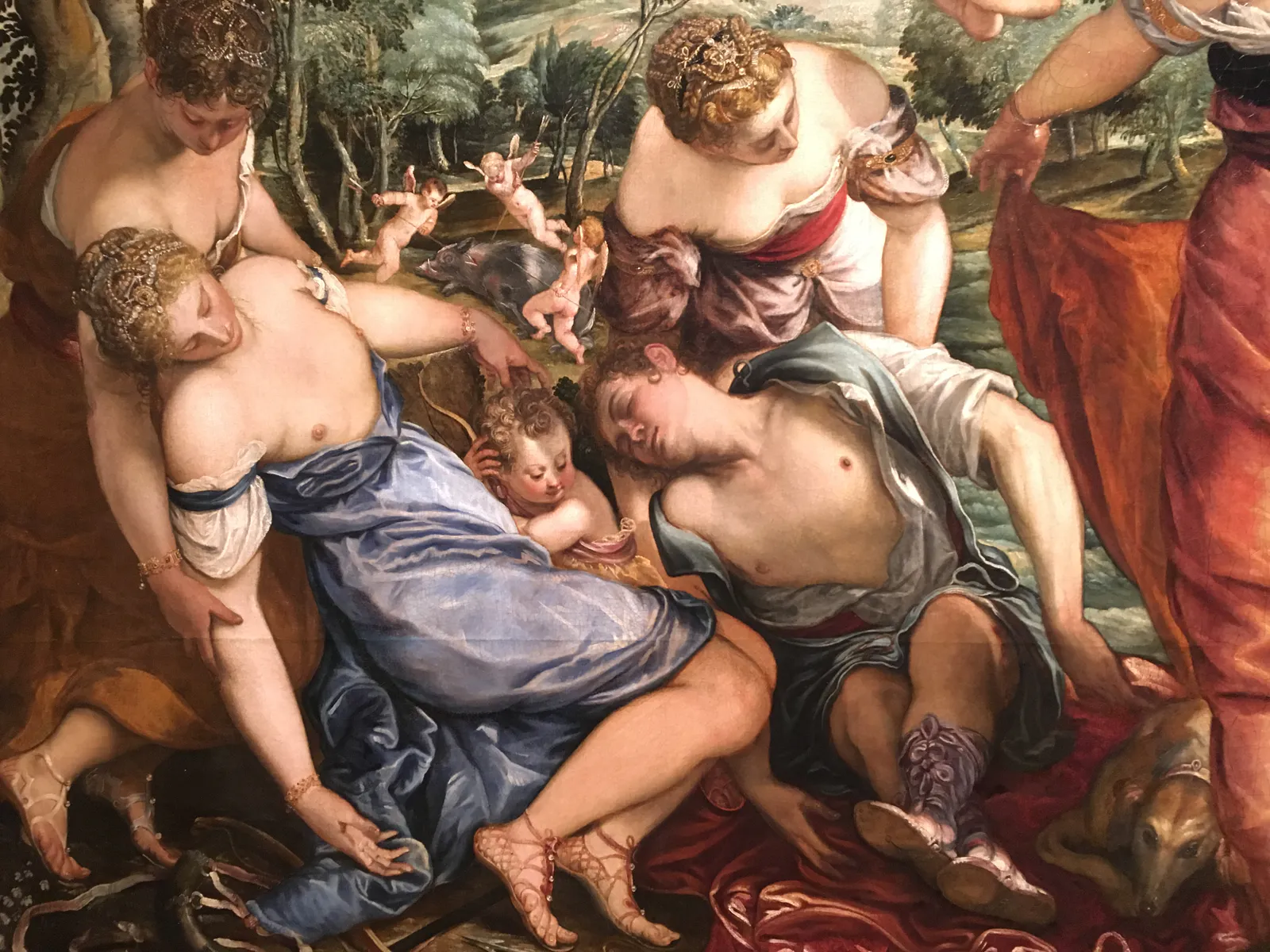
The Death of Adonis
Tintoretto's Workshop
The Death of Adonis (1550–55) captures Venus fainting at Adonis's death, diverging from Ovid’s Metamorphoses by including young women not in the original tale. Created by a Nordic artist in Tintoretto’s Venetian workshop, it blends Tintoretto’s dramatic style with the collaborator’s unique touch, evident in the expressive figures and vibrant colors. This fusion highlights the shared human themes of love and loss, inviting reflection on the timeless nature of myth and emotion.
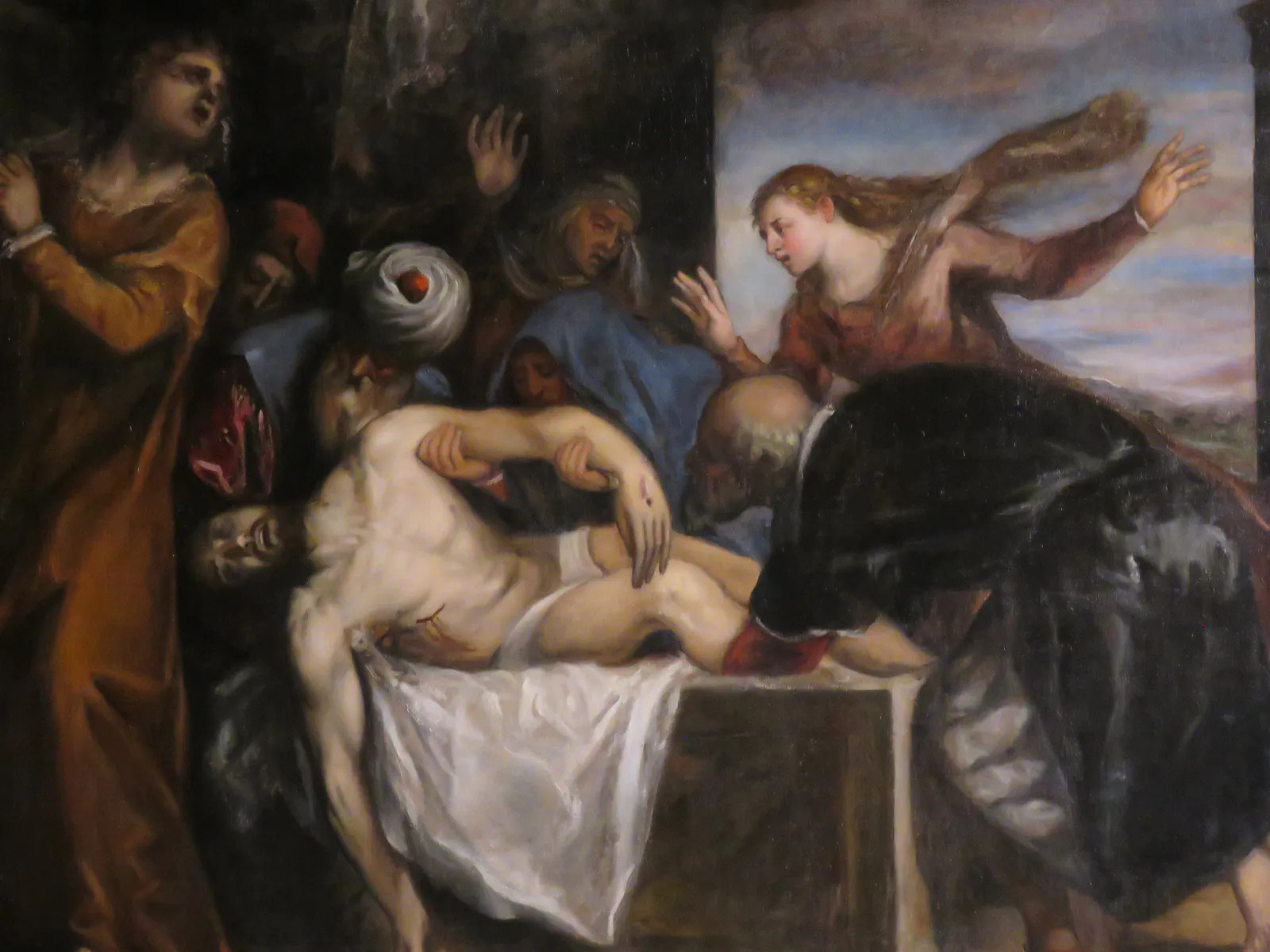
The Entombment of Christ
Titian and Palma the Younger
A poignant rendering of Christ’s burial, this oil on canvas (1618) was begun by Titian and completed by Palma the Younger. The composition captures collective grief, emphasizing the physical weight of death and the emotional weight of loss. The figures’ gestures and expressions mirror Renaissance ideals of pathos and human dignity.
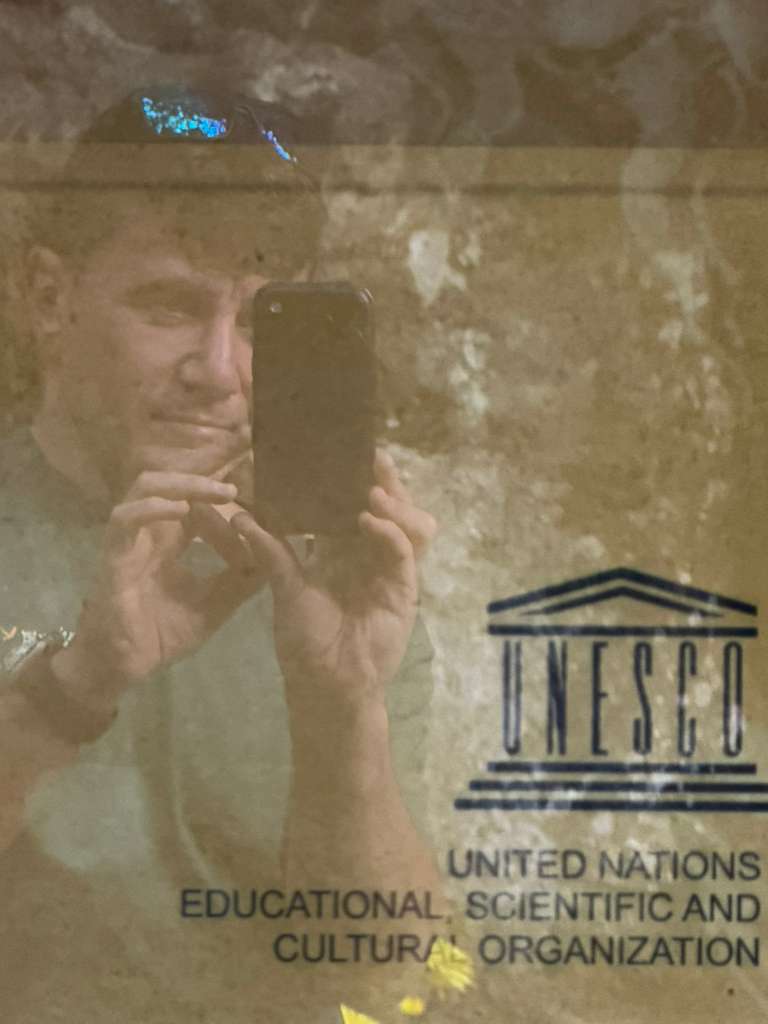
“When the path is beautiful, do not ask where it leads.” — Zen proverb
Welcome to my travel photography!
“When the path is beautiful, do not ask where it leads.” — Zen proverb
Welcome to my travel photography!
For as long as I can remember, my path has been one of discovery—seeking beauty, timelessness, and connection in every corner of the world. It has also been a journey of deep learning and understanding. I’ve been an avid traveler (or perhaps a travel addict?) for most of my life. My love for travel began long before I ever left home: as a child, I drew a fantasy map of my grandparents’ apartment and “traveled” through it with my cousin Sonya, imagining adventures in every corner. Nearly 90 countries and countless moments of awe later, I’m excited to share this journey with you.
Thanks to the tireless and ingenious programming of Diagilev, we’re now able to present about fifteen percent of the images I’ve accumulated over the years. More will be released in small batches depending on your interest. While the first release leans toward museum photography, later ones will include more nature, architecture, culture, and general travel experiences. If you’d like to receive email notifications about new releases, feel free to reach out—no commercial use, ever.
Throughout my travels, I’ve been drawn to two intertwined kinds of discovery. One is intellectual: learning why the world is the way it is. History became my guide, shaping my perspective and filling my camera roll with museums and old buildings. To me, history is not the past—it is the key to understanding the present and how the world became what it is. The other is emotional: seeking moments of elevation—spirituality, beauty, harmony—often found in nature, monasteries, and ancient sacred spaces. Together, these impulses shape my photography. It invites you to learn, admire, and soar—to rise above the mundane and see the world through a lens of curiosity and wonder.
Much of my later travel became possible thanks to my job with Delta Air Lines, but the wanderlust began years earlier. By the time I joined the industry, I had already visited over 35 countries and lived in several—largely thanks to a backpacking journey around the world with Luis León, whose face appears in many early photos. I grew up in Ufa in the USSR, and since leaving it I have lived, studied, and worked in Latvia, the United States, France, South Korea, Canada, Spain, Italy, Brazil, Japan, and Colombia.
A life of near-constant movement may seem a little crazy, but it has deepened my understanding of the world and produced the photography you are about to see. Over the years, my style has evolved—more intentional, more refined—yet its core remains the same: a search for understanding, timeless beauty, and a connection to those who walked this earth long before us.
I hope these photos stir something in your soul, just as they did in mine. I’d love to hear from you—whether reactions, suggestions, corrections, or a request to be added to the email list for new releases (no commercial use, I promise). You can learn more about my travels here, and my academic life here.
Enjoy our shared journey!