Ammonites and Geological Time
Ammonites: Deep-Time Cephalopods of Ancient Colombian Seas
Ammonites: Icons of Deep Time
During the Early Cretaceous, much of present-day Colombia lay beneath a vast sea rich in marine life—giant reptiles, molluscs, sea urchins, and crustaceans. Among these creatures were ammonites, soft-bodied cephalopods protected by spiral shells. Though their bodies had no bones, their external shells fossilized in abundance, especially in the Alto Ricaurte region (including Villa de Leyva, Sáchica, and Sutamarchán). Their name, from Greek words meaning “head” and “foot,” reflects a body plan resembling modern squids, octopuses, and nautiluses, and today they are key to understanding ancient oceans and ecosystems.
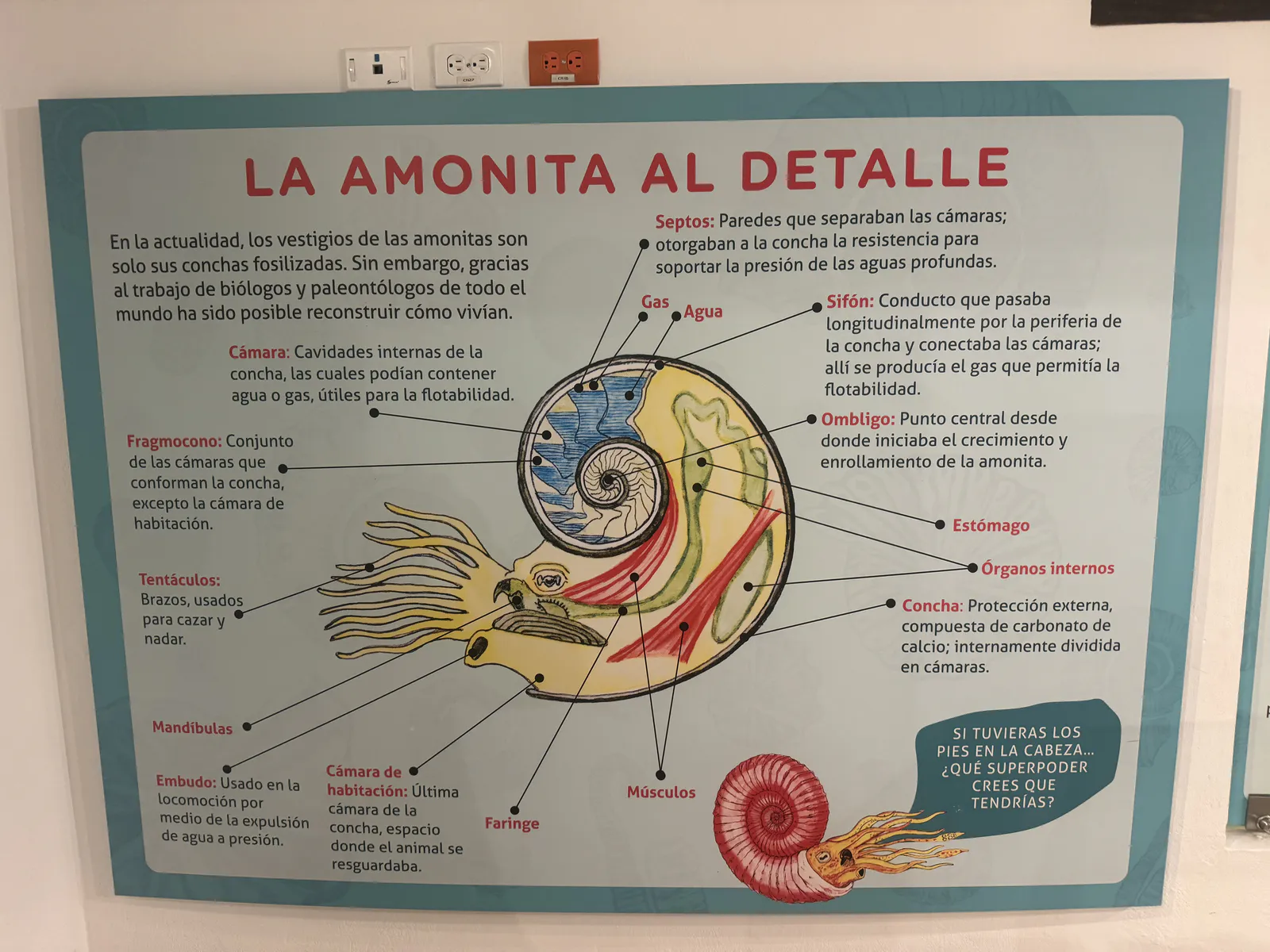
By comparing fossil shells with living cephalopods, scientists have reconstructed ammonite anatomy. The shell, made of calcium carbonate, was divided into internal chambers separated by septa and linked by a siphon, allowing gas and water exchange for buoyancy control. The animal’s soft body occupied the final living chamber, from which tentacles extended for swimming and hunting; a funnel expelled water to propel it through the sea, while internal organs were concentrated near the shell opening. Each feature contributed to survival in a dynamic, often dangerous marine world populated by predators such as turtles, fish, ichthyosaurs, and plesiosaurs.
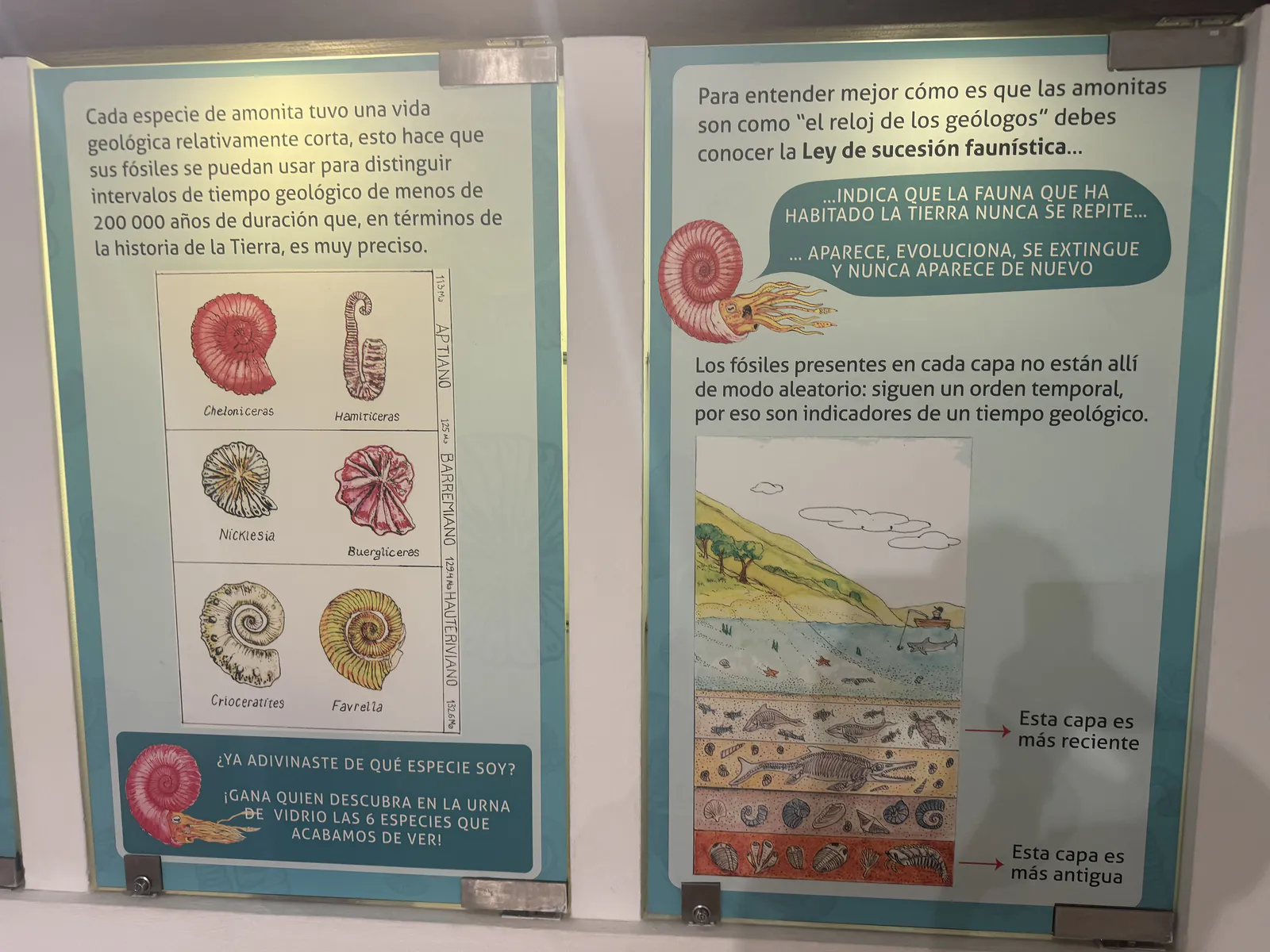
Ammonites are also powerful geological timekeepers. Because many species existed for relatively short spans—often under 200,000 years—their fossils allow scientists to date rock layers precisely. This fits within the Law of Faunal Succession: once a species disappears, it never reappears, and fossil assemblages follow a consistent order. Species such as Cheloniceras, Hamiticeras, Nicklesia, Buergliceras, Crioceratites, and Favrella mark successive stages of the Early Cretaceous, helping geologists build a detailed timeline from stacked sedimentary layers.
Their life cycle was equally complex. Ammonites showed sexual dimorphism: females were generally larger, while some males had additional soft structures near the mouth. After mating, eggs were fertilized and enclosed in a delicate membrane; females, able to lay thousands of eggs, chose warm, shallow waters for spawning. The embryonic shell, called amonitella, measured under 2 millimetres and began as a tiny coil that expanded as the animal grew. With age, shells changed: the spacing of septa could tighten, spirals shift, and ornamental features fade, while the living chamber altered in shape and size. After death, gases in the decomposing body sometimes kept shells afloat for long distances before they sank and were buried by sediment, eventually becoming the fossils that now serve as enduring icons of paleontological heritage.
During the Early Cretaceous, much of present-day Colombia lay beneath a vast sea rich in marine life—giant reptiles, molluscs, sea urchins, and crustaceans. Among these creatures were ammonites, soft-bodied cephalopods protected by spiral shells. Though their bodies had no bones, their external shells fossilized in abundance, especially in the Alto Ricaurte region (including Villa de Leyva, Sáchica, and Sutamarchán). Their name, from Greek words meaning “head” and “foot,” reflects a body plan resembling modern squids, octopuses, and nautiluses, and today they are key to understanding ancient oceans and ecosystems.
By comparing fossil shells with living cephalopods, scientists have reconstructed ammonite anatomy. The shell, made of calcium carbonate, was divided into internal chambers separated by septa and linked by a siphon, allowing gas and water exchange for buoyancy control. The animal’s soft body occupied the final living chamber, from which tentacles extended for swimming and hunting; a funnel expelled water to propel it through the sea, while internal organs were concentrated near the shell opening. Each feature contributed to survival in a dynamic, often dangerous marine world populated by predators such as turtles, fish, ichthyosaurs, and plesiosaurs.
Ammonites are also powerful geological timekeepers. Because many species existed for relatively short spans—often under 200,000 years—their fossils allow scientists to date rock layers precisely. This fits within the Law of Faunal Succession: once a species disappears, it never reappears, and fossil assemblages follow a consistent order. Species such as Cheloniceras, Hamiticeras, Nicklesia, Buergliceras, Crioceratites, and Favrella mark successive stages of the Early Cretaceous, helping geologists build a detailed timeline from stacked sedimentary layers.
Their life cycle was equally complex. Ammonites showed sexual dimorphism: females were generally larger, while some males had additional soft structures near the mouth. After mating, eggs were fertilized and enclosed in a delicate membrane; females, able to lay thousands of eggs, chose warm, shallow waters for spawning. The embryonic shell, called amonitella, measured under 2 millimetres and began as a tiny coil that expanded as the animal grew. With age, shells changed: the spacing of septa could tighten, spirals shift, and ornamental features fade, while the living chamber altered in shape and size. After death, gases in the decomposing body sometimes kept shells afloat for long distances before they sank and were buried by sediment, eventually becoming the fossils that now serve as enduring icons of paleontological heritage.
Inside the Ammonite
With Feet on the Head: Ammonites and Colombia’s Deep-Sea Past
With Feet on the Head: Ammonites, Icons of Paleontological Heritage
Millions of years ago, much of what is now Colombia lay beneath a vast sea teeming with marine life: giant reptiles, mollusks, sea urchins, and crustaceans. Among these creatures were the ammonites, soft-bodied cephalopods protected by their distinctive spiral shells. Although their bodies contained no bones, their external shells fossilized in great numbers, becoming key witnesses to Earth’s deep past. Their name, from the Greek kephale (head) and pous (foot), describes an anatomy “with feet on the head,” like modern squids and octopuses.
The Alto Ricaurte region—including Villa de Leyva, Sáchica, and Sutamarchán—is especially rich in ammonite fossils. This exhibition explores why these animals are so important for science: how they were built, how they lived, and what the seas they inhabited were like.
Scientists have reconstructed ammonite anatomy by studying their shells and comparing them with living relatives such as nautiluses. The coiled shell of calcium carbonate is divided into internal chambers separated by septa that strengthen the structure and allow the animal to withstand pressure. A siphon running along the shell’s edge connected the chambers, enabling the exchange of gas and water so the animal could rise or sink. The final chamber housed the soft body, with tentacles for swimming and hunting, a funnel for jet propulsion, and internal organs such as stomach, pharynx, muscles, and reproductive structures.
Ammonites are also crucial for dating rocks. Each species lived for a relatively short time—often less than 200,000 years—so their fossils provide very precise markers within geological strata. This fits within the Law of Faunal Succession: once a species disappears, it never reappears. As ammonites evolved and went extinct, their shells accumulated in layered rocks in a consistent order. Species like Cheloniceras, Hamiticeras, Nicklesia, Buergliceras, Crioceratites, and Favrella define different stages of the Early Cretaceous, allowing geologists to read time in stone as if it were a stratified clock.
Behind the fossils there were living animals with complex life cycles. Many ammonites showed sexual dimorphism: females were usually larger, and some males bore special soft structures such as lappets near the mouth. After mating, females laid thousands of eggs enclosed in delicate membranes in warm, shallow waters. The tiny embryonic shell, or amonitella, was less than two millimeters wide, beginning as a tight coil that expanded as the animal grew.
As ammonites matured, their shells changed: septa spacing narrowed, the spiral might tighten, ornamentation could fade, and the living chamber shifted in size and shape. Their lives were precarious, threatened by predators such as turtles, fish, ichthyosaurs, and plesiosaurs. When a shell was cracked in a bite, the soft body inside became exposed. After death, gases from decomposition sometimes kept shells floating for long distances before they finally sank to the seafloor, where sediment slowly buried and preserved them. Today these fossil spirals connect us to vanished oceans, making ammonites icons of Colombia’s paleontological heritage.
Millions of years ago, much of what is now Colombia lay beneath a vast sea teeming with marine life: giant reptiles, mollusks, sea urchins, and crustaceans. Among these creatures were the ammonites, soft-bodied cephalopods protected by their distinctive spiral shells. Although their bodies contained no bones, their external shells fossilized in great numbers, becoming key witnesses to Earth’s deep past. Their name, from the Greek kephale (head) and pous (foot), describes an anatomy “with feet on the head,” like modern squids and octopuses.
The Alto Ricaurte region—including Villa de Leyva, Sáchica, and Sutamarchán—is especially rich in ammonite fossils. This exhibition explores why these animals are so important for science: how they were built, how they lived, and what the seas they inhabited were like.
Scientists have reconstructed ammonite anatomy by studying their shells and comparing them with living relatives such as nautiluses. The coiled shell of calcium carbonate is divided into internal chambers separated by septa that strengthen the structure and allow the animal to withstand pressure. A siphon running along the shell’s edge connected the chambers, enabling the exchange of gas and water so the animal could rise or sink. The final chamber housed the soft body, with tentacles for swimming and hunting, a funnel for jet propulsion, and internal organs such as stomach, pharynx, muscles, and reproductive structures.
Ammonites are also crucial for dating rocks. Each species lived for a relatively short time—often less than 200,000 years—so their fossils provide very precise markers within geological strata. This fits within the Law of Faunal Succession: once a species disappears, it never reappears. As ammonites evolved and went extinct, their shells accumulated in layered rocks in a consistent order. Species like Cheloniceras, Hamiticeras, Nicklesia, Buergliceras, Crioceratites, and Favrella define different stages of the Early Cretaceous, allowing geologists to read time in stone as if it were a stratified clock.
Behind the fossils there were living animals with complex life cycles. Many ammonites showed sexual dimorphism: females were usually larger, and some males bore special soft structures such as lappets near the mouth. After mating, females laid thousands of eggs enclosed in delicate membranes in warm, shallow waters. The tiny embryonic shell, or amonitella, was less than two millimeters wide, beginning as a tight coil that expanded as the animal grew.
As ammonites matured, their shells changed: septa spacing narrowed, the spiral might tighten, ornamentation could fade, and the living chamber shifted in size and shape. Their lives were precarious, threatened by predators such as turtles, fish, ichthyosaurs, and plesiosaurs. When a shell was cracked in a bite, the soft body inside became exposed. After death, gases from decomposition sometimes kept shells floating for long distances before they finally sank to the seafloor, where sediment slowly buried and preserved them. Today these fossil spirals connect us to vanished oceans, making ammonites icons of Colombia’s paleontological heritage.
Con Los Pies En La Cabeza Las Amonitas, Ícono Del Patrimonio Paleontologico
“Con Los Pies En La Cabeza: Las Amonitas, Ícono Del Patrimonio Paleontológico” is a temporary exhibition at the Museo Comunitario El Fósil in Villa de Leyva that immerses visitors in the ancient seas that once covered this region of Colombia. Guided by the friendly character Nita the ammonite, guests discover how these spiral-shelled cephalopods lived 120 million years ago, from their anatomy and buoyant chambers to their tentacles, siphon, and delicate internal organs.
Set in a landscape renowned for its fossil beds, the exhibition explains why ammonites are considered icons of paleontological heritage. Clear displays show how their rapid evolution turned them into precise “timekeepers” for reading rock layers and reconstructing Earth’s past. Sections on reproduction, growth, and fossilization make complex scientific ideas accessible, creating an engaging visit for families, students, and anyone curious about the deep history beneath Villa de Leyva’s hills.
Set in a landscape renowned for its fossil beds, the exhibition explains why ammonites are considered icons of paleontological heritage. Clear displays show how their rapid evolution turned them into precise “timekeepers” for reading rock layers and reconstructing Earth’s past. Sections on reproduction, growth, and fossilization make complex scientific ideas accessible, creating an engaging visit for families, students, and anyone curious about the deep history beneath Villa de Leyva’s hills.
Popular categories
Advertising space